The holiday of Hanukkah, which starts this weekend, celebrates the inextinguishable light of Judaism. It recalls a failed attempt at forced assimilation that began with the seizure of Jerusalem by the Seleucid ruler Antiochus IV in 168 BC. Supported by a faction of Hellenised priests, Antiochus massacred or enslaved thousands of citizens, ordered the worship of Zeus as supreme god, and sacrificed pigs in the Temple. The Talmud relates that, when rebels led by Judah Maccabee retook the city and re-dedicated the Temple in 164, they found only a day’s worth of consecrated oil to light the sanctuary’s menorah. Miraculously, that oil lasted for eight days, long enough to prepare a new supply.
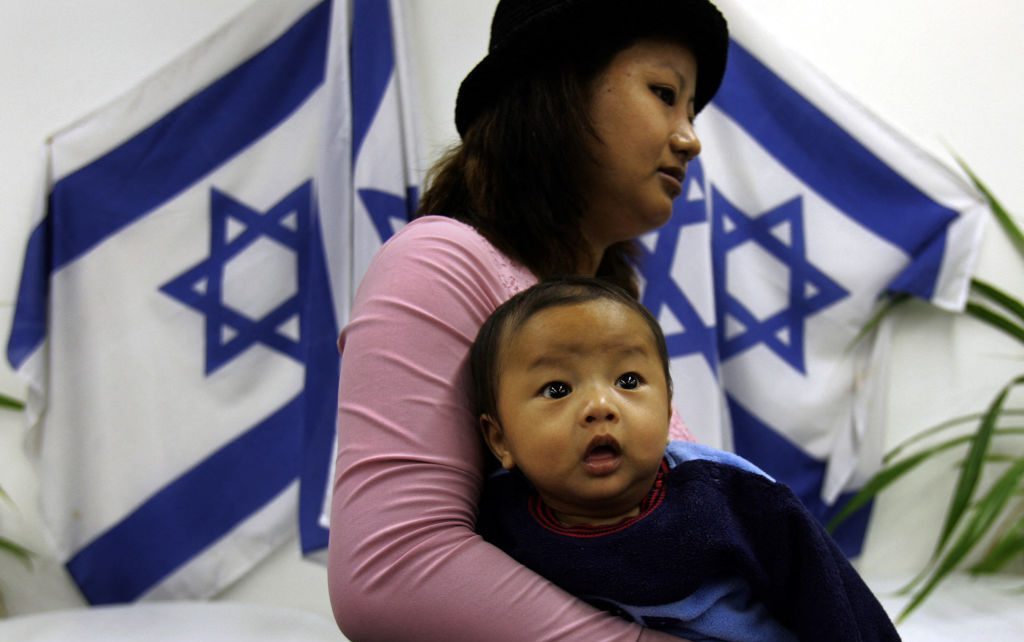
More than two millennia later, Judaism’s spiritual reserves endure. They caught flame in recent decades among the Bnei Menashe (Children of Menasseh) of northeast India, a group of roughly 9,000 Tibeto-Burmese people of the Chin-Mizo Hmar tribe. The tribe’s rituals and legends echo very ancient Jewish priestly practices as well as the story of the Exodus, down to the pillars of cloud and fire and the parting of the Red Sea. 19th-century missionaries convinced these former animists, whose ancestral patriarch was named Manmási, to adopt Christianity. They now believe they are descended from Menasseh, one of the Ten Lost Tribes that conquering Assyrians sent into exile in 720 BC. After 1951, when a tribal leader had a dream that Israel was their ancestral homeland, they began to learn prayers and observe Jewish rituals. In the Eighties, they started moving to Israel, where the government has just announced plans to help the remaining 5,800 immigrate by 2030.
The story of the Bnei Menashe raises fundamental questions about Jewish identity, questions which have been debated since the time of the Talmudic sages. Who is a Jew? What does it mean to be a Jew? And, not least, why would anyone want to remain, let alone become, a Jew? These are matters of existential import, in which both Jews and their enemies have always had a say. The unusually harsh proclamation that excommunicated Spinoza from the Jewish community of Amsterdam in 1656 — assailing him for his “abominable heresies” — declared that “the Lord shall separate him unto evil out of all the tribes of Israel”, nullifying even his ethnic identity. Conversely, unimpeachable ideological orthodoxy was not enough to save ethnically Jewish citizens of the USSR from persecution under Stalin.
Jewish identity, then, is clearly complex, framed as it is by ethnic, national, religious, and political components. The Book of Exodus relates that the 12 sons of Jacob — the Israelites who settled in Egypt — grew from a family and tribe into the Hebrew nation, a people that Pharaoh enslaved and ultimately sought to destroy. These slaves became Jews when Moses led them out of Egypt and they accepted the Torah given by God at Mount Sinai. In the Land of Israel, God ruled through intermediaries: first judges, then kings, and, in the Second Temple period, through high priests subject to various imperial governments. The Maccabean Revolt was thus politically as well as religiously significant.
Politics played little role in Jewish identity over long centuries in the Diaspora, when the affairs of local communities were administered by rabbis whose authority derived from their knowledge of scripture and the religious tradition. Writing in the 17th century, Spinoza believed that other nations’ hatred of the Jews prevented them from assimilating, and so preserved them as a people apart.
But identifying as a Jew, and being recognised as one, became two separate things after the wave of political emancipation that began with the French Revolution. Emancipation destabilised Jewish identity by making it, by turns and in shifting combinations, both voluntary and compulsory. Jews could choose to be religiously unaffiliated, yet identify, for example, as “culturally” Jewish. Nor did conversion guarantee that one was no longer considered Jewish: Benjamin Disraeli, who was baptized as a child and bought up in the Anglican church, was “hounded and reviled throughout his life — and beyond — as an oily, devious, dishonest Jew.” Then there are those horrors of the 20th century, with both the Nazis and Soviets persecuting and murdering many ethnic Jews who had zero connection with the religion.
Since its foundation in 1948, meanwhile, the State of Israel has had a say in determining who is a Jew, and therefore eligible for the protections and benefits of Israeli citizenship under the Law of Return. Interestingly, Jews who have converted to another religion are not eligible for immigration, presumably because they don’t feel the connection with the ancient Jewish homeland on which the Law, and its assumption of patriotism, is based. For the same reason, Palestinians do not enjoy a right of return. As part of its effort to filter out opportunistic migrants who have no commitment to Judaism, meanwhile, the government has obliged the Bnei Menashe to undergo conversion under the authority of the Orthodox rabbinate, a process that involves demonstrating their knowledge of Jewish religious law and practice. In 2008, indeed, some Messianic Jews were denied on the ground that they sought to enjoy the legal benefits of Jewish status while practicing Christianity.
Tests aside, though, and unlike the persecutors of Jews in the 20th century, it’s surely telling that the Bnei Menashe chose to be part of the covenantal community, coming to Judaism in an act, if not of rediscovering their past, at least of giving themselves one from which they wished to be descended. And after the October 7 pogrom it somehow seemed permissible — yet again — to gang up on Jews in public, that free choice seems particularly meaningful.
Jews have long been criticised for claiming to be God’s chosen people, which implies their superiority to other groups. But devout Christians and Muslims, too, believe they are God’s elect, and it would be strange if they did not. More to the point, election is not so much a privilege as an obligation — often an onerous one. “I know, I know. We are your chosen people,” Tevye famously laments in Fiddler on the Roof. “But once in a while can’t you choose someone else?” Judaism survives today not because God chose the Jews, but because the Jews persist, through thick and thin, in choosing God. As the German theologian and Holocaust survivor Leo Baeck wrote, “Israel is elect if it elects itself” — if, as he understood it, it embraces its vocation of being a “light unto the nations” by trying to mend the world through exemplary righteousness and charity.
“Election is not so much a privilege as an obligation — often an onerous one.”
Baeck’s “ethical monotheism”, which embraces the moral core of the rabbinic tradition in a way that is attractive even to unobservant Jews, understands Jewish particularism as a necessary condition of its universal mission. Of course, this contemporary understanding of what it means to be a Jew is only one of many. But common to all is a sense of obligation internal to what the Israeli national anthem, Hatikvah (The Hope), calls the “Jewish soul”. This sense of obligation is a constant, even if its perceived source — God, family, polity, one’s ancestors — varies widely. The theologian Emil Fackenheim famously derived the obligation to remain Jewish from the moral imperative not to give Hitler any posthumous victories. In our day, antisemitism is no longer sufficient, as Spinoza supposed, to preserve the Jewish people. Still, one wonders: do Jews remain Jews in spite of the persecution they’ve suffered, or because of it? In the Bible, both Moses and God call the Jews “a stiff-necked people”, and many have felt more solidarity with their brethren after October 7. The greatest massacre of Jewish civilians since the Holocaust renewed old questions about the meaning of Jewish suffering. Who among us is willing to say that it was all for naught?
Here is where the perspectives of two very different groups of people — educated Westerners like me, who come from a long line of Jews, and third-world Easterners like the Bnei Menashe,who want to become Jews — find common ground. While it would be strange to suppose that antisemitism would make one want to convert to Judaism, one suspects that the survival of the people of Israel over more than three millennia is, for the Bnei Menashe, an argument in favour of conversion. For it testifies to the Jews’ vitality, adaptability, toughness, and so bodes well for the future of anyone who wishes to join (or return to) them. Similarly, admiration for the noble accomplishment of countless generations of forbears, who kept the faith under the most difficul conditions, is, for many Jews today, a source of increased resolve in the face of widespread hostility.
As the philosopher Leo Strauss has suggested, the Jewish soul is, at bottom, characterised by fidelity or loyalty to one’s ancestors, “piety in the old Latin sense of the word pietas.” That virtue, which opposes every instinct of modernity, is by no means unique to Judaism. It is exemplified by Virgil’s Aeneas, a Trojan who carried his father Anchises on his shoulders out of the burning city of Troy when it was razed by the conquering Greeks. The homeless Aeneas would later become a progenitor of the Romans — whose belief that the future belongs to those who cherish the past was reflected in their worship of Janus, the god of gateways (jani) whose two faces look back and forward simultaneously.
Through long experience as a people in exile, the Jews, too, have learned what it means to inhabit liminal spaces, and to stand on the threshold between a known past and a deeply uncertain future. The festival of Hanukkah commemorates their remarkable capacity to begin anew by drawing on old resources, and so to recover what would otherwise have been lost. That capacity is reflected in the rebirth of their ancient language, the restoration of their ancient homeland, and now, either the return of a long-lost tribe or the ardent self-election of unlikely Jewish wannabees. And the fact that neither the orthodox rabbinate nor the Israeli government care which of these is the case tells us that, unlike ethnic or national identity, a deep and serious attachment to Judaism is universally sufficient to make one a Jew. As an Israeli rabbi who has helped to prepare the Bnei Menashe for conversion and immigration vividly put it: “They want to be Jewish, and so they will be.”







![Former Special Counsel Robert Mueller is seen testifiying July 24, 2019, before the House Judiciary Committee about his report on alleged Russian interference in the 2016 presidential election. A whistleblower report detailed Monday in the New York Post said Mueller's team "cut corners [and] broke rules to ‘get Trump.'"](https://www.constitutionpatriots.com/wp-content/uploads/2026/03/Muellers-Anti-Trump-Witch-Hunters-Drank-on-the-Job-Tried-to-350x250.jpg)