Jane Austen didn’t even like Bath, and she stopped writing when she lived here — but the city takes her anyway. It’s one of her infinite contradictions. The dilettantes came in late summer for the festival; I have come for her birthday week and see only the odd bonnet.
I try to book a walking tour online. But it will only take bookings for two — so technically Jane Austen wouldn’t get on her own walking tour. I book another and, by the Pulteney Bridge, I meet a young American woman who is impersonating the heroine of a Netflix Christmas film. She bounces up in curls and bobble hat and duffle coat and announces she has just finished Pride and Prejudice. Her praise, though, is understated, baffled even. She understands that Austen is a brand now and Bath is a city of brands: Cos; Mountain Warehouse; the Romans. But my Netflix friend is still a seeking woman: an Austen heroine. We all are, and that’s the game. Austen offers not a portrait but a mirror, and a woman reads Austen not to find Austen, but herself.
“A woman reads Austen not to find Austen, but herself.”
The tour is guided by an ancient German émigré who lives in Chippenham and is also, I think, in his Sunday best. As he takes us round — the house in Sydney Place, which is in denial about being Austen-related, almost sulking; Trim Street, which was too rough for Austen; the house in Gay Street — he treats her like another edifice of the city. In his words, she might be an abbey or a Roman bath: you can just get in her.
He is filled with detail, not sensibility. I think of Charlotte Brontë’s criticism of Emma: “anything like warmth or enthusiasm; anything energetic, poignant, heart-felt, is utterly out of place in commending these works”. But Austen was English, and she spoke to the speechlessness of the English: Brontë was half Cornish and half Irish. So we stare at the house on Gay Street, and we do not talk about whether Mr Darcy would be a hot fuck, though I think he wouldn’t. All Austen’s heroes are duds, except Captain Wentworth of Persuasion (“you pierce my soul”) but it doesn’t matter what I think, because Austen wrote someone for everyone. Hilary Mantel was writing a novel about Mary Bennet when she died.
Austen had stupid children in novel form: the Bridgerton siblings of the novels, now a Netflix juggernaut. The Bridgerton tour is led by an angry man from Surrey who I doubt has read all six novels. This is testament to Austen’s reinvention as theme park: anyone can have a go on her. The Bridgerton novels take the Austen aesthetic and run wild, mostly with lilac. They are pleasing and mindless and they speak to those who travel to their idea of Regency England for the clothes, and the comforting truism that, here, women do not work. Empire line is easy to replicate and flattering. A big girl — Penelope Featherington, who featured in the TV version — can look as good as a slender one, or better. Bridgerton also gives us the sex Austen denies us. Martin Amis, who wrote that he “wouldn’t have minded a rather more detailed conclusion [to Pride and Prejudice] — say, a twenty-page sex scene featuring the two principals, with Mr Darcy, furthermore, acquitting himself uncommonly well”, would have liked Bridgerton.
We fight our way through the Christmas market and our guide has a stand-off with carollers by the Colombian Coffee Company. We do a quiz as we follow him up Pulteney Street and the winner gets three out of 20 right and wins a bar of chocolate. This is Janeland as numbing out.
The true addicts are at the Jane Austen Centre on Gay Street, which has quotations from the novels on the back of the toilet doors. Austen lived a few doors up the hill at No 25, but when the centre tried to move to that house, the dentist tenant resisted them, which means people with toothache are stared hard at by Janeites, who then move on to the exhibition here. The door to the centre is manned by Henry Tilney from Northanger Abbey, who I always liked because he is funny. There is a male cast roving around the centre — Mr Bennet, Willoughby, Wickham — but they don’t dare have Mr Darcy for fear he might be groped by Janeites.
The gift shop sells a Pride and Prejudice photo casebook featuring hamsters in bonnets. Even hamsters can’t resist Jane. Or you can buy an Elizabeth Bennet bath duck or a Captain Wentworth Christmas decoration. Or Jane Austen bingo. Or, elsewhere in Bath, Jane Austen’s Christmas. Or Jane Austen’s Wardrobe. I meet a woman who has an Austen tattoo and another who reads Sense and Sensibility when, and only when, she is unhappy. Austen isn’t just an analgesic, of course, but she’s the best. Amis complains that she sets her bad girls loose, and this is “the limitations of her art” — Lydia Wickham, only 15, who believed in Wickham just as Lizzy did, is exiled without a tear — but you can hardly tell a (female) national novelist who to love, and who to push off the page.
The Janeites pass through in a reverential hush because they are communing with a god. I meet young women who bonded through a shared love of the novels — she guided their friendship— women who go to Austen for her feminism and women who go to her for her femininity. This is Jane Austen as life coach. At the town bookshop, I find a compendium of her wisdom called Janesplains. All her writing is how-to-be-a-girl, among the things girls want — houses, clothes, and love. And they send letters of thanks: “Dear Jane, thank you for your writing”; “I’ve found my Mr Darcy! Thanks for sharing the blueprint”; “You’re the best!”
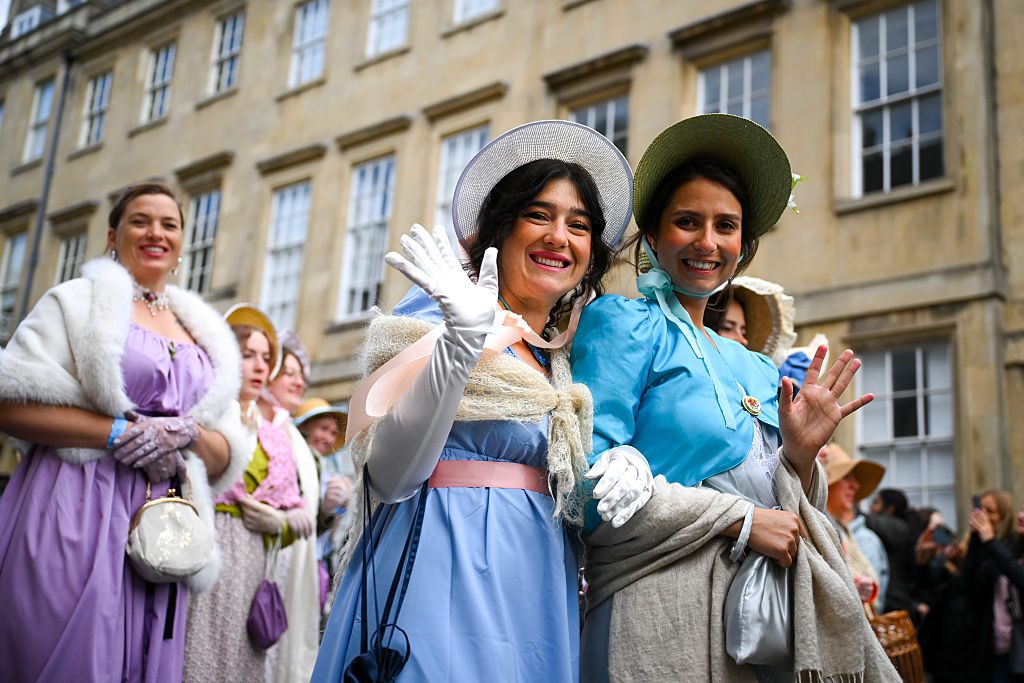
Of the true addicts, the very truest have tickets to the Yuletide Ball at the Pump Room: I heard the tickets sold out in eight minutes. I get there early and stand outside — no press is allowed; press is a modern intrusion — and stare through the window at women setting up the ballroom in a kind of trance. Their movements are over-deliberate, and over-graceful: they would pull the curtains on the world if they could. Soon, the guests gather outside in the mandatory Regency costume, alongside the drunks in Christmas jumpers, and when Christmas drunks approach them to ask them to take photographs for them the Janeites look astonished. It’s the intrusion. These women — all women, a few with hostage husbands — are clearly, though temporarily, not living in this world. The Janeites are the most functional and literary of all obsessives and so, like her, are the most socially acceptable. They are racing back in time to 1812, but they pause to tell me that, “her stories relate to women even now”, or “I am here for the sarcasm”, or “She was a Feminist!” or “the characters learn from their mistakes”. The older ones love Persuasion, the purist’s favourite, because it gives a woman love late in life, and that is incomparable solace. (Anne was 27.)
As I leave, a round young woman in a red cape runs past me, ducks round the Christmas tree and sprints into the ball. She has flushed cheeks, is laughing with happiness and for some reason she reminds me of the woman dressed as an owl I met a furry convention many years ago. As a woman she was ordinary. But then I saw her as an owl with vast eyes — from a Coca-Cola bottle, she told me happily, which she painted — and, as an owl, she was a god. Both owl and Janeite in red cape have the same quality of power found and held. And I think that is Austen’s essential message: not love, not by itself, but self-possession.