My second-favorite piece of Norman Podhoretz’s writing is the 1971 speech he delivered (and then published in essay form) to the American Jewish Committee. My favorite, though, is Norman’s written recollection of giving that speech, which gets its own chapter in his 2009 book Why Are Jews Liberals?
After Norman Podhoretz died on Tuesday at the age of 95, I reread his account of the whole affair. And I realized that even if it hadn’t been my personal favorite, it would still be first one I’d recommend to others in the wake of his passing.
When Norman was became editor of COMMENTARY, the magazine was published by the American Jewish Committee. It was also liberal in its orientation. To its great credit, the AJC gave COMMENTARY editorial independence. The AJC was liberal, too, but not as liberal as Norman—but by 1971 the dynamic had flipped. Repelled by the anti-American turn of the radical left, Norman moved right—which meant, at the time, that he moved to the center. The AJC was, by contrast, a bit spooked by the radical left and was careful not to provoke its wrath.
It was at this moment that the AJC did something rather strange: It invited Norman to give the keynote address at its annual meeting on the subject of his changing politics, more or less guaranteeing some sort of confrontation. In the book, he twice mentions his surprise at receiving the invitation. He would rise to the challenge.
There were two drivers of the political changes that Norman would discuss at that dinner. The first was the Six-Day War.
The period between World War II and the Six-Day War was a Golden Age for American Jews. The Holocaust had pushed political anti-Semitism outside the range of acceptability, and cultural anti-Semitism became tainted by association with fascism. University quotas faded into oblivion.
“Not only were obstacles removed, but invitations were issued,” Norman wrote. “Not only were Jews less and less excluded from more and more places; they were also made to feel more and more welcome, more and more at home. Having, for example, always considered itself—without thinking about the matter very much—a Christian country, the United States was now extending recognition to Judaism as, along with Protestantism and Catholicism, one of the three major American religions. The rabbi became an obligatory partner of the minister and the priest on every ceremonial occasion, and though this development was not without its problems, the fact remained that Jews as Jews were being invited in, no longer alienated to that most literal extent.”
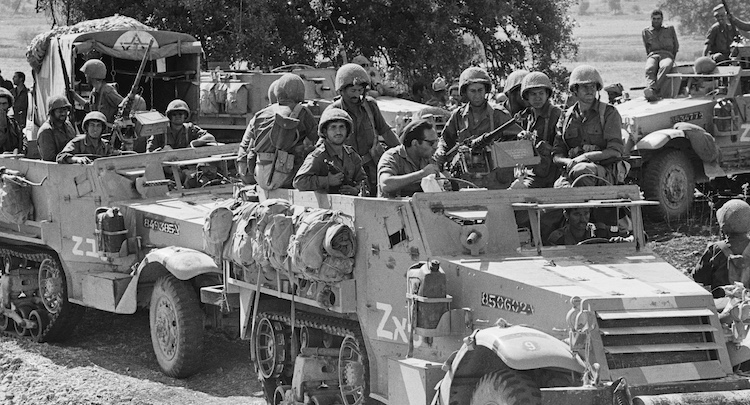
Then came the 1967 Arab-Israeli war. The Arab world mobilized for Israel’s destruction and the West seemed unalarmed. Israel not only survived but triumphed anyway. Norman was, along with his fellow American Jews, absolutely thrilled. “Jews celebrated it and will, I hope, go on celebrating it, forever and ever. But others, we soon found, did not celebrate it at all,” Norman said in his speech. “The nations of the world, many of them, denounced it and reproved it; the churches of the world, most of them, lamented it with an unction whose oily odor lingers in the air and still has the power to sicken any healthy stomach; and the intellectuals of the world… were a story unto themselves.”
Here Norman explained the reaction with a surgeon’s precision: “Jews are … not supposed to live, and if they do presume to live, they are certainly not supposed to presume to prevail.”
With a single word—presume—Norman had illuminated the source of friction. The world is fine with the Jews surviving and maybe even prevailing, but very few were prepared to live in a world in which the Jews could presume to prevail. Who were the Jews to be so presumptuous?
Anger about Israel’s victory turned into a wave of what was “pleased to call itself ‘anti-Zionism.’” Norman made clear he was not terribly preoccupied with whether or not these anti-Zionists were anti-Semites. What mattered was that “anti-Zionism has served to legitimate the open expression of a good deal of anti-Semitism which might otherwise have remained subject to the taboo against anti-Semitism that prevailed in American public life from the time of Hitler until, roughly, the Six-Day War.”
This is crucial. Norman Podhoretz was not attempting to “silence” criticism of Israel, as his critics, then and now, would say he was. Instead, his point was that American Jewish life was made infinitely better by the prevailing taboo against open anti-Semitism, and the anti-Zionists were the ones letting that poison back into American life and politics—even if they personally didn’t intend to do so. The objection was not that Jews’ feelings were hurt; it was that the anti-Zionists’ actions were likely going to do tangible damage to Jewish lives.
The second cause for worry was the infamous New York teachers strike of 1968. Public education was a refuge for Jewish teachers during the era of hiring quotas. But the emerging Black Power movement saw Jewish success in the union as unfair and somehow corrupt, and that movement’s allies and defenders among mainstream liberals eagerly legitimized its inevitable policy goal: the institution of some kind of proportional representation within the industry and the end of merit-based attainment.
This would plainly mean a return to quotas for Jews—and this time, those quotas would hit a part of the education system that had previously resisted them.
Expressions of bald anti-Semitism exploded back into public discourse. Because of the racial angle, this anti-Semitism “was more often explained, was more often ‘understood,’ and was more often blamed on the Jews themselves than it was ever forth-rightly and straightforwardly condemned” by the liberal establishment that was scared to be accused of racism, too. And here again, it was not the rhetoric itself but what it meant in practice: an intentional downgrading of Jews’ rights by restricting their employment.
So there you had it: The Golden Age was being deliberately shut down, and not by the right but by the left. What’s more, the processes at play here—racial quotas, a naked populist alliance of rich and poor against the middle, class warfare, and a spoils system—were not just un-liberal but un-American.
All those, then, who tried to claim that the COMMENTARY crowd had slipped into Jewish provincialism were wrong, Norman said: “Our concern for ‘special Jewish sorrows,’ far from leading us into an advocacy of Jewish withdrawal, has been one of the dynamically impelling forces behind the newly aggressive affirmation we have been making of the values of the liberal democratic order, and the newly militant defense of that order which we have mounted against the ideas of those, especially on the radical Left, who have devoted their energies either ignorantly or innocently or in full nihilistic awareness to damaging or destroying the liberal democratic order in America.”
The room at the AJC dinner was stunned. During the question and answer portion, angry accusations against Norman flew. A high-ranking AJC professional stormed out.
But Norman was calling it as he was seeing it, no matter what uncomfortable truths that revealed about the political coalition he still, at that point, considered himself a part of. He was a Jew, and he was addressing a Jewish defense organization, and he believed very strongly that there was nothing wrong with Jews defending their rights and their prerogatives. In his speech, he even used the line “kol yisrael arevim zeh ba-zeh,” meaning every Jew is responsible for one another.
Norman Podhoretz was driven by love for America. And no one better articulated how Jewish self-esteem and our communal obligation to each other are among the highest expressions of that love. May that lesson be learned far and wide.