“I am afraid to speak Ukrainian on the street,” says Iryna, a 30-year-old Ukrainian refugee living in Warsaw with her young daughter. “I feel nervous, especially with a small child, that someone might come and speak aggressively to us. I’ve seen the hostile stares on buses and trams. Even when I’m on my own I don’t speak Ukrainian on the phone. I don’t understand this dramatic shift in mood.”
Having fled her home in western Ukraine in the early days of Russia’s invasion, Iryna recalls the warm welcome received at first. Locals offered food, homes, and clothing to the more than 1.5 million refugees who poured over its border. “We were treated very kindly,” she says. Yet just in the last months, the mood has shifted alarmingly.
Iryna is far from alone in her anxieties. Several other women I met at a UNITERS Foundation centre, a charity in the Polish capital offering support to Ukrainians, spoke of similar fears. One pensioner from war-torn Zaporizhzhia was even pepper-sprayed outside an optician’s. “Now I try not to speak Ukrainian on the streets. If there are gatherings of Poles, my son recommends I stay away and watch out for myself.”
Hostility is surging. The centre’s windows have been smashed several times, and state funding has now been terminated. In Przemyśl, a rail hub by Ukraine’s border, the mayor removed the blue and yellow scarf from a big teddy bear in the Christmas market after an outcry. In the Baltic coast region, a school teacher called his Ukrainian teenager pupils “scum”, while other youngsters spat on and beat the refugees so badly that one was left with a broken nose. One pupil also reportedly played recordings of bombs falling on Ukraine while yelling “time to hide” at his victims.
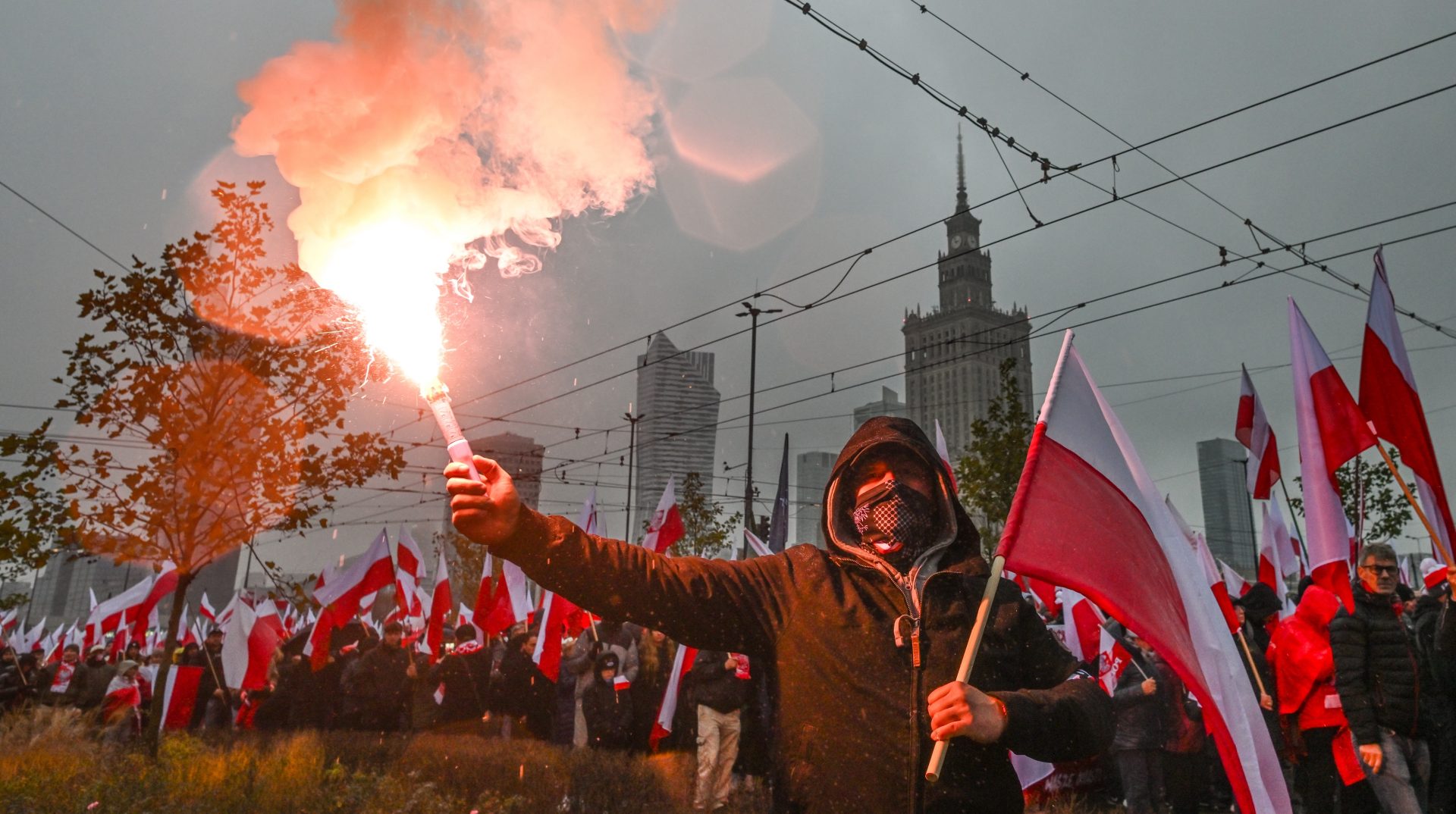
Poland is far from unique in seeing rising resentment to refugees. But these are people fleeing a neighbouring country riven by war, not some distant land with an alien culture. Moreover, Poland too is a country that suffered from Moscow’s repression for decades — it shares Ukraine’s loathing of Russia and helped lead Europe’s initial response to Vladimir Putin’s assault on Kyiv. But attitudes have changed and show how bitter political struggles over the future, often entwined with unresolved perceptions of the past, are erupting across the West. Sensitive historical fissures underlie this transformation, combining with an all too familiar catalogue of modern issues — disinformation, migration, populism, security, technology and trade battles — to create a highly combustible political environment.
“This is not yet a catastrophe but it is a new challenge for us,” says Miroslaw Skorka, chairman of the Association of Ukrainians in Poland. “For Poland, the story about victory over the Ukrainians was very important for post-war communist identity. So even during that explosion of support in 2022, a part of the population stayed silent. Now there is a schizophrenia: we need Ukrainians in the labour force to work and help grow our economy, but immigrants get scapegoated in schools and on the streets.”
“If there are gatherings of Poles, my son recommends I stay away and watch out for myself.”
Living on our island nation, with borders that have been fixed for centuries, British people often forget the turbulence endured by those living in the regions that historian Timothy Snyder has called the “bloodlands” of central and eastern Europe. Thousands of ethnic Poles were murdered in the Second World War by nationalists seeking to create an independent Ukraine, then many Ukrainians were in turn killed in savage retaliatory violence. In 1947, after the communist takeover, about 140,000 Ukrainians — including Skorka’s family — were forcibly moved in Operation Vistula from their homes in south-eastern regions to western areas taken from Germany in order to break up their community and curb support for insurgents, resulting in much hardship.
This left lingering historical sores on both sides — and these have been inflamed by resurgent nationalism, divisive politicians and the Kremlin’s adroit abuse of social media to spread discord in democracies. The sharp decline in sympathy for Kyiv is highly significant in a country that spent years warning complacent politicians in the West about Moscow’s expansionism, and that moved rapidly to bulk up its own armed forces in response to Putin’s aggression. Recent surveys of Poles have indicated that the majority oppose their neighbour joining either Nato or the European Union, and almost half want to reduce military support.
According to Marta Prochwicz, deputy head of the European Council on Foreign Relations in Warsaw, the nation remains united over its core approach to Russia. “Poland is as anti-Russian as Ukraine — it’s practically impossible to find pro-Russian attitudes in Poland. At the start of the war, the public mood was very supportive. Because of the common threat, the automatic, knee-jerk reaction of the party in power was to give military equipment to Ukraine straight away.”
When Vladimir Putin attacked Kyiv, the ruling party of Poland was the conservative Law and Justice (PiS). It had governed since 2015 and presided over a period of controversial judicial reforms, an abortion ban and the harsh anti-LGBT rhetoric. Yet faced with a looming election and the strong threat from the rival liberal party, led by former EU president Donald Tusk, PiS tried to fire up voters with populist policies and stunts. They unsuccessfully demanded Second World War reparations from Germany, backed farmers protesting against cheap grain flooding the market under an EU deal designed to help Kyiv, and urged Zelensky to apologise for wartime massacres by nationalists 80 years earlier.
Despite Tusk’s party winning the subsequent election, the stirring up of those issues had lasting effects. Farmers protesting at the border, and the increased talk of exhuming graves of massacre victims, started to turn the mood against Ukrainians. Donald Trump’s return to the White House accelerated these changes.
This year’s bitter, hard-fought presidential contest also saw the unexpected victory of populist historian Karol Nawrocki, an independent backed by PiS. Nawrocki opposed Kyiv’s accession to the EU or Nato until “important civilisational issues” for Poland were resolved — referring to the wartime massacres by Ukrainian nationalists — while proposing to give Poles priority access to benefits, doctors and schools.
This has led to tussles with Tusk over extending support to refugees, although the prime minister — weakened by his party’s failure to win the presidency — has ruled out sending troops to back a ceasefire in Ukraine. Last month, Nawrocki agreed for “the last time” to extend legal status for Ukrainians until March, leaving their future uncertain. This is despite studies suggesting that more Ukrainians work in Poland than in any other European nation and that they generated 2.7% of the country’s GDP in the last year. Meanwhile, sabotage attacks and September’s drone incursion into Polish airspace rattled many citizens — especially after two Ukrainians linked to Russian intelligence were identified last month as suspects behind some rail blasts.
The flood of people over the border highlights how Poland — with its fast-growing economy and rapid post-Soviet modernisation — has transitioned from a nation of emigration to one that offers alluring prospects as well as sanctuary. After Russia’s invasion, the million Ukrainians who came to Poland, joining the 1.3 million already there, were typically from more middle-class backgrounds than the earlier waves of “invisible migrants” working in low-paid jobs in fields and factories. Yet as one screenwriter with three university degrees tells me, she decided it was better to return home and endure Putin’s bombs than to be repeatedly offered cleaning jobs. “It is not a problem to clean some toilets — but it is a problem if I have to do this for the rest of my life.”
Now a new influx of men aged between 18 and 22 is further fuelling concerns, given reports that at least 100,000 men have reportedly left Ukraine after the ban on adult males going abroad was lifted in August. Among them is Roman Melnyk, 22, an English teacher from Kyiv I met at Warsaw station. “This is my first day abroad in my whole life,” he says, explaining that even his soldier father had urged him to leave their war-torn country. Yet these refugees have been less warmly received than predecessors. “We should not allow Ukrainians of military age into Poland,” was the response of the far-Right Confederation party. “Poland cannot continue to be a haven for thousands of men who should be defending their country, yet burden the Polish taxpayer with the cost of their own desertion.”
In contrast with the war’s early days — when the Polish president received a standing ovation in parliament for declaring that Ukrainians were not refugees but guests — polling now shows that opposition to accepting Ukrainian refugees is at its highest (at 45%) since responses started being recorded following Russia’s annexation of Crimea in 2014. And most Poles now believe too much assistance is being offered, saying benefits and health care should only be offered to refugees working and paying taxes.
Research has also shown that the words most associated with Ukrainians on social media are “demanding” and “cunning”. One analysis found that 94,000 anti-Ukrainian posts appeared on X in just over four months this year, often linking Ukrainians to sabotage attacks in Poland or anti-Polish atrocities in the Second World War. Pro-Russian accounts have also blamed Ukraine for the recent drone incursions. And these stories feed neatly into Russian disinformation narratives, which the army has described as a key part of Russia’s strategy of “cognitive warfare”.
Putin’s disinformation tricks have undoubtedly intensified the political divisions and hostility towards refugees. During the presidential campaign, for instance, seven cities received fake emails supposedly from Ukrainian House, a leading cultural and support centre, seeking consent for demonstrations in support of Nawrocki’s main rival. It emerged later they included a word left untranslated from Russian. “How can you be a Polish nationalist and repeat divisive narratives that obviously have their roots in the Kremlin?,” asked Ben Cope, the NGO’s director of programmes.
Yet Olena Babakova, an academic, journalist and migration researcher who moved from Kyiv 17 years ago, believes it is wrong to overestimate the Kremlin influence. “I often attend meetings with Polish politicians and when I ask why relations are poor, they blame Russian propaganda. And it was the winning presidential candidate who said the Polish NHS should develop an algorithm to automatically move Ukrainians to the end of the line for doctors so Poles could be first. If that is not racist, what is?”
She argues that refugees get scapegoated for wider economic and political failures. These are all familiar issues being discussed from Washington and Westminster through to Warsaw. Yet towards the end of our conversation, Babakova unwittingly echoes the British-Hungarian writer Gitta Sereny, who wrote about the complicity of a similarly passive society that refused to confront uncomfortable truths in darkening times.
“I have friends who tell me they limit their public presence in cafes, supermarkets or on the street in order not to be insulted,” Babakova says. “It is not that all Poles are anti-Ukrainian but the voices of a hostile minority, perhaps about 20%, have become so loud while the majority stays silent. Ukrainians who tell me they have experienced hate speech and violence always say the biggest problem is not that they were assaulted — but that everyone around them was silent.”