For years, the red canoe sat idle on its port side in the bottomland between Sexton Creek and the single-wide trailer where a friend of mine, Joe, lived with his wife. The creek’s uncertain waters were usually no more than a few inches deep, far too shallow to float the thing. The weather had been chipping away at its bones for so long that the vessel’s fitness for water was a matter of speculation. It seemed to me bound to the shore, without passengers and without a destination.
Then, late one night in July 2022, the rains came hard and fast, and Sexton Creek rose, filling up like a bathtub. Water rushed over the single-lane bridge and made the sole road impassable. With few options, Joe considered the canoe. He waded through knee-deep silt to get to it, steadying himself with one hand and dragging it along behind him with the other. At the front door, he latched the boat to the roof and urged his wife aboard. Panicked, she would not get in until the waters were at her shoulders. At last, the two of them climbed inside. They spent the rest of the night in the hull, clinging to one another under the invisible sky, waiting for the sun to rise, waiting for the waters to recede.
Heading northwest toward Williamstown, Kentucky’s Ark Encounter, a colossal model of the ark that protected Noah and his family in the Biblical account of the global flood, I am thinking about the canoe and its tender mercies. “A 100 year event,” the newsmen called those summer floods. I mouth the words Johnny Cash sang: How high’s the water, Mama? / Five feet high and risin’. When it was all over, 45 people were dead and thousands more displaced. As Joe and his wife left the bottom for the last time, they took the canoe with them. In the midst of chaos, what is there except the few preparations that can be made? That and some measure of faith. I drive on for hours in silence.
Finally, I spot a brown highway sign directing passers-by to take the next exit for the Ark Encounter. I soon find myself in a huge lot surrounded by hundreds of other tourists. From Argentina to Burma to Ukraine, people from all over the world have made the pilgrimage here to see this “life-size” rendering of Noah’s ark.
“From Argentina to Burma to Ukraine, people from all over the world have made the pilgrimage here to see this ‘life-size’ rendering of Noah’s ark.”
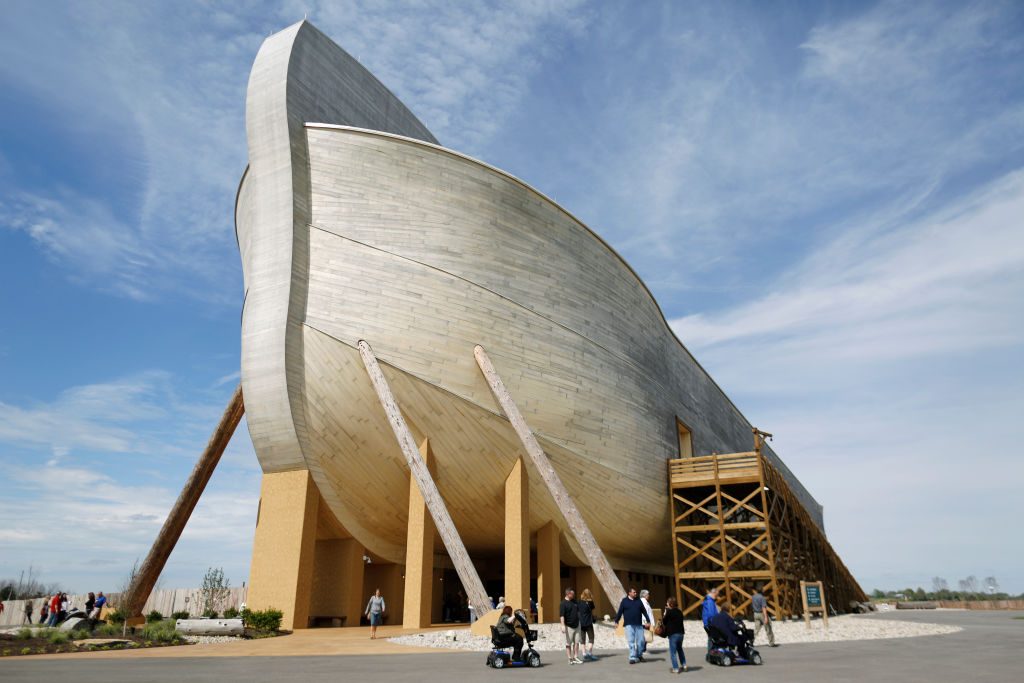
Everyone has to take a tour bus from the parking lot to the main attraction, which is hidden from view at first. I follow a young family with two little girls in tutus and hot-pink snow boots onto one of the waiting buses. I settle into a moulded plastic seat at the back and listen to the many languages that fill the vehicle’s interior. In a matter of minutes, we’re off, winding our way through the frosted autumn fields. A guy behind me who’s been speaking Russian with his friends jumps out of his seat and hurries past standing passengers toward the front of the bus. At first I think he’s left something behind. Maybe he wants to turn back. Then, I see him searching for something through the windshield while he clutches a camera in his right hand. He’s looking for the ark. He wants to be the first to see it rising up against the blue-grey marbled sky.
The sheer scale of the ark is overwhelming. Built according to the dimensions given in the Bible — roughly 510 feet long, 85 feet wide, and 51 feet high — it’s about the length of two Boeing 747s lined up end-to-end. According to the Ark Encounter website, it’s the largest freestanding timber structure in the world. Topiary animals marching in twos are miniaturised by the enormous ship. I stand for a while gaping at it before making my way up the entry ramp.
The ark is the brainchild of the famed Christian apologist and young-Earth creationist Ken Ham. Australian by birth, Ham started his career as a public school teacher in Queensland in 1975. During his first biology classes, Ham told me in a telephone interview, his students pressed him about his Biblical beliefs. Specifically, he remembers a young girl asking whether it was possible for Noah to get all the animals on the ark. It was then, he says, that he started praying for a museum where some of the Bible’s mysteries — the mysteries of divine creation as told in Genesis — might be further explored.
Ham eventually left teaching to enter the ministry full time. Following a move to the United States, he founded the apologetics organisation Answers in Genesis (AiG), where his vision of a Biblical museum was realised in the form of two popular attractions: the Creation Museum and the Ark Encounter. AiG’s broader purpose is to “enable Christians to defend their faith and proclaim the gospel of Jesus Christ” with a special emphasis on the first 11 chapters of Genesis. Though the ministry has been wildly popular among some evangelicals, it has faced substantial criticism from others, including those who hold evolution as God’s means of creation. Ham believes that the idea of theistic evolution undermines Biblical authority. And at its core, AiG is about promoting Biblical authority and the truth of the Gospel.
In 2014, at the height of AiG’s cultural visibility, the Creation Museum hosted a widely covered livestreamed debate, between Ken Ham and Bill Nye the “Science Guy”, that has since been watched by millions of viewers. The controversial match cast Ham’s young-Earth creationism against mainstream evolutionary science and an ancient Earth. Commentators have compared the event — somewhat tenuously — to the famous Scopes “Monkey” Trial. That was the 1925 Dayton, Tennessee case orchestrated by the ACLU to challenge a state law criminalising as a misdemeanour the teaching of human evolution in public schools. John Scopes, a substitute high school teacher, was convicted of using a textbook that favoured human evolution and fined $100, though the Tennessee Supreme Court later overturned that judgment on a technicality. With William Jennings Bryan leading the prosecution and Clarence Darrow leading the defence, the trial became a public spectacle. It underscored the growing divide between secularism and modern natural science on the one hand and traditional religious belief on the other, and foreshadowed America’s endless culture wars.
Meanwhile, the Ark Encounter has had its own share of exposure, beginning in 2016, with a modest reprise of the Bill Nye-Ken Ham debate. According to Ham, AiG’s properties have since seen a combined 1.5 million visitors annually, representing a spectrum of religious beliefs. That number includes the likes of former president Jimmy Carter, rock icon Ozzy Osbourne, and astronaut Barry Wilmore. Over the last five years, the ark has been home to 40 Days of Christian Music, one of the largest Christian music festivals in the world.
“Though the ministry has been wildly popular among some evangelicals, it has faced substantial criticism from others”
During my visit, the place is relatively quiet. There’s a placard near the entrance explaining that the ark’s designers have taken artistic license with some details to “enhance the guest experience”. The idea is to give visitors some historically supported sense of what life might have looked like for Noah and his family without contradicting the Biblical account. These instances “should not in any way be considered attempts to add our ideas to the Bible”, the sign advises.
On the first deck, the Christmas carols that have been playing fade into the background and are replaced by the ominous sounds of a ship in peril. Through the speakers, the storm rages, with thunder cracking and the ark’s wooden sides groaning in distress. Occasionally, an imaginary animal cries out. The dim lighting builds a sort of low-grade tension. Everyone’s half-whispering. The wide open rooms are filled floor-to-ceiling with bamboo cages and terracotta feeders. I’m following close behind three Mennonite girls wearing long cotton dresses and partially opaque white headcoverings. They’ve locked arms, and they’re holding each other close. “I’ve worked in the stables,” one of them says to the others, “if they wanted to make it totally realistic, they’d have made it smell bad too.” The three of them giggle wildly, conspiratorially. I laugh too, but I tuck my chin to hide my face.
Farther along, there are different cages with carefully crafted animal models inside. AiG adopts the idea that the ark housed two of every kind of animal — not every species — and seven pairs of clean animals (presumably those that could be offered as a sacrifice to God or eaten) and flying creatures. According to the “worst case scenario”, in which kinds are numbered generously rather than conservatively, the Ark Encounter’s researchers contend that Noah and his family would have cared for fewer than 7,000 animals. That would mean that there was room on the ark for all the animals plus plenty of space for food preparation, wood and metal working, and storage.
The second deck features a series of murals and dioramas that tell the Biblical story of the creation, the first murder, and the global flood. Some of the scenes try to imagine what Genesis 6:5 could mean when it says that “God saw that the wickedness of man was great in the Earth, and that every imagination of the thoughts of his heart was only evil continually”. In one scene, revellers watch warriors fight beasts in an arena. In another, worshippers bow down before a golden idol with the body of a man and the head of a serpent. In a third, builders hoard materials for the Tower of Babel. These are illustrations of exploitation — of the body, of the Earth, of all of creation. It’s perhaps the museum’s most explicit contemplation of justice and mercy, of the relationship between the consequences of the law and the consolation of divine love. “And the Lord said, I will destroy man whom I have created from the face of the Earth… for it repenteth me that I have made them,” it says in Genesis. And yet “Noah found grace in the eyes of the Lord”.
In a near-final scene, Noah stands on a ladder receiving a dove carrying an olive leaf in its mouth. In the Biblical account, it’s the symbol that the flood waters have receded and the Earth is habitable. Nearby, an Ethiopian man quiets his daughter in his arms. “Noah!” she shouts. “Noah! The dove!” To her, all of this is real. Noah’s lonely voyage has finally come to an end.
As I make my way toward the exit, I stop to examine a series of tiny folk art versions of the ark encased behind a glass covering. There are porcelain arks, tin arks, even paper arks — all different and yet the same. I think about the little wooden ark that sits on top of my dresser at home. I got it a few years back from a toy-maker in Lexington, North Carolina. It was part of his personal collection. For the first time since I began the tour, I’m moved almost to tears. I look at the people to my left and to my right, people speaking many different languages. It’s a kind of miracle that all of us are here, united by faith, wading through the chaos of our present world together.
I wonder about the deep sense of belief here and whether it goes beyond these walls. In the US, there’s been some evidence of renewed interest in the Christian faith. Though the percentage of Americans who identify as Christian has been in decline for decades, Pew Research Center’s 2023-2024 ”Religious Landscape Study” suggests a “leveling off”. As it stands, six in 10 American adults identify as Christians. The number is lower among younger Americans, but Barna Research Group reports that teenagers are increasingly curious about the Gospel message, with more than half of Gen-Z teens expressing a desire to learn more about Jesus Christ.
I try asking a couple of teenagers at the ark whether they’ve felt any sense of curiosity about the faith from their peers, but they don’t seem to know what I’m talking about. They’re from the Bible Belt South, and so most of their friends and classmates are professing Christians.
Outside, huddled at a fire pit to shake off the cold, I have better luck with a member of another generation. Bill, who is here with his adult niece, is in his late seventies. “She called me this morning,” he reflects, “and she said ‘guess where we’re going today?’” The visit is a gift, a post-Thanksgiving surprise. “I’ve been praying to the Lord that one day I might get to see this,” he says with a Southern drawl that sounds a lot like mine. He tells me that he lost his mother as a child, that he’s been kind of lonely lately. He seems to sense some sorrow in me. “Don’t live your days in heartache, child,” he says. “Jesus is coming back soon.”
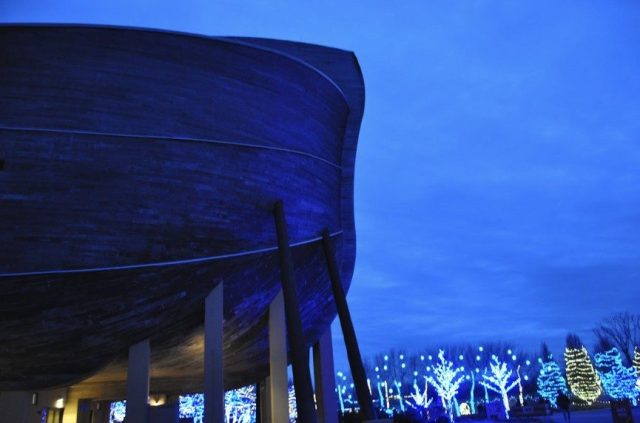
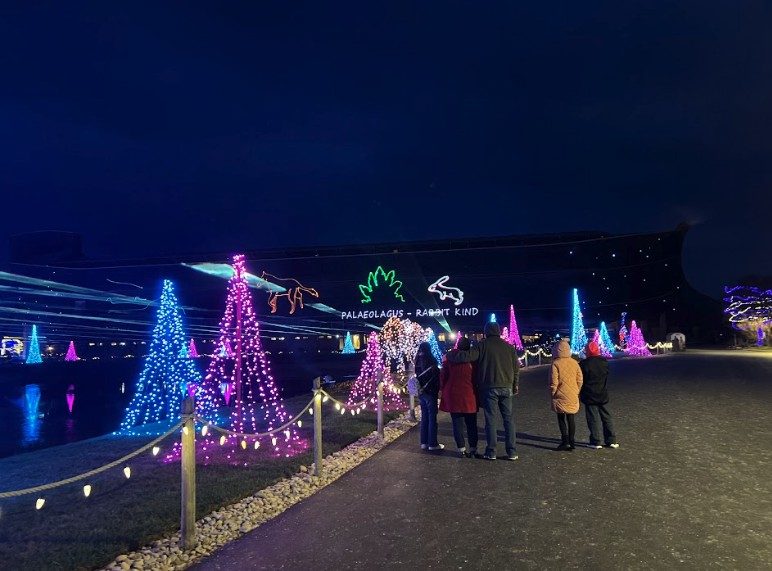
When the sun sinks low in the sky, there’s a change in the air. New music offers a dreamy, ethereal feeling. Lights project scenes from Jesus’s life against the great ark. He’s a babe in a manger, a teacher, a martyr, and the living Saviour. The spiritual meaning is not lost on me. It’s as though all of history, all of creation has been building toward this moment: the moment of redemption. I’m reminded of the words written in Luke: “Glory to God in the highest, and on earth peace, good will toward men.”
Lost in my own thoughts, I start making my way home. I consider the Eastern Kentucky floods and Joe’s red canoe. I asked him once what he was thinking as he was lying there in the boat waiting for the storm to pass. “I was asking the Lord to spare me,” he said, “and He answered my prayer.” Joe paused and looked out in the middle-distance. “I guess He’s got more work for me to do.”