Jobs, art, and even your Tannenbaum aren’t safe.
Would you give up real Christmas trees to support the development of artificial intelligence (AI) data centers? That’s what one Fox Business host recommended in the run up to Christmas.
During a discussion about a proposed AI energy project affecting a Christmas tree farm in Mount Airy, MD, host Dagen McDowell suggested that tree growers should accommodate the needs of AI data centers, even if it negatively impacts farms in the process. “That’s the very nature of a growing economy. Everybody needs to get on board,” McDowell said before dropping this bomb: “You know what: buy a fake tree.”
The controversial comment sparked outrage on social media as local farmers warned the project could cost them millions of dollars in land and business. “They’re trying to blame AI – if it’s not AI, it’s something else. It’s called growth and development of business,” McDowell insisted.
She may as well have added “bah humbug.” Where’s Tiny Tim when you need him?
Real Christmas Trees Matter
Real Christmas trees are a deeply rooted American tradition that has been cherished for a couple of centuries. The first Christmas trees in America were decorated by German settlers in the early 1800s, and by the 1850s, trees were sold commercially. President Franklin Pierce is often credited with putting up the first White House Christmas tree in 1853.
At first, Americans followed the lead of Europeans, whose Christmas trees were about four feet tall. But that changed by the 1890s, when the faithful embraced floor-to-ceiling trees, transforming the tradition into something unmistakably American.
Fast forward to the 21st century, and an estimated 30 million real Christmas trees are sold in the United States every year, grown on roughly 350,000 acres nationwide.
But now, the real Christmas tree has joined a growing list of American traditions under attack, alongside standing for the national anthem and neighborhood trick-or-treating. This isn’t hyperbolic: Real Christmas trees matter because tradition matters. It links one generation to the next, carrying values and meaning. Traditions remind us that some things are worth preserving just because they shape who we are. Within tradition, symbols turn words into something tangible. The Christmas tree is a rare example of both.
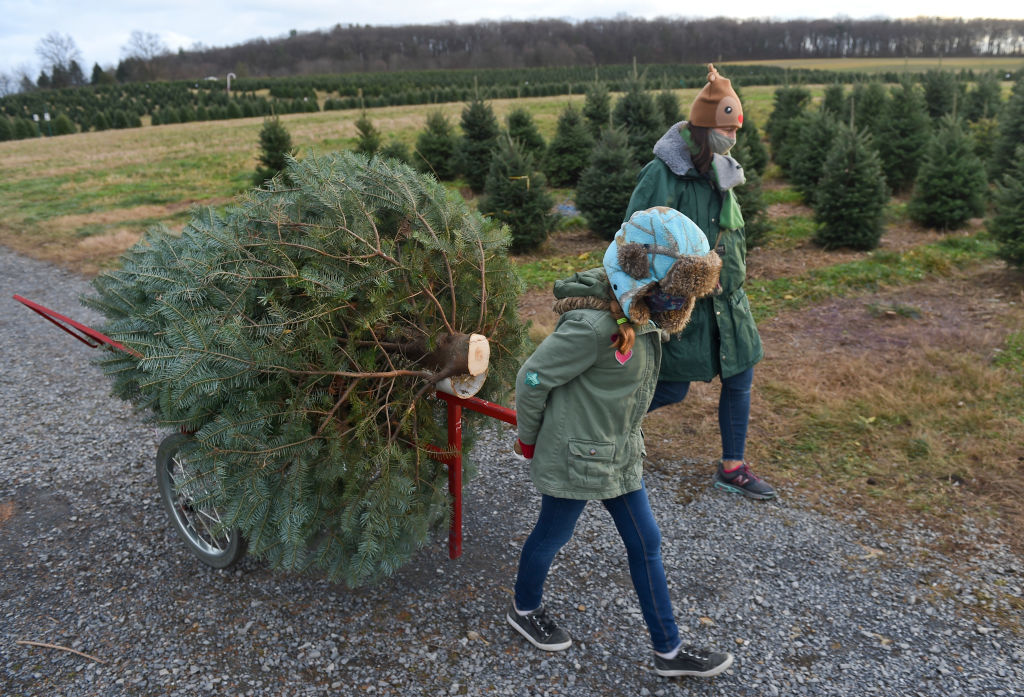
When you head out to a Christmas tree farm in the cold, chop down or choose a tree, and wrestle it back to your vehicle, it takes some effort. Maybe your hands get numb. The wind cuts through your coat. It takes time.
But when you put the tree in its stand, string the lights, hang the ornaments, and place an angel or a star on top, the work starts to make sense. All the effort transforms into a beautiful living symbol of the sacrifice Mary and Joseph made to bring Jesus Christ into the world – which is, of course, what Christmas is really about:
“And, lo, the angel of the Lord came upon them, and the glory of the Lord shone round about them: and they were sore afraid. And the angel said unto them, Fear not: for, behold, I bring you good tidings of great joy, which shall be to all people. For unto you is born this day in the city of David a Saviour, which is Christ the Lord.” Luke 2: 9-11
A fake tree requires little-to-no struggle. It’s assembled in minutes and put away just as easily. In an age when the synthetic is rapidly taking over — thanks in large part to artificial intelligence — real Christmas trees stand as a quiet act of resistance.
If the choice is AI data centers or a fresh woodsy fragrance of pine wafting through the family room, well, you’re going to have to pry the real Christmas tree from my cold, dead hands.
Liberty Nation does not endorse candidates, campaigns, or legislation, and this presentation is no endorsement.