Aristotle was the tutor of Alexander the Great, hired in 343 BCE by Alexander’s father Philip II when the future conqueror was 13 years old. Aristotle, the greatest of all philosophers, sought to describe the world as it is and not the world as it should be, that having been the focus of his teacher Plato. Aristotle’s signature contribution to the annals of human understanding centers on the mean—how to find the proper balance between the churning passions that can drive us to reckless and self-destructive behaviors and the often panicky instinct for self-preservation that can both protect and paralyze us. It is Aristotle who teaches us the importance of prudence as a hedge against impulsivity and boldness as a hedge against inaction.
Was Alexander a good student? Often considered the most successful military man in history, felled not in battle but by natural causes at the age of 32 after 12 years as the leader of Macedon, he was a perpetual motion machine and astonishingly innovative as a tactician—and viewed through most of history as the peerless example of the rewards that can be garnered from martial glory. “None but the brave,” wrote the poet John Dryden in his glowing portrait of a banquet celebrating Alexander and his wife Thais upon Alexander’s seizure of Persia, “deserves the fair.” It seems unlikely that Alexander was a real-life model of the golden mean.
The most enduring folk tale involving Alexander is about not overthinking—the story of the Gordian knot. In the city of Gordium, a prophet had declared the future ruler of all Asia would have to solve the impossible problem of untying an incredibly complex knot in a rope. Alexander simply took his sword and cut through it. Action, not ingenuity. Simplicity, not complexity. Solve a problem not by solving it but by ending the problem itself.
Doesn’t this explain better than any other theory the approach of Donald Trump in Iran and Venezuela? For decades, both enemies of America seemed to pose problems for us that seemed unsolvable, though the reasons shifted over time. Iran’s nascent nuclear problem could not be dealt with directly in the 2000s because we were too busy in Iraq. Venezuela’s seizure of American assets in 2008 relating to natural gas could not be dealt with because we had a history of standing by and accepting it when oil-rich countries nationalized their assets. When both regimes stole elections and oppressed their people while sponsoring terrorism against the United States—with bombs and narcotics, and cooperating with each other as Iranian assets went to Venezuela for passports to use to cross the border into the U.S. to move drugs and establish potential cells—we could not and did not act because, well, having not acted before, we weren’t going to act now.
Faced with these problems in 2024 from both regimes, Donald Trump surely got the same advice Joe Biden and Barack Obama and George W. Bush had received from other world leaders and from the experts inside his own government. The consequences of action were simply too hard to game out. All options were bad, so the least bad option—using Aristotelian moderation as your guide—would be not to do too much. Use sanctions. Send ships to the area. Support covert forces. Even help the enemy of your enemy (Israel). But do not do more.
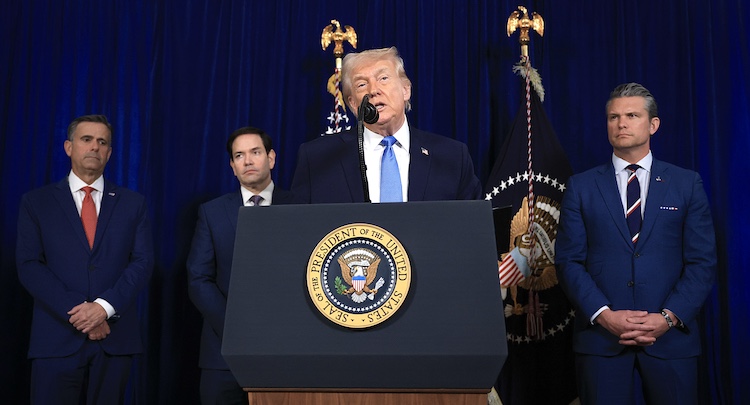
Looking at these knots, and having been told that untangling them would be near impossible, Trump chose another route. He took out his sword—the unparalleled American military—and sliced through them. In 37 hours from beginning to end, he took out Iran’s nuclear program. And in five hours this weekend, he extricated Nicolas Maduro from his position atop the Venezuelan greasy pole.
By doing so, he invokes another, more recent paradox, though I know in citing it I am going to get slammed by people for misunderstanding its original meaning. That is Heisenberg’s uncertainty principle. By which I mean, the idea that these problems are irresolvable is inalterably changed by resolving them—the facts on the planet Earth have changed in the Middle East and South America because of what Trump chose to do, and the prudent calculations that governed inaction are no longer operative because they describe the options in a world that no longer exists in the same way.
These actions could have gone haywire, like the Desert One hostage-rescue fiasco in 1980. But they didn’t. And we don’t know where the Iran strike will lead, although right now, it looks like the world is safer and one of history’s most evil regimes is weakening to the point of possible collapse. And we don’t even know what Monday will look like in Caracas, not even to say what next year will look like.
Aristotle didn’t say prudence required inaction. He opposed the extremes. And Trump’s actions are only to be considered extreme if you view them in isolation. They came in response to efforts before them to make things happen without military involvement. As Marco Rubio said, we spent a year offering Maduro all kinds of generous deals. He rejected them, called Trump a coward, dared him to act. It stands to reason that if the regime challenging the United States is itself an extreme actor, taking radical action against it might itself be the most prudent course. Alexander didn’t need to spend years solving the Gordian Knot problem when he had a blade sharp enough to solve it for him.