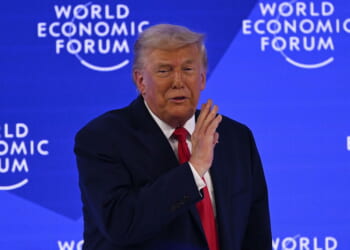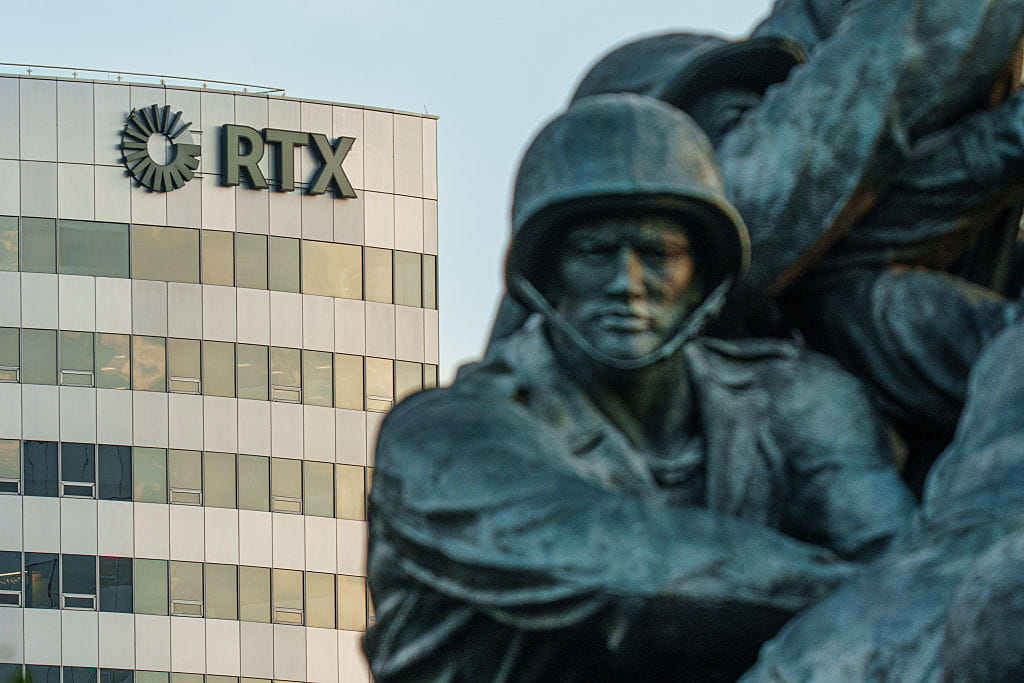
In a highly unusual move, President Donald Trump has taken one of the Big Five defense industries to the social media woodshed. Using a Truth Social post, the president admonished Raytheon, a division of RTX Corporation, as being the “least responsive to the needs of the Department of War.” Trump wants the defense industry to be as keen on building an industrial base capable of meeting the demands of defeating America’s adversaries as he is.
Defense Industrial Base Put on Notice
The Trump administration is engaged in a critical push to revive the defense industrial base by transforming the defense acquisition system. Secretary of War Pete Hegseth made this objective crystal clear in his heart-to-heart meeting with aerospace and defense industry executives on November 5, 2025. He told the audience: “The whole industrial base and most importantly, the large primes that we do business with today. These large defense primes need to change to focus on speed and volume and divest their own capital to get there.” Apparently, the industry, and particularly Raytheon, did not get the message. To put a finer point on what Hegseth was talking about, President Trump, in a Truth Social post, singled out Raytheon for special recognition – and not in a good way. He wrote:
“I have been informed by the Department of War that Defense Contractor, Raytheon, has been the least responsive to the needs of the Department of War, the slowest in increasing their volume, and the most aggressive spending on their Shareholders rather than the needs and demands of the United States Military…Either Raytheon steps up, and starts investing in more upfront Investment like Plants and Equipment, or they will no longer be doing business with Department of War.”
Those are strong words and should get Raytheon’s attention – and not just Raytheon but the defense industry as a whole, particularly the other four major defense prime contractors: Boeing, Lockheed, General Dynamics, and Northrop Grumman. The president’s words had an impact where corporations feel it most – in the pocketbook. After Trump’s post, “Shares of RTX, the parent of Raytheon, slid an additional 2% in after-hours trading after closing down 2.5%. A major defense contractor, RTX, manufactures advanced air-to-air missiles and many of the components in the F-35 fighter jet,” CNBC reported. Other defense stocks felt the impact of Trump’s ire. “Shares of defense giant Lockheed Martin fell 4.8%, Northrop Grumman slid 5.5%, and General Dynamics fell 3.6% during afternoon trading in New York,” Fox Business explained.
To codify more explicitly what President Trump has in mind, on January 7, the same day as the Truth Social posting, the president issued an executive order. The purpose of the EO, titled Prioritizing the Warfighter in Defense Contracting, is to focus defense industrial base contractors on quickly producing military capability to enhance the US armed forces’ ability to deter adversaries from conflict or, if necessary, soundly defeat them. To achieve that end, defense contractors must improve production performance and on-time deliveries. The EO points out: “Many large contractors — while underperforming on existing contracts — pursue newer, more lucrative contracts, stock buy-backs, and excessive dividends to shareholders at the cost of production capacity, innovation, and on-time delivery.” The president is strongly opposed to defense contractors paying exorbitant executive salaries while critical defense programs, over which they are responsible, are performing poorly, are behind schedule, and being consistently over budget. There is no fuzz on the EO’s intentions for major defense primes declaring, “Effective immediately, they are not permitted in any way, shape, or form to pay dividends or buy back stock, until such time as they are able to produce a superior product, on time and on budget.”
No Reward for Failure
Additionally, the EO addresses defense industry executives’ incentive compensation and asserts that the amount “under future contracts be tied to on-time delivery, increased production, and necessary operating improvements rather than short-term financial metrics.” The EO is trying to remedy what has become an industrial base legacy of defense contractors placing stockholders’ interests over warfighters’ needs. To achieve a revitalized defense industrial base, the Trump administration is addressing a first-principles problem: defense contractors rewarding themselves and their stockholders for poor performance. The Secretary of War has been given the authority to identify underperformers and take corrective action.
There was a time when, during World War II, the War Department and defense contractors worked together to achieve amazing results. In the preface to his book, Freedom’s Forge, Arthur Herman recounts how “businessmen, engineers, production managers, and workers” created a war materials behemoth that turned out, “86,000 tanks, 2.5 million trucks and half million jeeps, 286,000 warplanes, 8,800 navel vessels, 5,600 merchant ships, 434 million tons of, 2.6 million machine guns, and 41 billion rounds of ammunition – not to mention the greatest superbomber, of the war, the B-29, and the atomic bomb.”
To be sure, those were extraordinary times demanding unprecedented defense contractor cooperation and performance. Nonetheless, President Trump wants to see that same zeal for supporting the modern-day warfighter. If the defense industry contractors weren’t listening before, they should be now.