Why most of the state’s claimed carbon reductions may not be real.
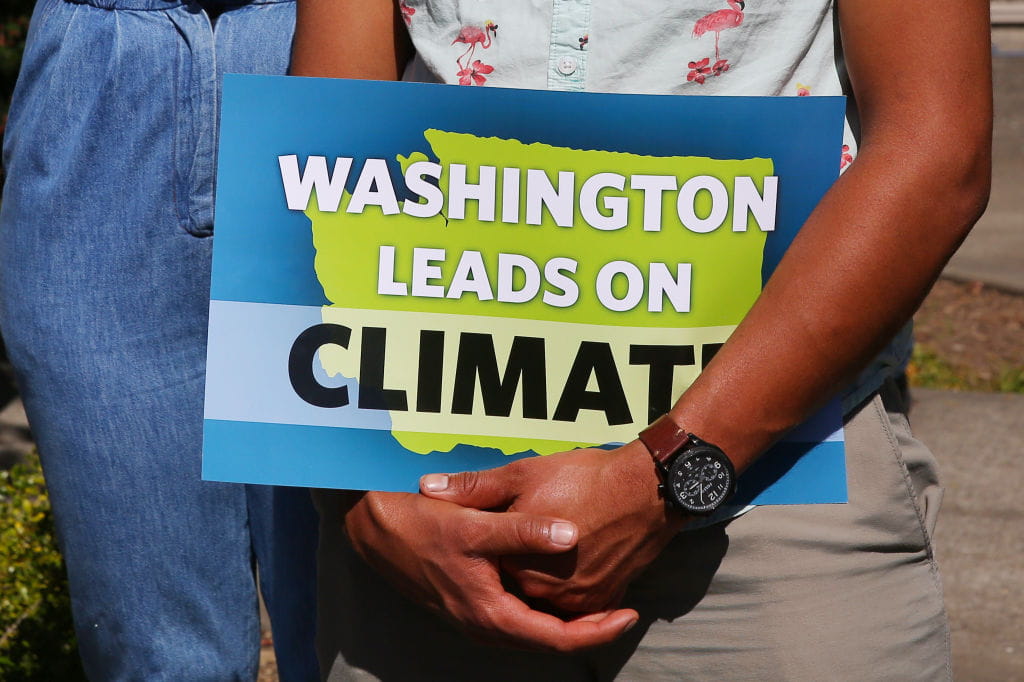
Washington state’s Department of Commerce estimated 7.5 million metric tons of greenhouse gas emissions would be reduced through the Climate Commitment Act (CCA). All that extra money polluters paid to continue business while lowering their contribution to pollution must finally be paying off, bringing the Evergreen State that much closer to controlling climate issues. Or so they thought. Turns out, what is being called a clerical error vastly overestimated emissions cut. Instead of millions of tons being reduced, it was just 78,000.
Climate Report Fumble
In November, the Washington Department of Ecology published its annual climate investments report stating that the CCA would reduce nearly nine million metric tons of greenhouse gas emissions by investing $1.5 billion of the funds collected from the program to cut emissions for fiscal years 2023 through 2025. This looked great on paper – until Todd Myers with the Washington Policy Center noticed the glaring error.
A press release from the Department of Ecology announced the nine million tons number, which the department said was the “equivalent of taking 40% of all gas and diesel vehicles in Washington off the road for a whole year.”
According to Myers, however, these claims are false. Furthermore, he said: “Ecology director Casey Sixkiller praised the report for providing ‘detailed, transparent information about CCA spending’ which ‘ensures that lawmakers can continue to guide those investments wisely.’ But a report giving significantly inaccurate data does not validate that lawmakers have wisely spent taxpayer dollars nor does it provide them guidance for doing so in the future.”
Myers explained that about 86% of the total CO2 reductions claimed by the report are probably fake. “Ecology’s claim that the average cost to reduce one metric ton (MT) of CO2 is only $40 is an obvious indication that the data in the report are wrong. Forty dollars per metric ton is pretty low, particularly when the average cost during the first year of climate projects was $1,410.14 per MT CO2. A drop to $40 would be remarkable if it were true. But it isn’t.”
There were approximately 3,600 projects but the results were based on just eight of them that focused on low to medium income households and providing electrical upgrades. Myers clarified: “The report indicates those projects were able to reduce emissions for just $1 or $4 per MT. This is obviously incorrect. There are probably no projects in the world that can reduce CO2 emissions for that price.”
Take the City of Ellensburg, for example. It received a grant for $4,125,835 to purchase heat pumps for low-income families to be able to switch fuel sources. The report claims 20% of those funds were used just to cover administrative costs as well as outreach and education. “The remaining $3.5 million funded 170 projects that Ecology’s report claims reduced emissions by 3.5 million metric tons,” Myers said. “To put that in context, that is equivalent to 60 percent of all energy-related residential CO2 in Washington state for all of 2023,” which he said is “clearly incorrect. The fact that the staff at Ecology failed to identify such an obvious error indicates how sloppy the report is.”
What Is the CCA?
According to the Washington State Department of Commerce’s website, the Climate Commitment Act was signed into law in May 2021 with the pledge to reduce greenhouse gas emissions by 95% by 2050. It is the cap-and-invest program that requires the Evergreen State’s largest emitting businesses to purchase allowances equal to their covered greenhouse gas emissions through quarterly auctions. The revenue from these auctions is then reinvested into programs to reduce overall carbon footprint. “The CCA works to center environmental justice and equity, investing in communities that bear the greatest burdens from air pollution as the state cuts greenhouses gases.”
Big promises that don’t garner a lot of trust when reports are so skewed. “What’s more, the spending I’m addressing only includes projects that the state says will yield ‘quantifiable emissions reductions.’ About 70 percent of CCA project spending isn’t even expected to reduce CO2,” Meyers explained. “For example, the nearly $16 million for ‘bicycle education to elementary and middle school students’ we highlighted recently is not expected to reduce CO2 emissions.”
No one is denying there was a huge error, at least. Jennifer Grove, assistant director of energy at the Department of Commerce told K5 News, “We made an error in reporting data for this program. The Climate Commitment Act is a vital part of the state’s efforts to control carbon emissions, and we’re committed to ensuring that the information we share is complete and accurate.” An updated report with corrected numbers is expected to be released in the next few weeks.
This latest gaffe is bringing more attention to the state’s climate control efforts. Recently, Liberty Nation News reported on the massive flooding that covered the western portion of the state. “Flooding is one of the most predictable and costly natural threats in Washington, and scientists have repeatedly warned that atmospheric rivers will grow more intense as the climate warms. These storms hold more moisture now, meaning they can dump extraordinary amounts of rain in very short bursts. Yet Washington’s climate-spending choices suggest that long-term infrastructure upgrades, levee modernization, and watershed-level mitigation have not been treated as urgent priorities.”
Out of the $1.5 billion from the CCA, a little more than $7 million was spent – “which is about one half of 1% [on flood mitigation],” Myers said, adding that he looked at what else the money was spent on and he claimed the state spent more than double that, $15 million for bicycle education programs for elementary and middle school students instead of levees and other areas that would help prevent flooding.
The error in the CCA report isn’t necessarily the most troubling aspect. Instead, these errors overinflate the program’s success, misleads the public, and erodes the credibility of current and future programs.
Liberty Nation does not endorse candidates, campaigns, or legislation, and this presentation is no endorsement.