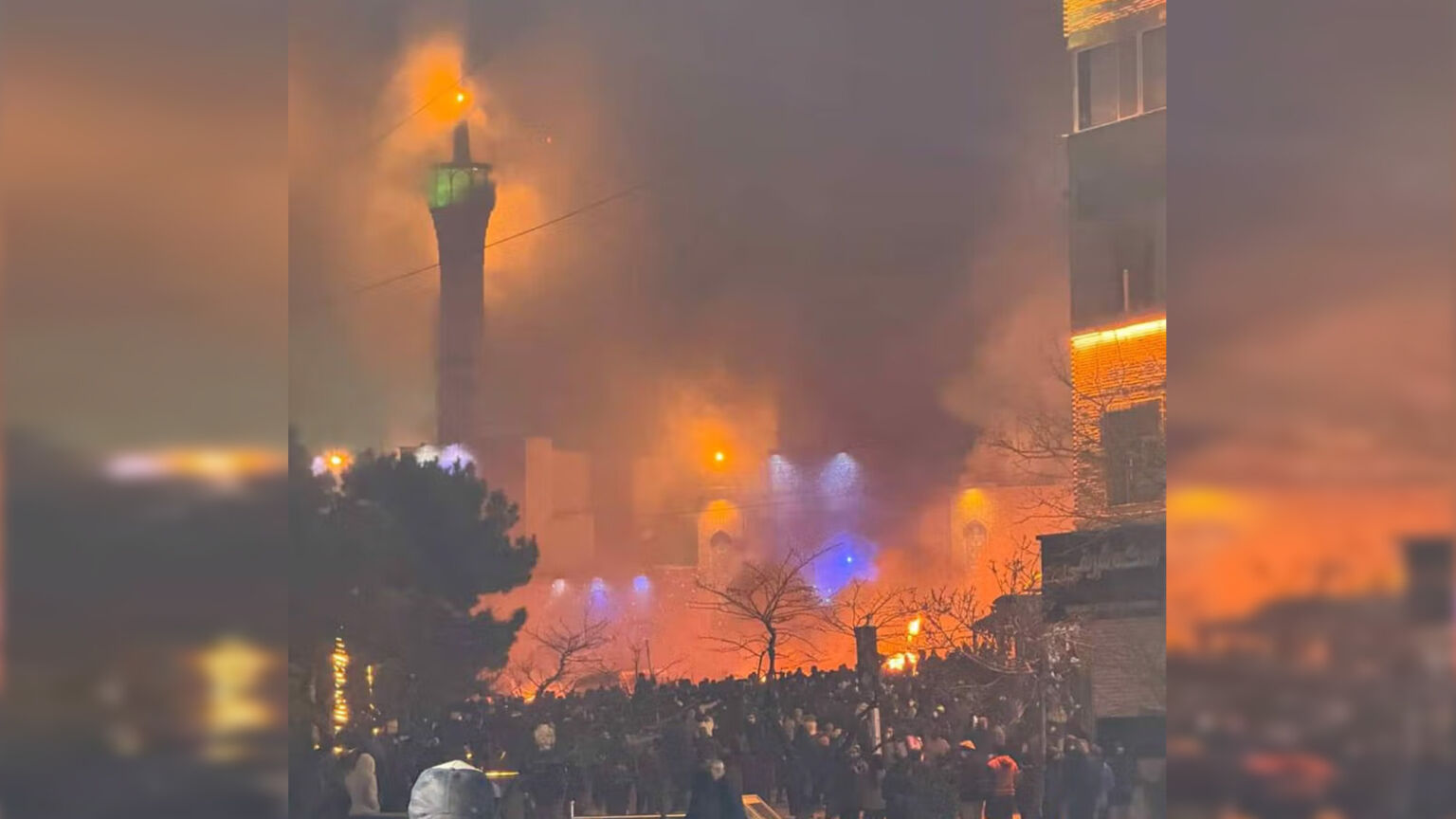
Demonstrators in Iran are risking their lives taking on their country’s brutal Islamic regime. As nationwide protests enter their third week, at least 2,000 have been killed at the hands of Iranian security forces. The true death toll is feared to be significantly higher.
A severe economic crisis, caused by a dramatic plunge in the value of the rial, triggered the protests in December. But the economy is not what motivates them now. The thousands of men and women on the streets are visibly energised by one goal: an end to Islamic rule. Among the limited information available online are videos of mosques being burned (including Tehran’s prominent Al-Rasool Mosque), young, unveiled women lighting cigarettes while burning posters of the ayatollah, and chants of ‘Death to the dictator’ and ‘Death to Khamenei’.
Incredibly, many on the left have cited this hostility to Islam as evidence the uprising is ‘foreign backed’. This reveals a spectacular ignorance of Iran, in particular its recent history. It ignores the uprising sparked by the death of Mahsa Amini in 2022, who was killed for exposing her hair on the streets of Tehran. In response, women took to the streets and publicly cut their hair, in stark defiance of Iran’s brutal ‘morality police’. Then, too, protesters demanded the downfall of the Islamic regime.
To suggest that the uprisings stem from Western meddling isn’t only a betrayal of Iranians. It is also an insult to the millions of people living in Islamic societies across the world who dream of a secular future.
Like many citizens of Muslim countries, Iranians are sick of life under Sharia law, which brutally punishes those who exercise freedom of thought and conscience. They detest the antediluvian religious injunctions that mandate the death penalty for blasphemy, and they loathe the bigoted mobs who are often the first to enforce it. Women have had enough of living as second-class citizens. Dissidents in Islamic countries around the world – the free thinkers and the feminists – are finding solace in the ongoing Iranian revolution.
Events in Iran have not occurred in a vacuum. In recent years, there has been a precipitous rise in secularism across the Arab world. The same trend is visible in Iran. Last year, Abolghasem Talebi, Iran’s representative for clerical affairs, said that 50,000 of the country’s 75,000 mosques had closed due to low attendance. This vindicates many surveys that reveal the ‘unprecedented secularisation’ of a nation that is ‘officially’ 99.5 per cent Muslim. Some studies suggest the figure is, in fact, as low as 40 per cent. In addition to this surge in secularism, more and more Iranians are celebrating Zoroastrian festivals (Zoroastrianism was the ancient religion of Persia). So popular had these festivals become that the regime was forced to ban them last year.
This takes us to a point that has not been made enough: Islam is not native to Iran. Its Islamisation resulted from the Arab conquests of the seventh century. The Umayyad dynasty – the first Islamic caliphate – repressed both Persians and their indigenous religion. It was not until the Safavid dynasty, which ruled present-day Iran from the 15th to the 18th century, that Shia Islam was established as the dominant religion. The collapse of the Safavids was followed by a string of monarchies, culminating in the 20th-century Pahlavi dynasty. The Pahlavis sought to establish a secular nationalism, rooted in a pre-Islamic Persian identity.
In 1979, the Iranian Revolution overthrew Shah Mohammad Reza Pahlavi. The resulting clerical rule – the only thing Iranians have known for nearly 50 years – ruthlessly imposed Sharia law on the population, aided by the repressive state machinery it inherited from the Pahlavi regime.
This is, of course, a cursory summary of a country with an incredibly complex history. But it is enough to show that Islam – particularly the fundamentalist Shia Islam adopted by the current Iranian regime – is not organic to Iran, nor supported by a majority of its population. Its success owed entirely to militancy of the 1979 revolution, and the unpopularity of the corrupt regime it overthrew.
The demonstrators are, therefore, shattering the postcolonial narratives favoured by the Western intelligentsia – those unable to see the cruelty of imperialism unless it bears the fingerprints of a Western power. They are also exposing Arab and Muslim denialism, which has allowed them to pose as perpetual victims of foreign interference, ignoring their own colonial legacies.
Dislodging Iran’s theocrats wouldn’t only be of benefit to its long-suffering people. Iran has been a profligate financier of terrorism since 1979, and is responsible for wars that have claimed hundreds of thousands of lives. Hamas and Hezbollah’s recent attacks against Israel are but two examples.
Be under no illusion: these protests are a struggle for freedom. They are proof that secularism is not a ‘Western construct’, but a real aspiration for those longing to live in a more just, humane society. It is a validation of Hegel’s timeless reflection: that history is the story of liberty becoming conscious of itself.
Kunwar Khuldune Shahid is a writer based in Pakistan.