The historical record serves as confirmation for followers of Jesus Christ that He walked among us, was crucified, and was raised.
Although several eyewitness accounts speak to that truth, the archaeological evidence supports it.
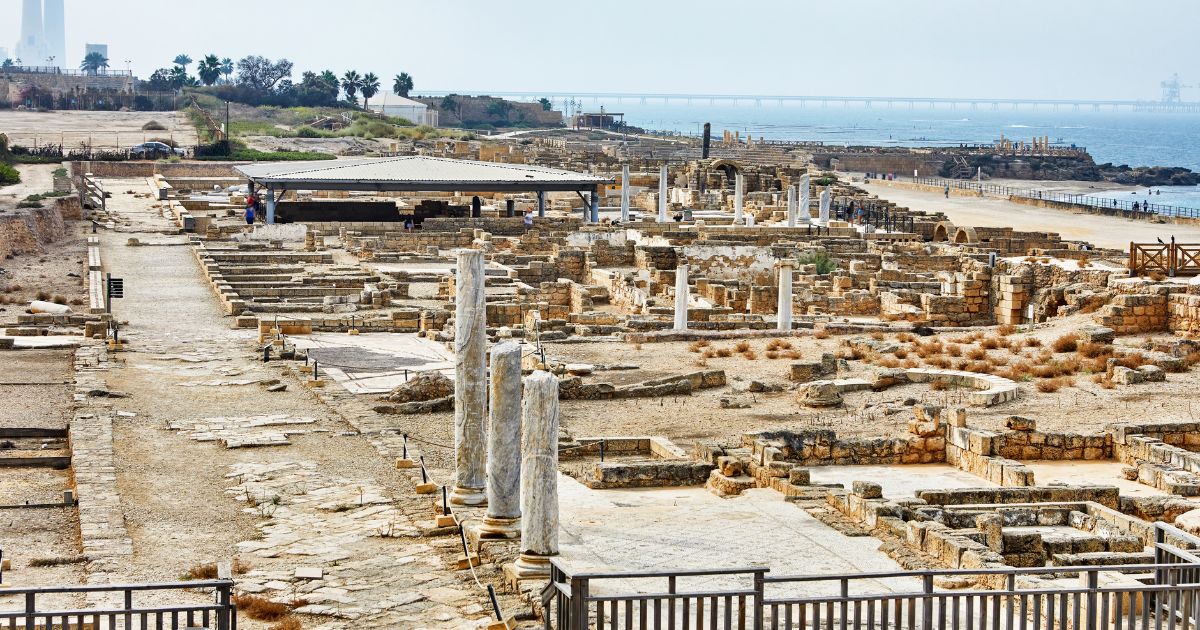
Excavation began on the port city of Caesarea Maritima in the 1950s after its destruction by Muslims in 1265.
It was here that Peter baptized the first non-Jewish Christian and Paul was put on trial before the Romans.
It is perhaps most famous in recent years for the discovery of the Pilate Stone.
In 1961, archaeologists found a limestone slab while excavating a theater in the city that reads, “To this Divine Augusti Tiberieum, Pontius Pilate, prefect of Judea, has dedicated this.”
The U.K.’s Daily Mail reported that the stone was part of a dedication to Roman Emperor Tiberius.
According to World History Encyclopedia, Pontius Pilate was the fifth magistrate of Judea, famously presiding over Jesus’ crucifixion. Before the stone was found, Pilate had only been known through written sources.
The Bible mentions him around 50 times, along with Jewish historian Josephus in his own writings.
Quoting Josephus, Biola University shows how significant Christ was from his “Antiquities of the Jews” also mentioning Pilate’s role in His death.
“And in this time there lived Jesus, a wise man, if indeed one ought to call Him a man, for He was a doer of miraculous deeds, a teacher of men who receive truth with pleasure. And He led many from among the Jews and many from among the Greeks. He was the Christ,” Josephus wrote.
“And, when Pilate had condemned Him to the cross at the accusation of the first men among us, those who at first loved Him did not cease to do so, for He appeared to them alive again on the third day given that the divine prophets had spoken such things and thousands of other wonderful things about Him. And up till now the tribe of the Christians, who were named from Him, has not disappeared.”
For #GoodFriday, the Pilate stone, a damaged limestone block and which mentions Pontus Pilate, the #Roman Prefect of Judea from AD26-36. This stone, found at the archaeological site of Caesarea Maritima in 1961 is the earliest surviving, and only contemporary record of Pilate. pic.twitter.com/ZVeeoVXVag
— Trimontium Trust (@TrimontiumTrust) April 2, 2021
Per the Daily Mail, mosaics uncovered in Caesarea quote Paul’s letters, while a governor’s palace and praetorium were also discovered.
Josephus himself wrote that Emperor Herod built it as a harbor for ships that traveled to Egypt. The remains of the city include the harbor, a stadium, and the aforementioned theater.
A reconstruction of the ancient city of Caesarea Maritima as it may have appeared in its heyday, compared to its remaining ruins today. The city was built under Herod the Great during c. 22–9 BC. pic.twitter.com/C20x1423uK
— Vintage Maps (@vintagemapstore) June 9, 2022
For Christians around the world, the Pilate Stone and the city can only confirm the historical record for our faith.
Christ was not myth, but God who became man and walked the earth.
Pilate’s significance cannot go understated for his authority and role in the crucifixion.
We now have hard evidence of his life.

Advertise with The Western Journal and reach millions of highly engaged readers, while supporting our work. Advertise Today.