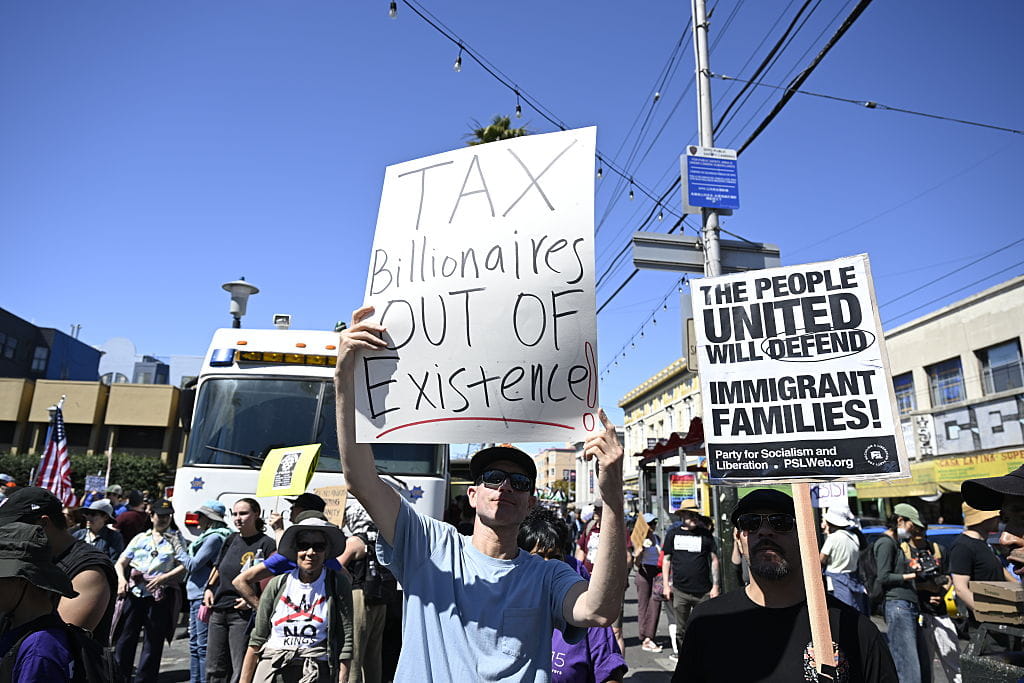
What happens when your city or state is sinking in financial debt? You put a tax on the wealthy to help make up the difference. At least, that’s what some blue state officials seem to think. Massachusetts, Minnesota, Washington, and California are just a handful of locales that are either looking into a wealth tax or are in the process of implementing it. But is it a good idea? The Golden State is finding out that going after the rich might not be the best move after all.
CA Wealth Tax
The best way to generate money is to tax the people, and those with the most money should be taxed even more. Or so the liberal logic defines. On December 26, 2025, California Secretary of State Shirley N. Weber proposed the initiative titled “Imposes One-Time Tax on Certain Individuals and Trusts.” If approved, this initiative would impose a 5% tax on assets held by individuals and trusts that are valued over $1 billion.
The Legislative Analyst’s Office (LAO), on its website, explained the difference between wealth and income and how some people gained their wealth in the Golden State. “Wealth is the value of all the things a person has come to own over their lifetime. Wealth is different from income, which is how much a person earns in a set period of time, like one year… California is home to a few hundred people with wealth over $1 billion, often called billionaires. Many of these billionaires gained their wealth as executives or investors in California technology companies.”
It is these individuals the one-time wealth tax is aimed it; billionaires living in the state as of January 1, 2026. LAO said the tax would be due in 2027, but they would have the option to spread the payments over five years – for a price, of course. The money collected will reportedly be put into a special account where the state will choose how and where to spend the money. “In particular, 90 percent of the money would have to be on health care services for the public,” LAO noted. “The rest would have to be spent on administration of the wealth tax, education, and food assistance.” The revenues would not be spent on schools or building rainy day savings, the website expounded.
The Tax Foundation, though, suggests that 5% wealth tax will be much higher. “Due, however, to aggressive design choices and possible drafting errors, the actual rate on taxpayers’ net worth could be dramatically higher.” Furthermore, “One particularly momentous policy choice has the potential to strip the founders of some of the world’s largest companies of their controlling interests and force them to sell off a significant portion of their shares. This could send stock prices plummeting to the detriment of tech employees and investors of all stripes, including ordinary workers whose 401(k)s would take a beating if Silicon Valley founders had to offload their shares in a hurry.”
The Golden State Exodus
People and businesses have been leaving California for states where the tax burdens are not so high. This month, U-Haul released its growth index and the Golden State ranked 50th, or dead last, for the sixth consecutive year.
In just the past five years, California has lost some major businesses, including Chevron, Tesla, Oracle, CBRE, Hewlett Packard Enterprise, software giant Palantir, SpaceX, Neutrogena, Realtor.com, and FICO. Larry Page and Sergey Brin, co-founders of Google, are the most recent of influentials in the Golden State to pick up and relocate.
Garry Tan, president and CEO of the tech company Y Combinator, explained to Fox News how this 5% wealth tax will be much more, using Google co-founders as an example. “Larry and Sergey can’t stay in California since the wealth tax as written would confiscate 50% of their Alphabet shares. Each own ~3% of Alphabet’s stock, worth about $120 billion each at today’s ~$4 trillion market cap. But because their shares have 10x voting power, the SEIU-UHW California billionaire tax would treat them as owning 30% of Alphabet (3% × 10 = 30%). That means each founder’s taxable wealth would be $1.2 trillion. A 5% wealth tax on $1.2 trillion = $60 billion tax bill, each. That’s 50% of their actual Alphabet holdings—wiped out by a ‘5%’ tax.”
David Friedberg, founder of The Climate Corporation, posted on X, “California started with the Gold Rush and might end with the Golden Exit.” He charged, “it has been underreported how much wealth has left CA because of the asset seizure tax being proposed.”
San Jose Mayor Matt Mahan also took to the social media platform, stating, “Each year, 40-50% of the state’s income tax comes from the top 1% percent of earners, who are the most mobile members of our society.”
CA Rep. Kevin Kiley (R) also chimed in on X, saying, “It turns out successful individuals would rather not have the government seize their assets simply to create a bigger pot of money for fraud, waste, and corruption.”
Tech billionaire and podcast host Chamath Palihapitiya suggested more than $700 billion in California wealth has left the state in just the last month. “That means the $2T of California wealth they expected to tax is now down to $1.3T and falling quickly,” he posted on social media. He added, “They were the sheep you could shear forever. Now California will lose this revenue source forever. Unless this ballot initiative is pulled, we will not stop the billionaire exodus. With no rich people left in California, the middle class will have to foot the bill.”
Service Employees International Union–United Healthcare Workers West is the union backing the wealth tax and claims that it is necessary to offset – you got it – the costs imposed by President Donald Trump’s signature tax bill. What’s a bit surprising is that Governor Gavin Newsom is actually against this initiative, recognizing the damage it can cause to his state. It’s not a done deal yet, though. The measure still needs nearly 900,000 signatures before it can be put on the November ballot.