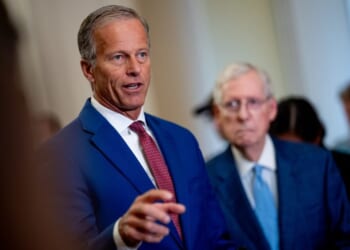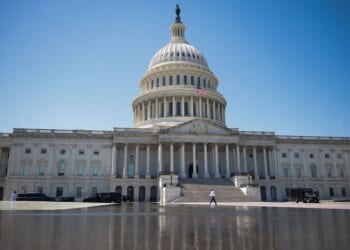
A big reason so many people voted to put President Donald Trump back in the White House was that he promised to drain the Swamp and end wasteful spending, putting Americans first. But as Congress works on passing the appropriations bills for fiscal year 2026, it is spurning many of the president’s proposed spending cuts. Meanwhile, as money is set aside for organizations that reportedly push left-wing propaganda and censor conservative voices, one federal agency continues to use taxpayers’ money to fund risky research. While some Republicans are actively trying to eliminate this type of funding, it seems others are enabling it.
National Endowment for the Swamp
The House recently passed a minibus in which it earmarked $315 million for the National Endowment for Democracy (NED), “a rogue organization that fuels global censorship and domestic propaganda,” according to Republican Rep. Eli Crane of Arizona in an X post. The Copper State lawmaker proposed an amendment to defund the NED, but the bill died on January 14, with the help of 81 Republicans who voted against it. Another 12 didn’t even vote.
 To get an idea of why somebody would want to stop funding such an organization, let’s look at some of the NED’s work. Keep in mind, its primary purpose is to promote democracy abroad. One of the ways it apparently tries to serve that mission is by occasionally holding “multi-stakeholder roundtables” that focus on “getting the next generation of activists involved in decision-making on key issues.” It also crafts policy goals, such as “Breaking Barriers: A Whole-of-Society Approach to Gender Equality in Media Development.” Annual lectures are another method the organization uses to spread its idea. Viewers at one in 2022 had the pleasure of listening to historian Anne Applebaum, staff writer at The Atlantic, speak “in utterly predictable and tedious terms about the need for government officials to stand up to people who engage in wrongthink, to prevent authoritarianism,” said journalist Chris Bray on his Substack Tell Me How This Ends.
The NED is supposed to be bipartisan, but its programs, events, and staff are rife with left-leaning activists who seem to have a vendetta against the GOP. Its board members have often “sought to delegitimize the Republican [P]arty,” explained The Heritage Foundation. “Through its grants program, the NED has supported development of the international ‘disinformation industrial complex’—including one grantee that sought to censor and suppress conservative speech in the United States in advance of the 2020 and 2022 elections.”
Other notable funding working its way through Congress includes $207 million each for the National Endowment for the Arts (NEA) and the National Endowment for the Humanities. The Smithsonian Institution is set to receive $1.1 billion. The US Agency for Global Media, which includes Voice of America, could get $653 million. Appropriators in both the House and the Senate have reached bipartisan agreements on eight of the 12 bills so far, with just under two weeks remaining until the January 30 deadline.
The number of Republicans voting to fund these institutions, programs, and agencies is a little surprising. It’s almost as if some are afraid of another 42-day government shutdown and just want to advance the bills and move on with their lives. “It’s now 2026, and we’re foolish as ever,” Rep. Crane said on X the day after his amendment failed. “The swamp is real, and it’s bipartisan.”
Batty Research
In another attempt to save millions of dollars and protect American interests, Sen. Joni Ernst (R-IA) and Rep. Paul Gosar (R-AZ) recently wrote a letter to Dr. Jay Bhattacharya, director of the National Institutes of Health (NIH), asking him to cancel more than $3 million in taxpayer funding for a live bat facility at Colorado State University (CSU). The grant would go toward researching and breeding bats to study infectious diseases and “zoonotic viruses, including SARS, SARS2 and MERS coronaviruses, and Ebola, Sudan and Marburg viruses,” according to USAspending.gov. Since 2016, the facility has received $12.9 million in federal funding.
Ernst has been sounding the alarm on this program for months. “We cannot allow any batty experiments of pandemic potential to be unleashed on our own shores,” she told The Washington Times in October 2025. “The world cannot afford another lab leak, especially one on U.S. soil or near our military bases.” Her concerns are not unfounded. White Coat Waste, a taxpayer-funded watchdog, uncovered dozens of lab accidents at CSU between 2020 and 2023, “with bats, cats, hamsters, and mice,” exposing “staff to coronaviruses, Zika, rabies, Tuberculosis, and other dangerous pathogens that can cause deadly outbreaks.”
The risk of funding this place seems to outweigh the reward – if there even is one. Yet Representatives Ernst and Gosar could have a steep hill to climb to get the facility’s appropriations canceled. An appeals court ruled on January 5 that the Trump administration can’t make steep cuts to federal funding provided to universities involved in scientific and medical research. If NIH Director Dr. Jay Bhattacharya can’t cancel the facility’s federal cash flow, it will likely continue to receive taxpayers’ money, especially since dozens of Republican lawmakers don’t seem as interested in cutting spending as they were during the DOGE days.
“Where is that enthusiasm now?” said Republican Rep. Mark Harris (NC) on the House floor after Rep. Crane’s amendment failed. “Why are we not continuing to slash waste, fraud and abuse?”
Congress no doubt has more challenges ahead. It still has to pass the Homeland Security funding bill, which is often the most difficult one. This time around, with all the controversy surrounding ICE, a clash is bound to erupt. Many Democrats have called for abolishing the agency, yet it’s hard to imagine a single Republican would vote for such drastic measures – at this point, however, who knows? That GOP lawmakers don’t always vote in lockstep, as Democrats usually do, can often disrupt the president’s agenda. But it also suggests that congressional Republicans have an independent agenda, a strength for the party that critics would say doubles as a weakness.