OAN Staff Cory Hawkins and Brooke Mallory
12:45 PM – Tuesday, January 20, 2026
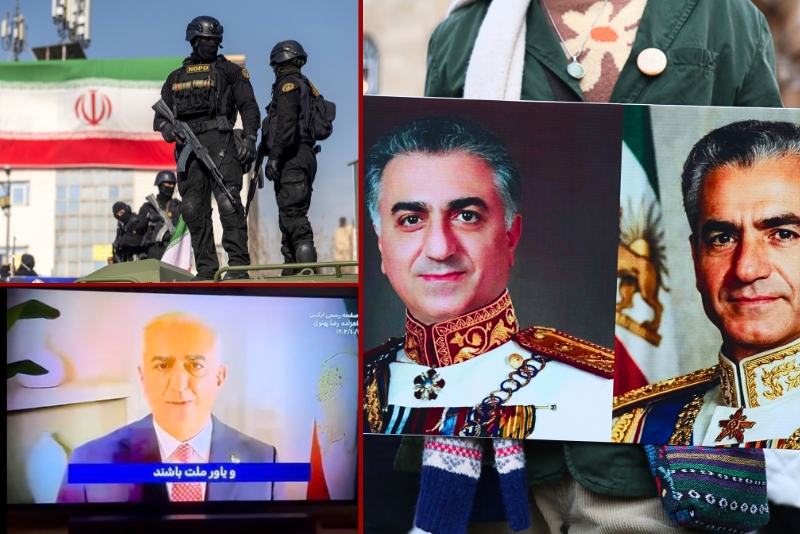
Hackers reportedly infiltrated multiple channels of Iran’s state broadcaster, the Islamic Republic of Iran Broadcasting (IRIB), disrupting satellite transmissions across the country, airing unauthorized content that expressed support for exiled Crown Prince Reza Pahlavi, while urging security forces to side with protesters.
The hack lasted approximately 10 minutes.
The recent cyber disruptions follow escalating anti-regime protests and unrest in Iran that rights groups and activist networks estimate have resulted in several thousand deaths amid a “government crackdown” on citizen dissent, with some estimates exceeding 4,000 fatalities.
However, many analysts have argued that what’s happening in Iran goes beyond “protests” and should instead be described as a nationwide uprising or a revolutionary moment.
The breach occurred during peak viewing hours across several IRIB satellite channels, abruptly replacing standard programming with a montage of anti-regime content.
The broadcast featured clips of Crown Prince Reza Pahlavi voicing support for the nationwide protests alongside footage of security forces surrendering. These visuals were paired with pleas for international intervention and a direct appeal to the military and police: “Do not point your weapons at the people.”
“This is a message to the army and security forces,” one graphic read. “Do not point your weapons at the people. Join the nation for the freedom of Iran.”
At another point, Pahlavi adds, “I have a special message for the military. You are the national army of Iran, not the Islamic Republic army. You have a duty to protect your own lives. You don’t have much time left. Join the people as soon as possible.”
The breach was a sophisticated technical operation, successfully infiltrating satellite feeds that reach a massive audience within Iran’s strictly controlled media environment. Despite a state-imposed internet blackout designed to stifle protest coordination, footage of the hijacked broadcast rapidly spread across social media via VPNs and satellite uplinks.
While the courageous perpetrators remain unidentified, Pahlavi’s office acknowledged the event without claiming responsibility. Analysts remain divided on the source of the breach, with speculation ranging from independent “pro-democracy hacking collectives” to more advanced state-sponsored cyber operations.
Pahlavi, the son of Shah Mohammad Reza Pahlavi, has lived in exile in the United States since the 1979 Islamic Revolution. While he declared himself Shah following his father’s death in 1980, he has increasingly transitioned his public identity toward that of a freedom advocate, championing a secular, representative government.
Pahlavi has expressed that he is not opposed to Islam as a religion or to people practicing it freely. His criticism is directed at political Islam and specifically the Islamic Republic’s system of clerical rule (velayat-e faqih), which suppresses individual freedoms, among other issues.
Throughout the current unrest, he has acted as a primary voice for the opposition, lobbying for international intervention with U.S. officials while framing the revolutionary movement as a struggle for national liberation. Pahlavi’s message remains centered on military defection, repeatedly calling on the armed forces to “join the people” and withdraw their support from the current regime.
Turmoil in the country sparked in 2022, following the death of Mahsa Amini, 22, a Kurdish-Iranian woman who was killed in police custody after she was accused of “violating hijab laws.” Her death ignited widespread “Woman, Life, Freedom” protests across Iran, initially over compulsory dress codes and quickly expanding into broader political dissent.
Tehran has yet to issue an official response to the breach, though the silence follows a familiar pattern for a regime grappling with persistent digital vulnerabilities. In 2022, hackers similarly infiltrated state broadcasts with anti-Khamenei messaging.
Meanwhile, the U.S. government’s current approach to Iran combines an aggressive “Maximum Pressure” strategy, revived and intensified under President Donald Trump’s second term through National Security Presidential Memorandum 2, with a carefully targeted exception known as General License D-2, which has been formally codified into regulation.
This dual policy deliberately creates a sharply focused economic environment. It imposes severe sanctions to deprive the Iranian regime of critical revenue streams, particularly from oil exports, petrochemicals, shipping, and evasion networks, in order to weaken its ability to fund nuclear ambitions, ballistic missile programs, proxy militias, and domestic repression.
At the same time, the regulation explicitly authorizes U.S. citizens and companies to export or provide certain internet-related services, software, hardware, and tools — such as messaging apps, social media platforms, video conferencing, cloud services, VPNs, anti-censorship technologies, and consumer devices like smartphones and laptops — to ordinary Iranian citizens.
This carve-out is designed to safeguard digital freedoms, enable uncensored access to information, support communication and organization among the public, and counter government-imposed internet surveillance and restrictions, all while continuing to prohibit transactions that would benefit the Iranian government.
By exempting essential technologies from broad sanctions, the U.S. ensures that tech companies can legally provide Iranians with the means to bypass state-mandated “filternets” and internet blackouts.
This approach aims to cripple the government’s ability to fund regional proxies or internal suppression while simultaneously empowering the Iranian people with the connectivity needed for freedom of expression and the documentation of human rights abuses.
Stay informed! Receive breaking news blasts directly to your inbox for free. Subscribe here. https://www.oann.com/alerts
What do YOU think? Click here to jump to the comments!
Sponsored Content Below