Over the past decade, a number of social democrats and left-libertarians have taken to claiming that open borders would be an unmitigated boon for any country that allows limitless numbers of foreigners into its territory. For example, open-borders advocate Bryan Caplan states that a failure to open borders is like leaving “trillion-dollar bills on the sidewalk.” In their pursuit of a vision for open borders that might strike ordinary people as remotely desirable, Caplan and other open-border activists put forward a thought experiment in which millions—or even billions—of human beings would relocate across nation-state borders over a span of a few years and in the process unleash the potential of the world’s economies.
In terms of economic theory, the assumption here is that there is a mismatch between the location of capital and the location of labor. If labor is allowed to move to capital in unrestrained numbers, that would make capital many times more productive than it currently is.
It’s an interesting thought experiment, but it unfortunately has little to do with reality. Open-border advocates like Caplan rely on theories in which the grim realities of geopolitics and democratic special interest groups don’t exist.
Moreover, open-borders advocates tend to reveal their real policy agenda in how they tend to focus overwhelmingly on pushing open borders only for powerful and wealthy nations. In other words, the open-borders crusade is really targeted at policymakers in wealthy Western countries alone.
Thus, these advocates tend to ignore the real world effects of open borders in places like Ukraine or the Baltics or Botswana or the Dominican Republic. For example, is the Dominican republic really leaving “trillion-dollar bills on the sidewalk” by not welcoming 10 million Haitians into the country overnight? Few can explain how the lives of most Dominicans would greatly improve from the abolition of the border between those two countries.
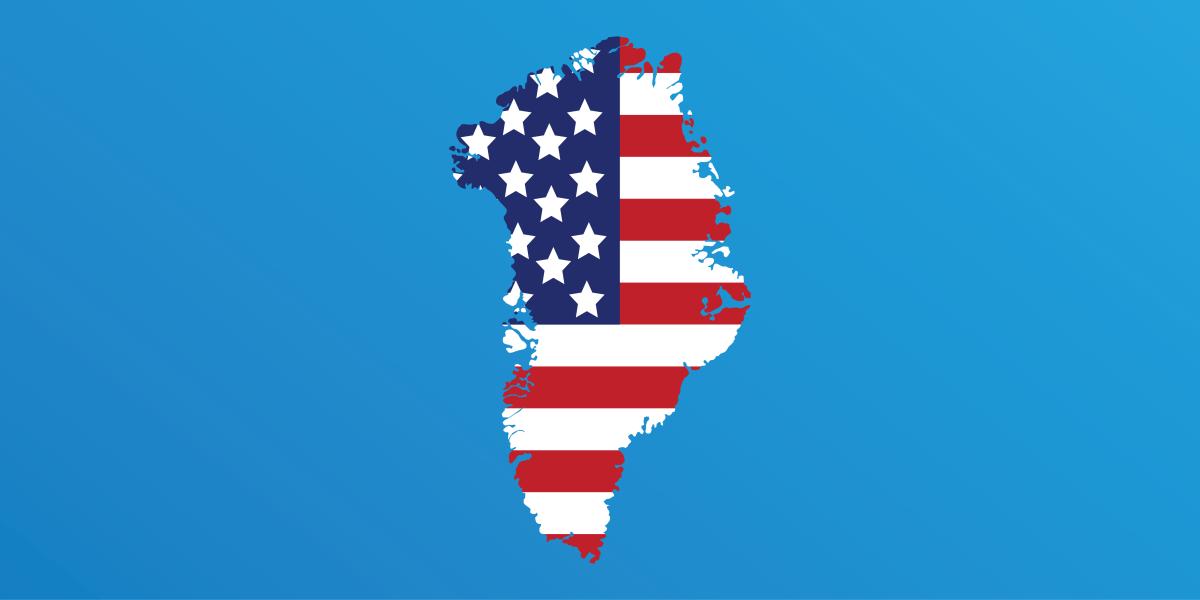
This then brings us to the case of Greenland. The general open-borders position is that if Greenland adopts an open border policy then the standard of living there will surge to never-before-seen new heights. While the Greenlandic economy relies in part on Danish subsidies, Greenland’s population nonetheless enjoys a relatively high level of per capita GDP. So, it should have no trouble attracting migrants from across the globe. Just imagine the riches they could enjoy if they opened their borders. As migrants from across the world flooded into Greenland over a period of months, those Danish subsidies would go much further as the cost of labor fell for producing Greenland’s fishing exports and service-economy output. The native population of 57,000 people might soon find themselves in the minority, but they would surely be enriched beyond their wildest dreams as national GDP increased.
Or it might not actually turn out that way.
In reality, were Greenland to adopt an open border policy, Greenland would quickly become a flash point for an international crisis. Global powers would immediately understand that the political fate of Greenland would be decided by the makeup of the new population as migrants flowed into the country unimpeded. Moreover, with such a tiny population of under 60,000, the democratic realities of Greenland could be greatly altered by the movement of just tens of thousands of people.
US President Donald Trump could hatch a scheme to pay his supporters to move to Greenland and become “citizens” there. Indeed, any number of larger countries larger states could simply send government employees (i.e., de facto troops) to squat there and demand citizenship. After all, under an open borders regime, there’s no control over who can settle there and call himself a new Greenlander.
The Danish state—which controls citizenship status in Greenland and wouldn’t want to look xenophobic—would then naturalize the new arrivals. At that point it will be a small matter to hold a plebiscite on the matter of Greenlandic sovereignty. The native population—which claims to want the status quo of membership in the Danish Realm—might not like how that election turns out.
Migrants as Political Actors
This counter-factual example helps to illustrate how the central problem of the simplified fantasy world of the open-borders advocates. It is the assumption that the political status quo would not be affected by the movement of large numbers of migrants who are all just as much political actors as they are economic ones.
That is, open-borders advocates usually assume that even if the population of a specific country were to quickly double in size due to migrants from other countries, the political status quo would remain largely unchanged. Indeed, Caplan appears to assume away any significant change to the economic system, implying that economic institutions would carry on as if nothing changed. All that would change is the supply of labor, and the native population would enjoy new managerial positions. Caplan tells us that as new migrants pour in, the native population would be “managing and training new arrivals, not competing with them!”
Now even if we had good reason to believe this in terms of economic theory, ceteris paribus, that is not how political realities work. Not even Ludwig von Mises, who tended to support open borders as an ideal, thought that open borders presented potentially catastrophic political challenges. This is why Mises noted that if Australia were to open its borders, immigrants would “inundate” the country and “If Australia were thrown open to immigration, it can be assumed with great probability that its population would in a few years consist mostly of Japanese, Chinese, and Malayans.”
Mises does go on the state that this in itself would not be a problem so long as there were only a strictly “liberal” government—by which Mises means a government devoted to near total laissez-faire—under which no portion of the population need fear political domination from another portion.
Yet, as Ralph Raico explains, it is unclear why Mises would think that the prevailing ideology and political system of Australia would somehow be immune from momentous changes in the makeup of the population. Raico concludes that this blind spot on the part of Mises stems from the fact that Mises does not appear to have ever employed a well-developed theory of how people and societies become supportive of private property and freedom in the first place. Obviously, not all societies support such things, so why did it develop in some places and not others? And would replacing a pro-property population with a population with entirely different views lead to the breakdown of pro-property institutions?
Raico writes:
Since Mises has no theory of what forces tend to create and maintain a liberal society — aside from incessant rational economic argumentation — he has no reason to suppose that an Australia governed at a certain point according to liberal principles would continue to be so governed. But if Australia should, by some chance, slip back into interventionism, then the “national minority [now Australians of European descent] must expect the worst” from the majority of Japanese, Malayans, etc. …
Free immigration would appear to be in a different category from other policy decisions, in that its consequences permanently and radically alter the very composition of the democratic political body that makes those decisions. In fact, the liberal order, where and to the degree that it exists, is the product of a highly complex cultural development. One wonders, for instance, what would become of the liberal society of Switzerland under a regime of “open borders.”
This brings us back to the issue of Greenland. The political views and institutions of the current population of Greenlanders is the product of a certain history and a certain cultural development. Obviously, were a flood of American or Chinese nationals to arrive in Greenland, it would be absurd to assume that the new population would assimilate to that—especially if the native population were reduced to a minority group. In other words, the very meaning of what it meant to be a person of Greenland would change almost overnight.
The Geopolitics of Immigration
The above scenario of an open-borders Greenland invents nothing new in the history of geopolitics and immigration. The United States, of course, spent much of its history encouraging migrants to squat in foreign lands and erect new political institutions that were in the service of the United States. This happened countless times in Indian lands, of course, but this Greenland scenario is essentially identical to what happened in Texas in the years leading up to the independence movement there. Mexico opened its border effectively unrestrained settlement from the United States, and the native population of Hispanic Catholics was soon overrun by Anglo Protestants. A similar phenomenon occurred in West Florida.
In each case, migration adjusts cultural and political realities to the advantage of one nation-state over other polities.
This method of gradually adjusting international borders via migration has been pioneered in modern times by the “passportization” process sometimes employed by Moscow in eastern Ukraine. In this way, ethnic Russians living near the Russian border in foreign countries are granted Russian citizenship and given Russian passports. Under an open -borders regime, these newly naturalized foreigners could easily be augmented by new arrivals. Some have suggested that China may eventually employ a similar tactic along the Russia-China border as described in the Hudson Institute’s report “The Great Siberian War of 2030.” Extrapolating from the report’s observations on the Siberian borderlands—dividing Russia from a far-more-populous China—it becomes apparent that a Russian open-border policy would quickly expand Chinese geopolitical influence in the region at the expense of the Russians.
Strangely, we don’t hear much in the way of advocacy of open borders in Ukraine from the open-borders activists.
To his credit, Mises saw the potential problem that immigration poses in a world of competition among sovereign states. Writing in Omnipotent Government in the days of National Socialism, Mises warned: “the maintenance of migration barriers against totalitarian nations aiming at world conquest is indispensable to political and military defense.”
Nearly 20 years after his comments on Australia and migration in Liberalism, Mises sees the political repercussions of large-scale immigration and even the potential for expanding state despotism via migrating populations. Obviously, this is not a problem of markets, and it has always been true that there is no economic argument against immigration. However, there are many forces at work other than market forces and this is well demonstrated by the geopolitical realities surrounding Greenland.