The post-WWI map of the Middle East briefly looked very different from the one that was to gain a patina of semi-permanence. The Ottoman state, having lost the war, was divided up by Western powers in 1920. Among the minority nations who were given a taste of autonomy under Western rule were the Kurds. Turkish nationalists rebelled and this time were successful in their more limited ambitions; a new treaty in 1923 inaugurated a Turkish state—at the Kurds’ expense.
The phrase “at the Kurds’ expense” would become a familiar one. This week, Western powers would continue their century-plus tradition of seeking stability at the Kurds’ expense.
In essence, recent events are the result of simple power politics and the Trump administration’s prosecution of its foreign policy along those lines.
President Trump tends to favor the stronger party in any conflict, or at least tends to give the stronger party more latitude in finishing the fight. This sometimes works against America’s traditional allies—Ukraine, for example, and this week the Kurds. It’s a form of leading from behind as applied to Trump’s unsentimentalist approach to conflict resolution.
The Kurds have held semi-autonomous regions in Iraq and Syria and their militias were instrumental in the American war on ISIS. Thousands of Kurds died in the war and many more continued to put their lives on the line guarding ISIS prisons.
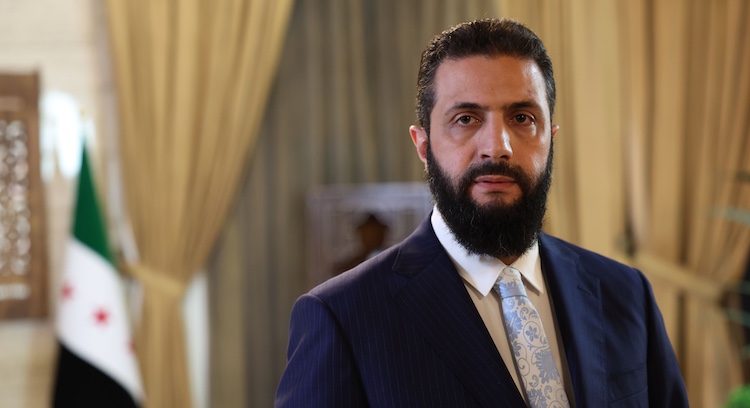
Full Kurdish independence has never seemed just around the corner, but the working assumption was that the U.S. would never diminish Kurdish sovereignty, even if we couldn’t bring ourselves to expand it. That policy survived the Syrian civil war and the fall of the House of Assad, but it died this week in favor of aiding Ahmed al-Sharaa’s consolidation of power in the new Syria.
Sharaa is an exemplar of win-and-you’re-in geopolitics. Had his militia, which had its roots in an al-Qaeda offshoot, failed, Sharaa would have been immediately forgotten by history. Instead, he led the coalition of rebels to victory over Damascus and, now, has received U.S. backing and the lifting of sanctions. Sharaa has traded fatigues for tailored suits, like many an erstwhile rebel before him.
Since overthrowing Assad, Sharaa has struggled to consolidate power. There are patches of Kurdish land in Syria’s northeast and a Druze stronghold in the south with ties to their Israeli cousins across the border.
Last year, the Syrian Democratic Forces—the main Kurdish militia in the war against ISIS—agreed in principle that its fighters would be absorbed into an overarching national army. In return, official state discrimination against Kurds would be eliminated and they would be permitted to retain a remnant of local self-governance. That integration floundered.
Two weeks ago, according to Reuters, Syrian officials pitched an offensive in Kurdish areas and the U.S. offered no objections. Through Turkey, a message of American approval reportedly followed—as long as civilians were protected.
Last week, U.S. envoy Tom Barrack “met with SDF commander Mazloum Abdi in the Kurdistan region of Iraq and told him that U.S. interests lie with Sharaa, not the SDF, the three sources said.” The U.S. only sought to restrain Sharaa when his troops went beyond agreed-upon lines. Sharaa announced a temporary cease-fire on Tuesday, and Barrack released a statement officially throwing the Kurds under the bus: “the original purpose of the SDF as the primary anti-ISIS force on the ground has largely expired.”
A Kurdish official raged: “What the coalition forces and American officials are doing is not acceptable. Are you truly lacking in principles? Are you so willing to betray your allies?”
The answer is, sadly, yes. After all, Syrian state-building is only one of two major points of interest for the U.S. The other is the fight against ISIS, which is contained but not eliminated. The Kurdish forces proved themselves willing and capable allies in that fight. What’s the evidence that Sharaa’s forces can simply step in and manage the same role as effectively? Sharaa’s fighters are more vulnerable to the malign influence of Turkey and more dependent on the Saudis than were the Kurds. If Sharaa fails, either the U.S. will have to put boots on the ground or ISIS will replace our Kurdish allies in those areas instead of Syrian troops. The possibility of a Kurdish insurgency isn’t entirely out of the question in that scenario.
Perhaps it’ll all work out, but Sharaa has yet to earn the trust that the Trump administration is putting in him, and Barrack seems blind to the pitfalls of Turkish influence inside Syria and around the Middle East. Trump’s love of the strong horse may weaken the U.S. this time.