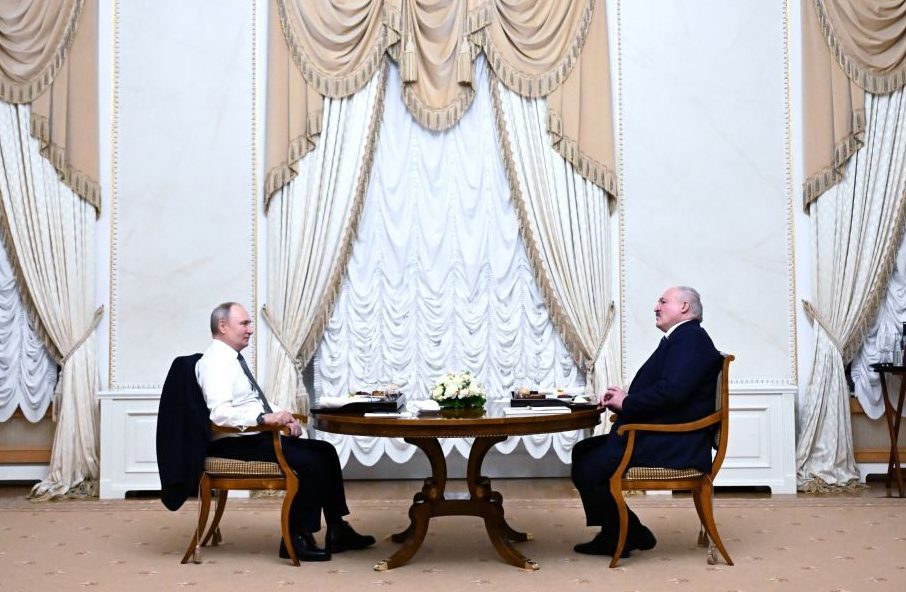
Belarus is often thought of as a sideshow in the politics of Eastern Europe — a foregone conclusion, a tragic throwback. The nation’s post-Soviet recovery was cut short by Alexander Lukashenko, a dictator in the Soviet mould — and by a Russia that was more than willing to smother its smaller neighbour within its suffocating embrace.
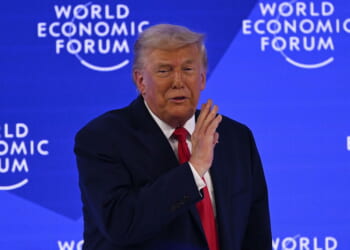
But Belarus’s eager acceptance of Donald Trump’s invitation to be a founder member of his Board of Peace — “one of the most consequential bodies ever created in the history of the world,” apparently — tells a different story. Lukashenko has always been deft at playing Russia and Europe against each other for his own benefit and these skills ought to serve him well in any new Trumpian world order. Not only is America newly receptive to authoritarian leaders like him; the prospect of now playing America off against its former European allies and meanwhile assuming a key role within the new Russian world will play to the strengths of a leader who is a far cannier political operator than is commonly assumed.
It is, after all, no accident that Lukashenko, now 71, is the most enduring political survivor in the Russian sphere — no small feat in a landscape full of car bombs, plane accidents, and defenestrations. Indeed, in February 1997, while Boris Yeltsin was recovering from heart surgery, Lukashenko almost became leader of Russia itself.
Six years on from the collapse of the Soviet Union, Russia had bid farewell to one political order, but had yet to give birth to the next. Yeltsin’s popularity was floundering. In a bid to exploit the wave of lingering Soviet nostalgia among the Russian masses — and to show strength as several former Warsaw Pact states joined Nato — Yeltsin made a play to pull Belarus even closer into Russia’s orbit. He set in motion the creation of the “Union State”, a confederation between Russia and Belarus that was supposed to inspire the likes of Kazakhstan and Ukraine to deepen their reliance on Moscow too.
Lukashenko, who had quickly consolidated power in Belarus after winning the first (and thus far only) free and fair election in the country’s history in 1994, had other plans. He and his deputies drafted up a treaty that effectively gave Lukashenko perpetual control of the Supreme Council of the future Union State — a kind of reverse takeover that meant he would succeed Yeltsin at the head of Russia’s political hierarchy.
“What the drafters came up with essentially meant one thing: Russia was losing its sovereignty,” Yeltsin later wrote in his memoir. In a diplomatic flurry of existential proportions, the Russian leader dispatched his officials to Minsk to intercept the document and talk Lukashenko out of his plan. It took an entire night of negotiations — and according to Yeltsin, lots of liquor — to get the job done.
Lukashenko only truly gave up his designs on the Kremlin once Putin rose to power in 2000 — and the Union State treaty that he ultimately signed has mostly been used by Russia as a means to absorb Belarus rather than the other way around. However, Lukashenko’s ambitions of power and influence have persisted in other, more subtle forms. And as Trump has laid the groundwork for an American rapprochement with Moscow over Ukraine, the Belarusian strongman has found himself on the precipice of yet another generational inflection point. American interests are reorienting away from Europe; and the rise of a new transactional, Trumpian logic in international affairs is reshaping not only America’s role in the world, but Russia’s as well.
Naturally, Lukashenko has jumped at the chance to get in on the action. Belarus’s place on the so-called Board of Peace is the clearest evidence yet of a thaw with Washington — the first since 2020, when Europe and the US ousted him from their good graces following his brutal crackdown on anti-government protests in Belarus. Last year, through several deals with the US, Lukashenko traded 175 political prisoners for sanctions relief, most recently releasing 123 people including several high-profile activists and politicians in exchange for the elimination of American sanctions on the critical Belarusian potash sector.
The immediate benefits to his regime are obvious — an opening for renewed trade with the US and diplomatic legitimisation on the world stage, with Lukashenko positioning himself a one-of-a-kind liaison to the Kremlin during any peace process between Russia and Ukraine. But despite his frequent chest-thumping, Lukashenko is no Trump, and his designs go far beyond short-term dealmaking. As a new world order is born out of the tragedy of Ukraine, Lukashenko understands that not only that Trump might end his ostracism from the West, but that this is his best shot to transform himself from Putin’s underling into his right-hand man.
“This is his best shot to transform himself from Putin’s underling into his right-hand man.”
And a Russo-American grand bargain would do more than allow Lukashanko to ride to freedom on Putin’s coat-tails — it would allow him to make deals with the Americans on his own terms. At the same time, by engaging with Trump and continuing to harass the EU, Lukashenko can drive an even deeper wedge between the US and its former European allies — thus creating the foundation for a new order. The EU, with its lofty goals of democratisation and justice in Belarus, will be left out in the cold. An agnostic US will meanwhile build new ties with Lukashenko and a newly victorious, post-war Russian sphere.
Despite being a pariah on the continent for the better part of 25 years even before 2020, Lukashenko had been surprisingly effective at maintaining ties to liberal Europe — while doing comparatively little to reform his dictatorship in return. Time and time again, the EU allowed itself to be deceived by Lukashenko into thinking he could change — a naïveté that he exploited to keep his masters in the Kremlin far enough at bay to keep them from swallowing him whole. In 2008, having watched Putin’s tanks roll into Georgia, Lukashenko secured a window to the West for himself by freeing several political prisoners, leading the EU to lift a travel ban against him — only to spark Brussels’ ire anew by violently suppressing post-election protests in Minsk two years later. In 2015 the story repeated itself. Lukashenko came under pressure from Putin to establish a Russian military base on Belarusian territory, leading him to release more prisoners in exchange for the EU unfreezing his assets and eliminating other sanctions. While Belarus and Russia were in the midst of an oil and gas dispute in 2019, Lukashenko visited Vienna, marking his first visit to the EU in years.
The house of cards came crashing down in 2020 when Lukashenko’s crackdown on post-election protests transformed both Belarusian society and his regime. Feeling more threatened than ever by his own people, Lukashenko pursued his enemies with relentless fury, infamously forcing a Ryanair passenger plane to land in Minsk to arrest Belarusian activist Roman Protasevich who was on board.
For Europe, this was the final straw, and Lukashenko has found himself permanently locked out of the West ever since — more at Putin’s mercy than ever before. And while his 2020 crackdown allowed him to hold onto power in Belarus, he paid for it by watching his worst nightmares about Russian power in Belarus manifest before his eyes. Despite having broken with the Kremlin line on Crimea in 2014, calling it a “bad precedent,” Lukashenko now had no choice but to allow his country to be used as a staging ground for Putin’s full-scale invasion of Ukraine in 2022, and thus a co-aggressor. Although he resisted pressure to conscript Belarusians themselves to join the war, in a major move, he allowed Russia to station nuclear-capable Oreshnik ballistic missiles in Belarus late last month.
Of course, Lukashenko is hardly interested in the welfare of Belarus as a country — and only cares about the instruments of its state insofar as they allow him to achieve his personal goals. As a product of the Soviet bureaucratic machine, he has always ultimately seen Moscow as his centre of gravity — and despite his distrust of Putin, he has played the part of his enforcer well.
Now that the Trump administration has arrived on the scene with offers that Europe is no longer willing to make, Lukashenko has bifurcated his policy toward a divided West. Washington, rather than Brussels, is now his insurance policy against Putin. Even while drawing closer to Trump, Lukashenko has continued to antagonize the EU, triggering a state of emergency in Lithuania last month after sending smuggler balloons over the border. In effect then, by courting the Americans, Lukashenko has been helping Putin articulate an ultimatum to the EU. Sanctions on Belarus and Russia and support for Ukraine will be met with grey-zone warfare and instability along Nato’s frontier. Legitimisation, sanctions relief, and negotiation with the Kremlin via Minsk will be met with business opportunities, humanitarian releases of Belarus’s oppressed — and peace along Europe’s frontiers.
Meanwhile, like two lovers stuck in a bad marriage, Putin is nearly as dependent on Lukashenko as he is on him. The Belarusian leader has done everything in his power to underscore this fact since the start of the war in Ukraine — in 2023 after all, Lukashenko negotiated a deal between the Kremlin and Yevgeny Prigozhin during the latter’s march on Moscow, casting himself as Putin’s saviour.
And within Trump’s imagined new order, Lukashenko sees a place for himself as an equal to the Russian leader. Moscow is hoping to reestablish its influence on its “near-abroad” after the dust settles in Ukraine — and as Putin’s most important international ally, Lukashenko already forms the lynchpin of the Russkiy Mir (that is, the Russian world). He has already done his best to support loyal regimes like Georgia’s and to corral wayward allies like Armenia and Kazakhstan back into the flock.
And despite thumbing their nose at him a few years ago — Kazakhstan’s President Qasym-Zhomart Toqaev called Lukashenko’s suggestion that his country join the Union State a “joke” in 2023 — these states seem to have reluctantly come around to the notion that they will have to continue appeasing the Russian bully one way or another. Kazakhstan and Belarus strengthened their military ties in 2025 less than a year after Lukashenko chided his Kazakh counterpart for not being more involved in Russia’s war in Ukraine. The Armenian Prime Minister Nikol Pashinyan once said he would never visit Belarus as long as Lukashenko reigns; nevertheless the pair met and shook hands in Moscow last year.
Of course, all of this is only made possible by Lukashenko’s Orwellian oppression of the Belarusian populace — which goes beyond even Putin’s authoritarian chokehold on the Russian masses. The prisoner deals with the EU and now Trump have taught Lukashenko that imprisoning his own people not only helps him stay in power, but gives him a bargaining chip. “We are basically goods for sale,” said the Nobel Peace laureate Ales Bialiatski who was freed as part of the most recent prisoner release in December. Moreover, with over 1,100 political prisoners (and counting) still behind bars in the country, Lukashenko still has plenty of human “goods” to sell the West. Once he runs out, he will surely arrest more to keep the train rolling.
Naturally, given its borders with three EU countries, Belarus still needs Europe. Trump’s recent removal of sanctions on potash means little if Belarus has no means to export them. And however desperate Putin may be, sharing power is not something he has ever been keen on — especially with a fair-weather friend like Lukashenko. But the world is changing and the Russkiy Mir is changing too. Putin is tightening his belt. The war in Ukraine has now stretched on for longer than the USSR’s Great Patriotic War against the Nazis. He will need a stable bulwark as he reconstitutes his forces and his political capital — and Lukashenko will doubtlessly be there to save him once again. Indeed, the Belarusian dictator will have secured the very balance he has always desired: power beyond his own borders, plus his own fiefdom, army, and intelligence services within them.
Whether this dream ever manifests is anyone’s guess — and it will depend enormously on what the world looks like once the guns fall silent in Ukraine. Moreover, it is hard to imagine Lukashenko could achieve this without further sacrificing Belarus’s independence. But Lukashenko changed his calculus after 2020 and he may be happy to do the same again, so long as he finds himself where he has always wanted to be — in the halls of power of the former Soviet world that molded him. Yeltsin may have stopped Lukashenko from taking over Russia back in 1997. But he was never able to stop him from trying to restore his place at the heart of the Russian world.