Mythology does not record whether Cassandra, whose double curse was the gift of prophecy fated to be ignored, felt at least some glimmers of satisfaction as her city of Troy burned around her. On the evidence of Davos, perhaps her penultimate indignity, before capture and death, was to watch those who dragged the wooden horse within the walls, against her fervent warnings, pose, too late, as hard-nosed sceptics of Greek magnanimity.
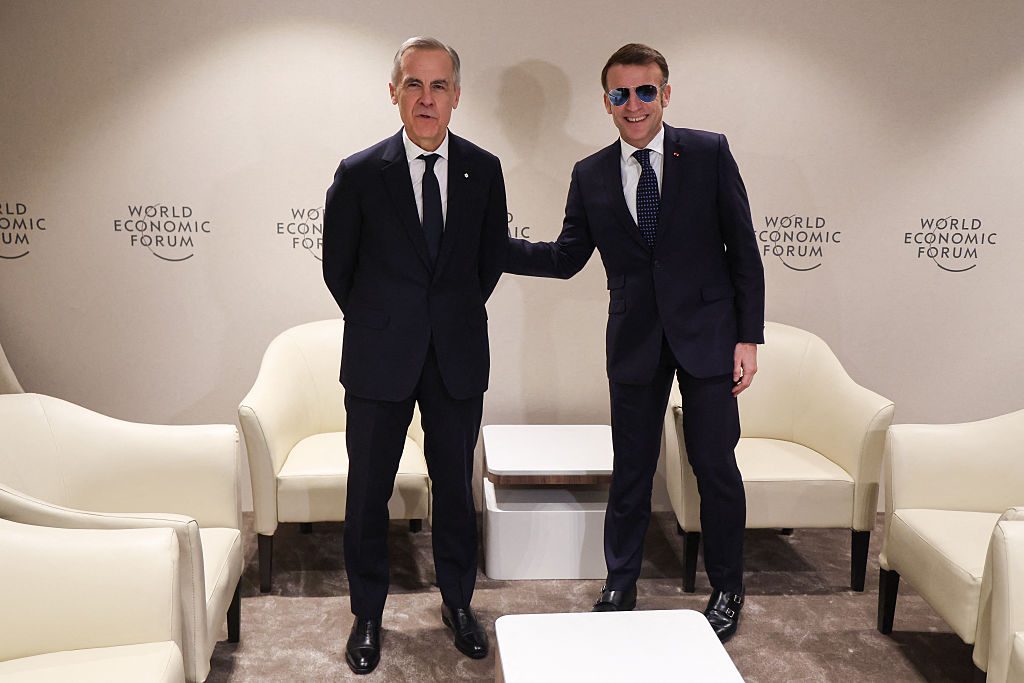
It is hard not to empathise with Macron — longstanding and much-mocked critic of Europe’s dependence on the United States; prophet of our mother continent’s strategic autonomy — as he was forced to watch the former handmaiden of transnational globalisation, Mark Carney, win plaudits for his speech declaring that the rules-led global order was always a fiction, and that economic interdependence has become “the source of your subordination”.
Carney’s speech, excellent though it was, and destined for the reading lists of IR undergraduates yet to be born, nevertheless performs the function of permitting centrist liberals, far too late, to adopt the positions they until yesterday feared and vilified. Inevitably, we must endure the podcast from the Iraq War propagandist and the failed occupation governor earnestly informing us that the liberal order is fake and America’s empire is harmful. Yet it is fruitless now to complain that our leaders are weak, slow-witted, and negligent: had they been otherwise, they would not have been elevated to their role in Washington’s imperial system.
A clearer assessment of our place in the world was given, if unintentionally, by the European leaders at Davos, when Belgium’s Prime Minister sadly declared that “being a happy vassal is one thing, being a miserable slave is something else”, as if this were a meaningful distinction. Like Orwell’s analysis of Dickens’s politics, observing that the novelist’s lament was not the fact of exploitation in itself but that the factory owner was insufficiently benevolent to his proles, America’s regional branch managers in Europe chafe not at the fact of their servitude, but at its worsening terms. When Nato chief Mark Rutte’s obsequious text message to Trump was leaked by his graceless master, we understood that their current shame is that they are now being made to kneel in public, and not grovel, as before, in private comfort.
Carney’s speech explicitly likened the non-American West’s position today to that of the subjects of a Soviet satellite state before 1989, an analogy that would once have been mocked as provocative contrarianism by those who today applaud him. It is like watching the functionaries of an Eastern European politburo declare themselves market liberals when the winds whipping about them became too bitter to ignore.
It is worth considering, then, whether Keir Starmer, or whoever replaces him, can be considered a more functionally independent ruler than a figure such as Aleksandr Lukashenko. In preserving his personal fiefdom, Lukashenko has, after all, managed to evade his country’s active involvement in Russia’s imperial wars — a feat beyond the abilities of our own rulers. Whatever his personal inclinations, or the desires of his supporters, there is little prospect of Starmer joining any meaningful or concerted European pushback against Washington’s coercion of Denmark to cede its sovereign territory. Over decades, Britain’s security elites have sought to make themselves indispensable to America — in reality settling on a form of commensalism, like the fish that live inside sharks’ mouths feeding on the detritus of their host’s meals, peering out at the world with the optical illusion that they are themselves the fearsome arbiter of the deep. This superficially advantageous viewpoint has fostered a dangerous British appetite for risk. Like Poland and the Baltics — which at least have history and geography to justify their unwelcome dilemma — Britain’s resultant, excessive exposure to the Ukraine War has deepened its already worrying and sovereignty-eroding dependency on America’s security umbrella.
Like Europe as a whole, only dangerously far more so, Britain’s Ukraine strategy was of cajoling America into a far more assertive posture against Russia than anyone in Washington, of either party, desired, occasionally leading the way to show that the path is firm. Yet the coalition of the willing has proved, unfortunately, far more willing than it is able. As long as that remains the case, Europe and particularly Britain find themselves, through fear of Russia’s vengeance, more tightly bound within America’s own imperial designs. The proposed British deployment to guard the territorial integrity of a post-armistice Ukraine is essentially a weak and overstretched tripwire force dependent on the hope that, should Russia attack or confront it, the US will immediately come thundering to its rescue. Given that, in the actual real world in which we live, European nations are deploying troops to guard European sovereign territory from American annexation, this is not a robust planning assumption. Without the certainty of American support, the mooted deployment does not help Ukraine, endangers Britain and deepens our dependency on Washington’s capricious favour. The errors of over-confidence, old and new, have not only left us dangerously exposed to an escalation we cannot match but entirely at America’s mercy.
The options facing Britain now are few and unpalatable. Even if desirable, placating the US is impossible when its orders are self-contradictory and incoherent. Trump’s last set of demands, for increased European defence spending, were interpreted, perhaps accurately, as a shakedown for increased purchasing of American materiel. Yet, as the Danes are surely learning, logistical and technical dependence on Washington is of little value when Washington is itself the aggressor. Theoretically, Britain could hedge against American domination through deepened collaboration with a more sovereign Europe, yet the EU’s current structure of diffuse sovereignty, a recognition that it is a body composed of multiple countries with divergent interests, explicitly designed to smooth and regulate a world of trade dependent on American hegemony, leaves the continent a sleeping giant without a brain.
In its current form, the EU cannot long sustain a coherent course of action, and lurches from crisis to crisis, both self-made and imposed. One path for European middle powers is the essentially amoral balancing act shown by Hungary, juggling great power sponsors and foregoing an outward-facing foreign policy. Another is shown by Turkey, pursuing a similar balancing act at the interstices of imperial rivalries, but in pursuit of an aggressive and expansionist foreign policy. Both methods have proved successful, in their own ways, not least in prolonging the rule of their leaders: over time, rather than anomalies, such paths of naked self-interest are likely to become the European norm. As another European strongman playing-off empires against each other, Serbia’s Aleksandar Vucic soberly cautioned at Davos of the Greenland crisis: “This will happen again, but it will be deeper and more problematic, and everyone will have to take care of their own interests.” Even now, as the United States pursues its own diplomacy with Russia over Europe’s head, Poland and the Baltic states are too invested in the Atlantic alliance — for reasons as much sentimental as rational — to confront their sponsor in the shared interests of Europe as a whole. As Poland re-arms, it will in time assume the ability to pursue a more sovereign foreign policy, but it will also struggle to persuade Madrid or Rome into a posture of eternal confrontation with Moscow.
“The options facing Britain now are few and unpalatable.”
The current logic of the EU then, just as predicted by Sumantra Maitra’s prescient and influential “dormant NATO” paper, is for subsidiary, tactical and perhaps ephemeral alliances among regional nation-states to pursue their divergent interests. One glimpse of what this might look like can be seen in Greece’s pursuit of a deepened defence relationship with Israel, hedging against the increasingly revisionist and aggressive Turkey which Nato collapse will embolden through allying with non-Nato partners. It was, after all, Greece and Turkey’s brush with war in 2020 that first elicited Macron’s assertion that Nato was “brain dead”, a statement of fact derided at the time by those who would then confidently assert that the Ukraine war had revitalised the alliance. Rather than with the EU as a whole, one feasible route for Britain is therefore pursuing bilateral or “mini-entente” alliances with select European partners. In this context, Britain’s refusal to join France and Italy in negotiating directly with Russia looks untenable. An act of superficial British resolve, its real-world consequences of leaving British and European interests in Washington’s fickle and increasingly malicious hands is not a productive path forward.
The hard truth is that decades of past errors have limited Britain’s choices, leaving dwindling room for independent manouevre. Yet our current errors of timidity and path dependency, particularly the default strategy of waiting for a more benevolent American master, are set to compound these mistakes, checkmating our future as a sovereign state. To claw back some vestige of sovereignty, Britain first of all requires a drastic rethink of its Ukraine strategy, a risky course embarked upon years ago in a very different world. Much of the previous Ukraine discourse, such as holding out for Nato membership or firm American security guarantees for Ukraine, has already been rendered obsolete by the dwindling value of either, as Sweden and Finland are rapidly learning.
A Trump administration, happy to use Europe’s fear of defending itself against a revanchist Russia to extract territorial and other concessions from its subordinate clients, has no real urgency to conclude the war. Yet until the Ukraine issue is resolved, Britain has no realistic option to carve an independent path or hedge against America’s increasingly onerous demands. It is difficult, without washing our hands of the matter entirely and retreating to quiet isolation, to think of a satisfactory route out of this dilemma. At the very least, home defence should become a far greater priority to British planners than any lingering dreams of defending America’s Pacific empire: basking in the reflected glory of world hegemony has already proved harmful enough.
Rather than enhancing British power, as decades of policymakers assumed, Britain’s slow descent within Nato from a partner to a client state has served to constrain our actual sovereignty. If Denmark is “irrelevant” to deciding the future of its own territory, as the US Treasury Secretary declares, or Canada exists at America’s mercy, as Trump menacingly asserted at Davos, then what does the future hold for Britain? As the current crisis proves, Britain will not defend Denmark nor, when the time comes, Canada, against American coercion because it cannot, and so is functionally less independent than either.
Everything desperately said of Greenland to stave off annexation — that America is already sovereign de facto, and can expand its bases, and pour in troops unhindered — is just as true of Europe, and Britain as a whole. Trump’s repeated declaration that it is not worth America defending territory it does not fully possess implies, as the least alarming interpretation, that Nato’s Article 5 mutual defence clause is already defunct. Yet, showing their customary foresight, European security wonks are celebrating as a victory for European resolve the precedent apparently now being set that US bases on European soil can overnight become American sovereign territory, while European leaders squirm at their helplessness being exposed to world derision. Yet Trump has burdened them with no new chains they have not previously competed for as honours. Europe’s subordination is the fruit of all the glittering prizes and titles, thinktank fellowships and security conferences that Washington offered them. Men will fight long and hard for a bit of coloured ribbon, Napoleon remarked. America’s innovation was realising that a continent can be bought with lanyards.