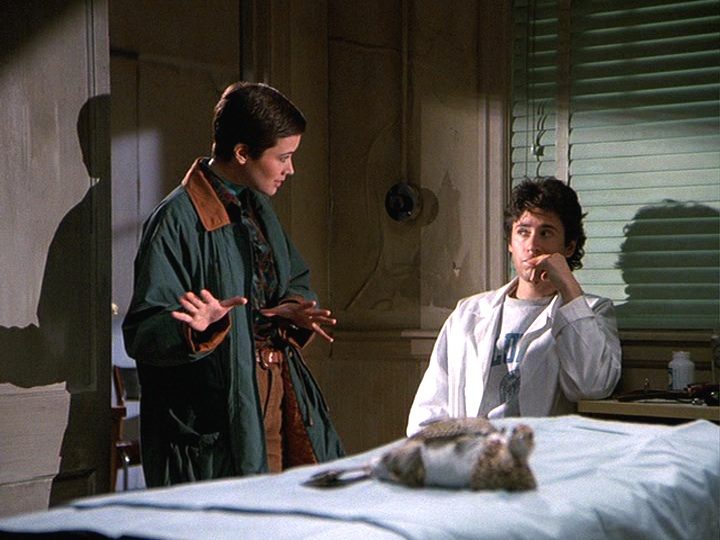
There is an episode from Northern Exposure, the Nineties TV show, that has forever lingered with me. In it, New York doctor Joel Fleischman goes hunting with his Alaskan friends, Chris and Holling, hoping to prove to the beautiful but hard-edged Maggie that his urbane view of hunting’s cruelty is the correct one. But instead of feeling distaste, Joel feels a rush of pleasure when he makes his first kill: a duck. When he and his friends go to retrieve it, he is horrified to discover that it’s still alive. “You’ve winged him. Finish him off,” says Holling casually. “What? How?” asks Joel. “Why, wring his neck,” replied Holling. “With my hands?!” Joel is in crisis. The next scene shows him rushing into his doctor’s office, with the wounded duck on a make-shift stretcher. “Sterilise the sheets!” Joel calls out to his assistant.
Dr Fleischman rather eccentrically operates on the fowl, trying to remove the buckshot. But the bird dies. And Joel is despondent. At the local bar, he is consoled by the waitress, Shelly. “When things get gnarly, Dr Fleischman,” she says, “it’s best to do the sad thing. Don’t be afraid to salt your oatmeal with your tears.” The fact is, Joel loved hunting: the primal experience of tracking his prey, of being outdoors, of sleeping under the stars. “And the killing,” he tells Shelly, “The killing was the best part. It was the dying I couldn’t take.”
I think of that line each time I hear about Canada’s MAiD policy which is vigorously putting an end to dying. There is a clear distinction between killing and dying, and between dying and death. In that episode of Northern Exposure, the bloodlust of killing is turned to compassion when Joel encounters the dying bird. Dying elicits his compassion in a way that death does not. Death causes grief, but bearing witness to dying moves him deeply. The Greeks had a few words for compassion. What Dr Fleischman seems to experience is splagchnizomai, which means literally to be moved in your bowels. This gut-wrenching compassion can spur one into unexpected action — such as operating on a wounded duck.
Perhaps this old episode has stayed with me because it is interwoven with my memory of my grandmother’s dying. It was slow. She had many strokes, but she had a strong heart. She lingered, and she suffered, and the family suffered, too, as we watched. I was 13, and then 14. My mother would insist that I visit her. It was frightening and depressing. Grandma would usually be unconscious. Her mouth would hang slack. She was skinny, and her breathing was always raspy. Occasionally she would be awake. But she couldn’t speak. I am not sure if my being there had any measurable effect on her at all. It may even have disquieted her.
But being there had an effect on me. There are not many places a teenage girl would less rather be than in a hospital by the bedside of a dying old lady. It smelled. I would hear other patients moaning. I felt awkward. Painfully so. Do I hold her hand? Talk casually? Remind her who I am? During these visits I acutely felt the desire to flee. If splagchnizomai is about being moved to action as a gut-response, I was being moved to avoid the suffering. But I could only sit there. It was a long wait to the end.
Those awkward, painful moments deepened me. I didn’t grow comfortable with suffering, but I grew comfortable with being uncomfortable. I was obliged to witness suffering, which is distinct from the pain of grief, and so her dying laid a demand upon me. It forced me to be connected to her, to suffer with her. It compelled me to learn about duty. I’ve realised, only in hindsight, that this burden was a gift. I learned, in part, how to suffer, and that suffering should not be done alone. There are more important things than ease.
A friend of mine who works as a chaplain at a Canadian hospital spends his life doing such sitting. He is witness to about one death a day. Most dying, he tells me, is like my grandmother’s: slow. Very often it is even gentle. Still, we don’t all die well, he’ll tell you. We die as we have lived. If you are bitter and resentful in life, you will be more so during your dying. If timid, more timid. If loving, more loving. Dying is frightening, and when we are afraid, we retreat into what is familiar.
When patients speak to the chaplain, they do not typically speak of the pain of dying but that of living. He hears about the sting of betrayal, the hurt of being wounded by someone you love. He hears of the pain of being misunderstood, overlooked, and left bereft. He hears about ordinary, heartbreaking loneliness. And he hears about the torment of guilt, of the wrongs we have inflicted on others. We feel the burn of shame, the ache of remorse. We often endure our own failings only through the dull consolation offered by self-delusion. “Life is pain,” as the classic line goes, “anyone who says differently is selling something.”
We need to be comforted for our living as much as for our dying. And we don’t want to endure the living or the dying alone. When it comes to that, all living is a movement towards the grave, and dying is a kind of intensified living. It only appears that some of us aren’t dying, as my chaplain friend says. Really, he says, we are one body, falling toward death together.
“We need to be comforted for our living as much as for our dying.”
He is not the first to say this. John Donne wrote vividly of dying as a kind of urgent, heightened form of being alive. He was no stranger to death, burying five of his children, as well as his beloved wife Ann, only 33 years old. And in 1623, he grew dangerously sick himself, suffering for 23 days. As he lay near death, he would read the countenance of his physicians for signs of relief or worry (he finds mostly worry) as he submits to their increasingly desperate treatment, such as affixing spatchcocked pigeons to his feet to draw the humours away from his head. He grew in his love for his physicians as they cared for him.
The pigeon-slippers seem to have worked. Donne did not die of this illness; he lived another 10 years. Later, when he was truly dying, he wrote and preached his final sermon: “Death’s Duel.” It is his own funeral sermon, and its focus is on death. It is very different from the reflections he wrote on dying, Devotions upon Emergent Occasions, which he rushed to print in 1624 as he felt that his dying reflections would be a gift to others. In Devotions, Donne writes of the compassion he grows to have for himself during his illness, which is not at all the same as self-pity. Compassion allows him to see himself as though from the outside, lucidly, and to love himself without self-deception. Dying also draws him closer to others. On the 17th day of his illness, Donne writes these astonishing words:
“No man is an island, entire of itself; every man is a piece of the continent, a part of the main. If a clod be washed away by the sea, Europe is the less, as well as if a promontory were, as well as if a manor of thy friend’s or thine own were: any man’s death diminishes me, because I am involved in mankind. And therefore never send to know for whom the bell tolls; it tolls for thee.”
Donne understands that we are all of us falling toward our death. The bell is tolling for you and for me. To hasten death by bringing an end to dying involves me and you. I know that suffering increases, and that dignity, defined as choice and control, recedes during dying. We in Canada are involved in our shared, messy humanity. We seem to cohere around our support for the programme, somewhere around 84% of Canadians approve of it. But there is a depth of compassion that can only come from sitting with one whose living is the experience of dying. It is the dutiful, the uncomfortable, the painful, and even, at times, the undignified burden of sharing dis-ease. Dying deepens us in a way that grief does not.
Does it trouble me that almost all MAiD cases, 95.6% of them, are white and middle class, my own cohort? It does. We are either very progressive, believing that burdening loved ones is unethical and limits their agency, or we are keen to defer to experts, limiting our own. But no doctor, no health policy expert, no politician, has more moral authority over death than you or me. Dying has no expert class, no progressive elites. They are not more involved in mankind than you or me.
Other cultures do dying differently. When I would visit an Eritrean friend in palliative care, I was almost never the only one at her bedside. There was a constant vigil kept by other members of her community. This lasted months. Her suffering was great, but it was shared. Only on one occasion was I the only visitor by her bedside. She asked me to read her favourite psalm, a lament by David. She took comfort in David’s suffering: “There is no health in my body,” the Psalm says, “I groan in anguish of heart.” She felt joined with the ancient Hebrew poet, and her suffering was less because of it. She took comfort in humanity’s shared suffering. On that occasion, I left the hospital feeling nourished and cared for. It reminds me still of that Northern Exposure episode, at the end of which Dr Fleischman is literally nourished by the bird that died under his care. “Huh. Not bad,” he says while chewing it.
We are entangled creatures; we are involved with each other. To burden our loved ones by forcing them to act dutifully, against ease, sitting at the side of a dying loved one, is to precisely act with compassion and treat the dying with dignity. It is also to treat the living with a kind of dignity, one that has faith in our capacity to endure the suffering of others, to not flinch from painfully awkward tedium, to be able to endure the burden placed on us by sitting beside someone dying. It is a gift that the dying can bequeath to the living.