The annual federal funding fight is already a tense time. But after yet another ICE shooting in Minneapolis – and the conflicting narratives that followed – the already imperiled spending bills passed by the House last week now arrive in a Senate more plagued by partisan animosity than usual. With the January 31 deadline just days away, the specter of another shutdown looms even larger.
ICE Controversy Causes Cold Feet
On January 22, the House passed the last remaining full-year appropriations bills – including funding for DHS. As Liberty Nation News’ Graham J Noble explained, funding for ICE was a sticking point, and Republicans conceded to multiple demands from Democrats over ICE in order to secure some bipartisan support. The bill would require ICE agents to wear bodycams and attend training on how to deal with the public. The final tally came out to 220-207, with seven House Democrats breaking ranks to join the GOP in passing the bills and Thomas Massie (R-KY), who almost never supports government spending period, opposed as usual.
The package now headed for the Senate this week, therefore, has its detractors on both sides already. Many Republicans won’t be happy to see extra restrictions and reduced funding for ICE, while the fact that ICE is being funded at all greatly offends many Democrats.
And then came another ICE-related shooting of a protester in Minneapolis. On January 24, Alex Pretti, a 37-year-old ICU nurse at a VA hospital who had come out to protest the ICE operations, died after being shot by federal agents. According to the agents on the scene, Pretti approached them aggressively with a gun. Early reports suggested video evidence showed he was holding a phone, not a firearm, but additional footage showed ICE agents subduing him and apparently pulling a weapon from his waistband.
The counternarrative, however, is that he didn’t have his gun out and that he was shot after being disarmed and subdued – if, in fact, he was truly armed to begin with. According to a review of videos by CNN, just after the officer emerges with what was supposedly Pretti’s gun, a gunshot is heard, quickly followed by “at least nine more shots.”
Did Pretti have his gun in hand – or even on his person – and was he a viable threat when ICE agents shot him – or at all? Whatever truth eventually emerges, many Americans – including elected members of Congress – have already decided.
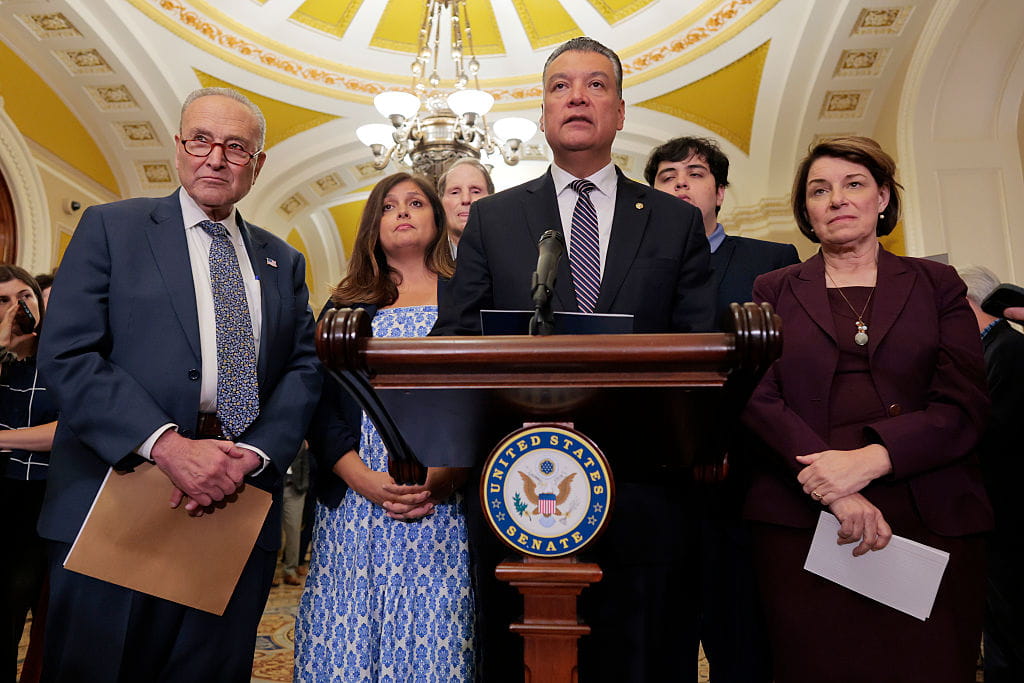
A number of lawmakers now seem to stand united against the spending bills. “I hate shutdowns… but I can’t vote for a bill that includes ICE funding under these circumstances,” Sen. Angus King (I-ME) told Face the Nation on Sunday. He wasn’t alone. Sens. Dick Durbin (D-IL), Jacky Rosen (D-NV), Catherine Cortez Masto (D-NV), and Tim Kaine (D-VA) – all of whom, King included, were among the eight in the Democrat caucus who voted to end the record-breaking shutdown in November – have vowed not to pass the spending package so long as the DHS portion is included.
Shutdown Looms Again
Republicans can’t pass these final appropriations bills alone – assuming 100% GOP participation, they’ll still need seven Democrats to make it happen. As things stand now, another shutdown seems the most likely outcome. But it certainly isn’t the only possibility.
First up, in order to avoid yet another shutdown so soon, a handful of Democrats could cave. This may be the least likely outcome. Each party’s base tends to blame the other side for a shutdown anyway – but with the madness in Minnesota right now, lawmakers on the left now have yet another way to justify the move to their constituents. Joining Republicans in funding ICE, however, will almost certainly result in a tough re-election campaign – sooner rather than later for the 13 Democrat-held seats up for grabs in November.
Another outcome, of course, is that the GOP gives in to the new calls for pulling out DHS appropriations to be discussed separately. The other bills could pass while the funding for ICE and the rules of the agency’s operations can be changed drastically. This would have the same effect for many Republican politicians as Democrats crossing the aisle to pass the current bill as is – and there are 20 GOP seats up for grabs in November. Senate Republicans have seemed more likely to blink first in recent history, with three – Susan Collins of Maine, Alaska’s Lisa Murkowski, and Kentucky’s Rand Paul – who routinely join the Democrats in shutting down certain types of Republican bills, even if for different reasons. Still, while this might be the slightly more likely outcome in the Senate than Democrats allowing the bills to pass, it’s made overall more difficult by the fact that the changed legislation would have to return to the House to be passed again.
But should such a thing occur – if the Senate and House both pass an amended spending package that penalizes DHS and ICE more than the current version already does – President Donald Trump could always simply veto it. In fact, it’s entirely possible that could happen anyway, should the president decide the concessions made in the House are already a step too far.
Should Trump veto the spending package, though, he’ll absolutely own the consequences. Republicans and Democrats failing to agree on funding allows voters to lay blame wherever it’s politically convenient for them. But vetoing a bipartisan spending package results in what can only be called a Trump shutdown.
That’s a tough spot to be in for Trump, to be sure, but it also reflects negatively on the GOP as a whole as the president’s party. This could be rough come election day. But it still presents an interesting option for any Republican lawmakers looking for an easy way to pass the blame, without concern for where it lands, so long as it isn’t on them personally.