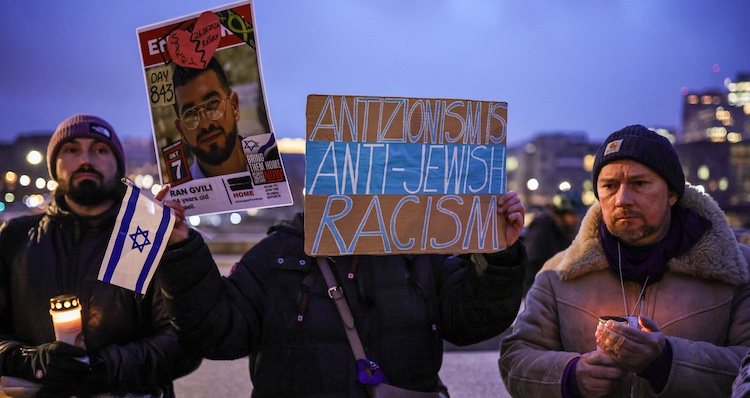
The body of Ran Gvili has been recovered by Israel and returned home. There are no Israeli hostages in Gaza. One of the terrible books opened on October 7 has been closed.
The yellow ribbons and pins are coming off, and the clock in Hostage Square will be turned off (if it hasn’t been already); it has been 843 days.
Much has already been written and much more will be written about this crisis, about what it means for the family of Israel to know where all its children are, and the many other ramifications of today’s news. I will focus on two points.
First, although this hostage crisis was unique—it began with Hamas taking more than 250 captives on October 7—it is rare for there to be no hostages in Hamas-controlled Gaza. By the time the terror group took full control of the enclave in 2007, Gilad Shalit was already in captivity. His release would come in 2011. Less than three years later, Avera Mengistu, a troubled young man reportedly suffering from mental illness, wandered into Gaza and was kept hostage by Hamas until last year.
The holding of Israeli hostages is, therefore, one of the defining elements of the Gaza Strip under Palestinian, and certainly Hamas, governance. To truly move into a new era, then, Hamas must be disarmed and ousted from power—and the model of Palestinian resistance that countenances such atrocities must be left in the dustbin of history.
As I wrote in March 2024, a key turning point in the Israeli-Palestinian conflict came in 1978, when several Israelis were taken captive in South Lebanon, at the time a Palestinian stronghold. Ahmed Jibril, the leader of a faction that broke away from the Popular Front for the Liberation of Palestine’s main organization, was able to get Israel to trade 76 Palestinians for one live Israeli hostage and the bodies of a few others. That led Palestinian terrorist leaders to adjust their tactics accordingly.
Much like Hamas’s strategy of operating from civilian homes, hostage-taking is part of what Palestinian terrorists see as Israel’s chief vulnerability: that it cares about the life and dignity of every individual. In other words, the conflict we see today is, zoomed out, a Palestinian war to exploit Israel’s humanity. Why anyone thinks a conflict that is set along these lines can or will be solved by turning artificial borders into official ones is beyond me. No one who kidnaps babies is interested in real estate.
And second: what Avera Mengistu’s story revealed. Apparently grief-stricken over the loss of his brother, and undergoing periodic mental-health treatment, the 28-year-old climbed over a border fence and into Gaza in 2014. He was returned in 2025.
Who holds a grief-stricken, mentally ill person hostage for a decade? Hamas does.
Nor is the danger of such aimless walking limited to Gaza. Here’s a headline from late December: “IDF escorts Israeli woman out of Palestinian West Bank town she entered.” There really wasn’t much more to the story. A military statement read: “After IDF troops scanned the area, the forces located the civilian and extracted her safely out of the village.”
When did headlines about Israelis having to be extracted from Palestinian neighborhoods become so dog-bites-man?
Here’s one from a week earlier: “Mentally ill Israeli extracted safely from Hebron overnight after wandering for hours.” Jews are only permitted in about 20 percent of Hebron. If one enters the other 80 percent, it makes headlines no matter what happens to them.
This one’s from less than two weeks ago: “Israeli and PA forces extract Jewish man seen wandering in West Bank city of Qalqilya.” Sounds dangerous; what happened? “An initial investigation has found that the man entered the city to go to a car repair shop.”
Another from late December: “Troops extract 2 Israelis who entered West Bank’s Area A near Hebron, Nablus.”
The case of Avera Mengistu highlights the fact that still, after all these decades of “peace” negotiations, the Judenrein nature of Palestinian Arab towns is simply accepted to the point where nearly every headline about an Israeli leaving such a town alive contains a version of the word “extraction.”
The October 7 hostage crisis is over. But has the world learned any of the lessons that have been on display since it began?