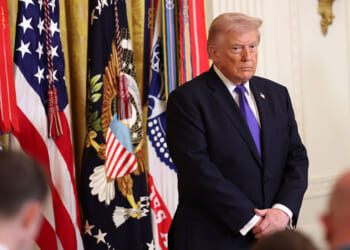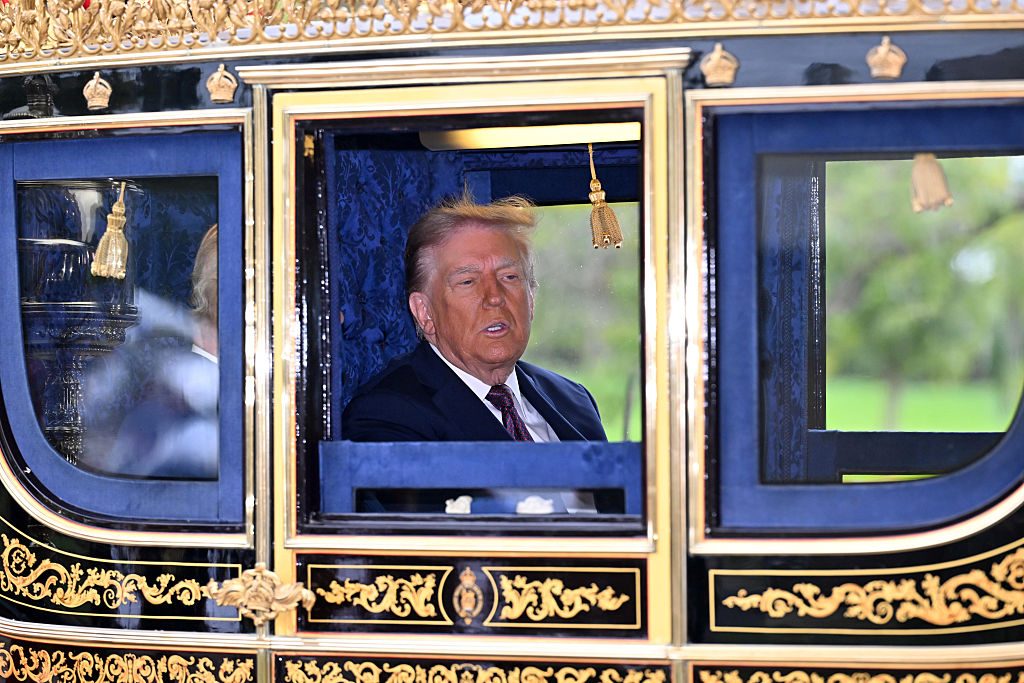
In late 2025, President Donald Trump took to the podium in order to make a very Trumpian announcement. The US Navy, which has long been mired in crisis, was to be restored to its former glory. More than a century earlier, Theodore Roosevelt had inaugurated a new era of American power with the so-called “Great White Fleet”, and now it was Trump’s turn. The new “Golden Fleet” would break the Navy out of its doldrums, and put to bed any discussions about the waning of American power. At the heart of this “Golden Fleet” would be a new line of heavily armed battleships, more lethal and technologically advanced than anything the world had ever seen before. They would, of course, also be named after Trump himself.
There are at least two odd things about the idea of a “Trump-class battleship”. The first is that naming ships after sitting presidents isn’t really supposed to happen according to the commonly accepted naming conventions of the US Navy. More strange, however, is calling a ship in 2026 a battleship to begin with. Battleships are intimately connected with military doctrines and concepts that simply aren’t relevant to modern navies: the battleship is a descendant of the ship of the line, a concept belonging to a time when navies quite literally arranged their ships up along battle lines and fired broadsides at each other. Today, cannons are simply obsolete as premier ship-to-ship weapons: they’ve been replaced by missiles that are orders-of-magnitude superior in terms of range and accuracy. Missiles and torpedoes are also so powerful nowadays that putting heavy armour on ships no longer makes sense; modern producers of high-grade naval armour are about as common as modern blacksmiths capable of forging full suits of gothic plate armour.
The last US battleship was completed in 1944, and no other country in the world considers them to be even remotely relevant in the modern age. Yet even so, America is now supposedly gearing up to build a whopping 15 to 25 of these massive ships, essentially overnight. What explains this sudden about-face? The answer to that question is not really military in nature. Rather, it has to do with the ongoing collapse of the political process inside the American system itself. Simply put, these ships will never be built. In fact, it’s more accurate to say that they cannot be built. Above anything else, these imaginary battleships are yet another descent into an increasingly overt hyperreality, where the words and pictures coming out of the official bureaucracies have less and less to do with what is actually going on in the reality, and where the staid bureaucratic processes of the American empire are breaking apart.
So why won’t — or can’t — these ships actually be built? Well, on the most basic level of legal and bureaucratic proceedings, money hasn’t actually been appropriated for this ship programme. This is a much bigger problem than it might appear at first blush. Money isn’t just necessary to build a ship; it takes a lot of time and money to produce a workable design that is detailed enough for a shipyard to use. The Navy’s previous attempts at designing new ship classes all involved some sort of bidding and planning process; this does not seem to have happened here. Given that the recent history of the US trying to launch new ship classes has been a history of constant, unceasing failure, trying to repeat that process without even appropriating money for the design process itself is all but guaranteed to end in frustration. The reason this hasn’t happened is likely to be very simple, however: if appropriating money for a Trump-class battleship was put up to a vote, it would almost certainly be voted down.
And the White House’s prospects are unlikely to improve, for the Democrats are likely to retake control of Congress in the midterms. To add even more insult to injury, the US government looks headed for another shutdown of some kind, in the wake of the fatal shooting of Minneapolis resident Alex Pretti. After that point, no money will be available for this white elephant that, lest we forget, bears the name of the Democrats’ most hated political enemy. But even if the White House could somehow find the money, there would be nowhere to actually build the ship. The US has very few shipyards of the size necessary to build a battleship-sized hull, and the two or three that do have that capacity are already busy with carriers. Getting them to build new battleships means making them stop building carriers, which is nonsensical at a point where the Ford-class programme is already many years behind schedule. The US could of course always build new shipyards, except for the slight problem that it is completely broke, borrowing completely unsustainable sums of money every year just to keep the lights on.
Finally, the Trump-class battleship is built around several weapon systems that, strictly speaking, do not actually exist. This includes a 32-megajoule railgun, as well as very high power laser weaponry for shooting down drones. Both of these concepts have a very long way to go before they can be reliably weaponised; for now they exist only as experimental research projects. In the former case, the Navy spent almost two decades trying to make this kind of railgun design work, only to finally concede that the physical challenges were just too hard. Yet suddenly, without any resumption of a Navy railgun programme, the Navy is now slated to build a new ship class with a working railgun system by the mid-2030s. Has the Navy actually been given any money to help it finish the research on this wonder weapon in fifteen months, after it tried and failed for fifteen years? No, of course not.
To sum up the state of play: Trump has announced a massive, glorious new era for the Navy, promising a new ship named after himself that no one ever asked for and that lacks any funding. The design itself essentially doesn’t make any sense from a doctrinal standpoint, it can’t actually be built without seriously compromising the US Navy’s capabilities for a generation, and it sports a series of weapons that, in operational terms, don’t exist. Throughout this entire process, Navy brass have all nodded and smiled politely, talking about how we need to free ourselves from “cognitive biases in our brain” regarding the whole affair, while swearing up and down that the ships will almost certainly be “badass”, and so people should just have a little more faith in the whole process.
“Trump has announced a massive, glorious new era for the Navy, promising a new ship named after himself that no one ever asked for and that lacks any funding.”
It’s useful to understand how and why this is happening. It would be simple enough to conclude here that Donald Trump is becoming some sort of tyrant or dictator, and that these strange and doomed projects which he names after himself are merely the natural result of his own hubris running amok. Yet that is a very superficial explanation, and one that fundamentally misdiagnoses the root of the problem. Yes, it’s becoming clear that the American political system is experiencing a collapse of basic legal and procedural norms. The Trump-class battleship illustrates a curious paradox here: even as Trump gets increasingly more “hands on” — wielding more and more power that used to be outside of the prerogatives of the Presidency — the actual power of the United States seems to be waning. Strangely, personal rule and political weakness seem to go hand in hand.
But this isn’t actually all that strange. History is, after all, full of all manner of dictators, tyrants, and God-Kings. What usually defines these figures, however, is that their ascent to power is tied up with the creation of new bureaucracies and methods of rule. Pre-revolutionary France was a mind-boggling patchwork of competing feudal claims and rights; the revolutionaries ruthlessly burned that old system to the ground and put in new, hyper-rationalistic laws and institutions. It was this work of destruction and renewal that Napoleon leaned on to conquer almost all of Europe. The Nazis didn’t destroy the entire German bureaucracy, but they still overhauled it massively. Rather than cutting all the departments they didn’t like, they simply created new, alternative ones: inaugurating a system of constantly warring bureaucratic departments locked into a Darwinian struggle for money and influence. It was this dynamic that allowed the Nazi Party to assert a greater degree of direct control over the German state than had been possible during the Weimar era. In China, the Kuomintang and the Communists rebuilt the shattered state apparatus while fighting against the Japanese — and each other.
Donald Trump did promise something similar to a bureaucratic revolution, that much is true. But that revolution struggled to get off the ground, and it has already failed. DOGE no longer exists, and all attempts to balance the budget or prevent the US from collapsing under the weight of its growing deficits have been abandoned. Instead, Trump is busy looking for new ways to expand the American empire — including by threatening violence against his oldest allies — even at a point where many observers are talking about the rapid decline of the US empire in very honest terms. And while Trump’s political opponents constantly accuse him of engaging in various shocking and illegal power grabs, the nature of these power grabs, with the one exception of DOGE, is almost invariably just a result of the decay of the American state. They take the form of laws that exist on the books no longer being followed — the most egregious example of this is probably the Hatch Act — or unstated rules and norms of small-r republican government — such as the independence of the Federal Reserve — which are increasingly being ignored or outright violated. These accusations are often true, yet they are in some sense also unfair. Donald Trump wouldn’t have been elected if American voters did not strongly feel that the American system was broken and no longer worked for their benefit; him trying to preserve all the legal and small-r republican niceties of this broken system would in the end represent not just a betrayal of his own voters, but also a kind of a societal and political dead end. Change was coming no matter what: Trump was arguably just the man that happened to be in the right place at the right time.
Far from being a 20th-century fascist or an ancient Greek tyrant, Donald Trump is increasingly looking like America’s own Charles I. Like Charles I, Trump finds himself stuck at the head of an executive apparatus whose relationship to the legislature has, for all intents and purposes, completely collapsed. The second Trump administration has entirely failed at pushing any kind of legislative agenda even when compared to the fairly dismal record of his first term; it has by and large given up on even trying to get new laws passed. Rather, it constantly pushes new legal arguments, asserts executive powers no previous president has ever claimed, and uses its control over the Department of Justice to harry recalcitrant bureaucrats to go along with its edicts. This growth of executive power and assertiveness is actually an acute sign of weakness: the executive can no longer cajole the legislature to pass or amend the laws, and so it increasingly finds itself living outside the law entirely.
When Charles I could not or did not want to face Parliament, he revived various long-dead and quaint institutions, and twisted others far beyond what they were ever intended to do. He made the failure to attend his coronation a fineable offence for any man who earned £40 or more; he began demanding ship money — originally a feudal levy imposed on seaside communities to pay for the Navy — from all of England, even without an actual wartime emergency. When Trump imposed tariffs against the entire world on 2 April, he claimed extremely broad powers of taxation for himself, citing a narrow legal authority that delegated some congressional authority in cases of emergency. Just as with Charles I during his 11 years of personal rule, every day was now redefined by Trump as an emergency, and the only person who got to decide what was and wasn’t an appropriate use of emergency powers was Donald Trump himself. Many of Trump’s more shocking actions during his second term in office follow this basic pattern: some half-forgotten legal doctrine or executive power is dug up and used to justify things that haven’t really been done before. DOGE was originally created by President Obama, as the US Digital Service, but it was Trump that transformed it into a tool of bureaucratic warfare. ICE was born during the tenure of George W. Bush, but Trump has expanded its budget more than tenfold and changed what was once a low profile, mostly plains-clothes agency into an army of heavily armed, masked gunmen driving down American streets like the Marines once did in Fallujah.
Of course, things didn’t turn out all that well for Charles. His constant expansion of executive power was at first tolerated, then chafed against, and then violently opposed. When he was finally forced to call another Parliament, it immediately began passing laws constraining his powers. Emboldened and nursing a slew of grudges built up over a decade of personal rule, Parliament soon began prosecuting Charles’ friends and allies: sentencing the Earl of Strafford to death for the crime of high treason. From there, the situation deteriorated further, and England soon found itself in the midst of civil war.
Is it possible to imagine that Congress, after a period of being ignored by the American executive while nursing various political grudges, might begin to act to constrain Trump’s powers? That it will act to limit, hinder, or even impeach the people around Donald Trump, triggering an increasingly acrimonious divorce between the different parts of the American state? The answer to that question is that imagination isn’t even necessary: the proceedings have, for all intents and purposes, already begun. The Trump administration is already trying to prosecute the head of the Federal Reserve to get that institution under control, and it’s only a matter of time — and a Republican defeat in the midterms — until the people doing the prosecuting find themselves the targets of a fresh round of political persecution. Meanwhile, the chronic inability to actually settle on a budget, which recently culminated in the longest government shutdown on record, is set to get worse. As in the run-up to the English Civil War, the basic ability to pass legislation and fund expenditures is rapidly degrading. Yet the worse things get in that regard, the more Donald Trump will be tempted to dig into obscure, quasi-legal prerogatives. The more those prerogatives are exercised, the stronger resistance will become.
When suns run out of fuel, they begin to physically balloon in size. When a president or a king loses strength, when the political system they sit at the top of begins to crumble, they tend to respond by claiming more and more power. Trump’s science-fiction battleship — like his grand ambitions towards Greenland — does not herald a new era of unlimited American power. It is, like the personal rule of Charles I, merely a swansong: a final farewell to a system ready to come apart.