A blockchain conference is an accelerationist dreamscape. Held to the thrumming beat of techno, such events are a swirl of places, people, and projects — influencers and investors, developers and salesmen, hackers and scammers, lawyers and bankers, artists and builders. There are crypto exchanges and stablecoin issuers; market makers and token-listers; the promoters of deFi and DePIN applications; projects hoping to tokenise houses, horses, diamonds, funds, and people; men — for they are mainly men — selling AI agents, AI agent platforms, and even hoping to build AGI itself. Many are here simply for the speculation, but others want something more — to abolish banks, to replace national currencies, to eliminate even the nation state. Some of them want to use you. Some of them want to get used by you. Uniting them all, however, is the sweet dream of money — making it, owning it, issuing it, liberating it. Desires such as these are what moves the world.
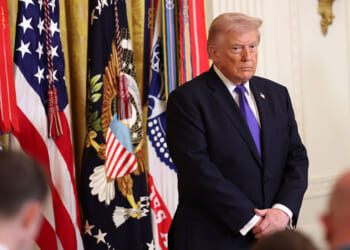
At first glance, web3, which is what this new stage of the internet has been named, makes a peculiar bedfellow of Right-wing populism. A movement rhetorically dedicated to nation, family, and place has turned — once again — to a stateless world of mobile capital, financial speculation, and institutional decentralisation. Yet the embrace is becoming ever-closer. Once a crypto critic, Donald Trump has proclaimed his ambition to make the USA the world’s leading place for blockchain — and launched his own memecoin in the process. In Britain, Reform is proposing a bitcoin reserve and various crypto tax cuts; Farage reportedly hopes that crypto can usher in a new “big bang” of British finance. Explaining this contradiction requires something more than sovereignty, money, or ideology: it requires libido.
As the philosopher Jean-François Lyotard had it: “Every political economy is libidinal”. His provocation points to an essential truth: beneath the calm calculations of rationality, we and our institutions are driven by energies, compulsions, and desires that both stand outside and shape our self interest. Libido pushes us to seek wholeness, mastery, and recognition, and we seek these things through our choices. The modern economy of money, marketing, and consumers is a machine: a machine for creating, stimulating, predicting, and satisfying our desires. So too is modern politics. The desire for sovereignty — whether of an individual, a community, or a state — is the political expression of desire for wholeness, mastery, and recognition. The protean power of the Right comes through recognising and embracing these realities — and in the embrace of blockchain, we once more see this playing out.
Blockchain is booming. Token prices are high, and projects, talent, and capital continue to enter the industry. Ecosystems are expanding, thriving developer communities are churning out decentralised apps, and consumer adoption — mainly driven by stablecoins — is growing rapidly. Through Bitcoin ETFs and similar instruments, the capital of ordinary savers is entering the industry. Asset management firms like Blackrock and Aberdeen are experimenting with blockchain-based fund distribution, and more and more fintech companies are offering blockchain based services.
Blockchain was born in an assertion of sovereignty — the sovereignty of the individual. The pseudonymous programmer Satoshi, whoever he was, designed bitcoin so that people could exchange value entirely outside the realm of the state. A blockchain is a distributed computer, one relying on physical infrastructure anywhere in the world. With transactions recorded on the decentralised and open ledger and executed via automated “smart contracts”, the development of blockchain thus opens up the possibility of economic activity entirely unmediated by the state or the centralised institutions of big finance. As such, crypto tokens and blockchain technology are notionally borderless. Tokens can be issued by anyone or anything that holds a wallet, and passed freely between wallets, entirely without the oversight of any central authority. This is a vision of self-reliance and autonomy, one with revolutionary implications — the concept of a world without governments, borders, or taxes, and based on the radical self-reliance of sovereign individuals.
Blockchain technology may not respect the sovereignty of states, but bodies and bank accounts necessarily must. Responding to more than a decade’s worth of scams and speculative bubbles, and troubled by wider risks to financial stability, international authorities have used their physical and financial power to regulate the industry. Blockchain has thus become both a challenge to sovereignty and a vehicle through which sovereignty is expressed.
Four broad regulatory models appear to be emerging, and in them we can see the psychic and institutional imperatives of the blocs that have birthed them. In China, sovereignty is control; with a tradition of state intervention, and guided by fears of capital flight, China has repeatedly banned and sought to limit digital asset activity. In Europe, sovereignty is limitation; EU Markets in Crypto-Assets regulations have sought to emphasise consumer protection and bloc financial stability, thus inhibiting risky enterprises. Offshore, sovereignty is opportunity; through special laws and exemptions, small and nimble states like the UAE, Singapore and El Salvador seek to attract international business. In America, meanwhile, sovereignty is the pursuit of dominance.
Trump has promised to make the USA the “crypto capital of the world”. In his hands, crypto policy is conceived as a tool of national power. A chief goal is upholding the hegemony of the dollar. Last July, the United States passed the GENIUS Act, a major piece of federal legislation designed to reinforce the dollar’s role in stablecoins. Stablecoins — tokens that represent a “real”, fiat currency, and are pegged to the real currency’s value — are growing rapidly. Over $300 billion of these tokens have been issued; they are expected to account for up to 12% of cross-border payments by 2030. Over 99% of all stablecoin volume is conducted using coins pegged to the dollar. Because dollar-pegged stablecoins typically back themselves by buying US treasuries, the international adoption of stablecoins therefore becomes a means of servicing US debt. At the same time, the international use of dollar-pegged stablecoins boosts the continued dominance of the dollar, and with it the extraterritorial power of the USA.
Away from stablecoins, US securities regulation has been reconceived as a means to boost US crypto leadership. Previously a bulwark of anti-crypto sentiment, the SEC — Securities and Exchange Commission — has now become the home of “Project Crypto”, a plan to reshore crypto businesses and facilitate American primacy in blockchain through new and permissive securities rules. The Senate and House, meanwhile, are considering two further bills designed to give a comprehensive regulatory structure on digital assets.
Spurred on by these changes, a will to power now permeates the American crypto industry. Support for crypto merges with the muscular advocacy of US strength. Through what it calls “a16z”, its crypto-focused subdivision, the leading VC firm Andreessen Horowitz advocates for US leadership in crypto, the development of crypto-friendly regulation, and the reshoring of US-oriented crypto projects. Away from crypto, its executives advocate for “American dynamism” and a refashioning of American capitalism to suit a renewed era of geopolitical threat — a mission, in their view, that requires a harnessing of the “dynamism of free enterprise” towards the cause of “national renewal”. In September, a16z proposed that AI, crypto, and the reindustrialisation of American manufacturing should not be regarded as isolated movements, arguing instead that they are “deeply entwined” and “foundational to the next American century”. With AI and reindustrialisation respectively providing intelligence and physical capacity, a16z depicts the role of crypto as providing ‘the ownership layer’. It fills this role through tokenisation.
To tokenise a thing is to create a fungible, tradeable, digital and programmable representation of that thing — a token. These tokens can represent anything — a house, a human, a dollar, a behaviour, a song. These tokens become a new form of asset, and the upshot of that is that literally anything can be transfigured into money. Tokenisation reveals both the ambition of crypto, and its psychic promise. Bitcoin promises a form of money, or at any rate financial value, outside of the central control or any actor or institution, but it is tokenisation that is driving the industry forward. To read certain analysts is to gain the sense of an imminent goldrush; McKinsey predicts $2-4 trillion in assets will be tokenised by 2030; the Boston Consulting Group predicts that $18 trillion’s worth of assets will be tokenised by 2033. Redstone, meanwhile, predicts that 30% of the world’s entire stock of assets will be tokenised by 2032.
At core, tokenisation is about markets. If adopted at scale, tokenisation has deep implications. For capital markets it promises more speed, more liquidity, more access by investors, and more products. More profoundly, it points to a deeper triumph of financialisation: the entire world and everything in it can be rendered into monetary form, made liquid and available to trade. The logic of property and of the market can thus be extended ever deeper into our minds and behaviours. Seen in this light, the American embrace of crypto is nothing short of a psychic crusade — an appeal to builders and developers to uphold and deepen the values of the market. Hence crypto’s libidinal role, its association with that will to power — for tokens create property, property creates markets, and markets create desires.
Markets are built on what people want, not what they need, and they acquire what they want through money. Money, and perhaps more often the absence of money, is in our clothes, our food, our homes. It is in the way we talk, the way we walk, and the routines, habits and hobbies that fill our time. Money — how we get it, how we manage it, what we do with it, and what it does to the people and places around us — shapes almost every aspect of our lives. That it does so should be of little surprise. For what is money? Far more than a mere medium of exchange, money has long since become the medium of existence. Money is trust, money is power, money is the tie that binds almost every living human into a web of economic interdependence. Money is the sixth sense, one that gives strength to the other five. Above all, money is desire — frozen desire, ever ready to be made liquid in pursuit of the needs and goals the market gives us.
“Money is the sixth sense, one that gives strength to the other five.”
Desire — even greed — is neutral. Libido — the life spirit, the generative energy of human society — is natural and inevitable. The challenge comes in how we harness it, the specificities of the desires to which our libidinal energy may fix. Channelled incorrectly, the desire for wealth becomes the driver for fraud; a desire for respect, the jealous vanity of the tyrant. By weakening our physical ties, digital life accelerates this challenge. Left to feed upon itself in a world of screens, desire risks turning inward — an eternal hall of mirrors, a gooncave of the mind. A political and economic world where signs, symbols, and tokens crowd out the reality they seek to reflect.
Money is the life-blood of capitalism, and changes to money can carry revolutionary significance. As Lenin observed, “the simplest way to exterminate the very spirit of capitalism is to flood the country with notes of a high face-value, without guarantees of any sort.” Though thankfully unaccompanied by either the butchery or hyperinflation produced by Lenin and his ilk, Bitcoin was born in a moment of financial crisis — the great recession of 2008. Crypto thus developed amid a crisis of trust in banks and governments. Thanks to quantitative easing, it then developed in an era of low interest rates; crypto mania has to a large extent depended on the need for institutions and individuals alike to seek higher returns than those now offered by the banks. Low interest rates mean high asset prices; high asset prices mean a generation prevented from acquiring capital. Crypto, crypto speculation, and a new mood of anti-elitism have been the response. When institutions and money can no longer be trusted, individual self-sovereignty becomes more attractive.
For states, sovereignty is an opportunity, but it is also a challenge. As the world separates into three great power blocs, smaller states must use their agency to adapt: for if the strong are learning to do as they please, then the weak will suffer what they must. From Bukele’s repositioning of El Salvador as a “bitcoin nation” to the UAE’s quest to bring in crypto capital, small and mid-ranking states can use the spread of blockchain to bring talent, money, and opportunity to their borders. Having left Europe, Britain must understand and seize its new reality. Not to grasp the opportunities now offered us would be the crowning absurdity of Brexit.
As a top-10 economy, the historic seat of the global financial industry, and the leader in European technology, Britain has more opportunities than most. The question for the United Kingdom is whether or not it wants to be a place of desire, a country in which ambition can be articulated and realised. Prudence saves lives, but ambition builds nations. To surrender leadership in blockchain technologies is to surrender the future of finance, and to say — yet again — that ambition has no place in the United Kingdom. London birthed neither the first joint stock company, nor the first stock exchange, yet it used both to become the world’s great centre of finance. With crypto, it can do so again. Despite the patriotic noises, US crypto dominance remains unassured; with key legislative and regulatory changes still unannounced and unscoped, its reforms remain a matter of vibes over substance. In Europe, meanwhile, regulatory conservatism means it is surrendering its future. Britain need not make the same errors.
No technology is neutral. As designers and as users we inscribe our needs, our dreams, and our desires on the systems that surround us. In blockchain as elsewhere, Britain must decide what it desires — and whether it still desires anything at all.