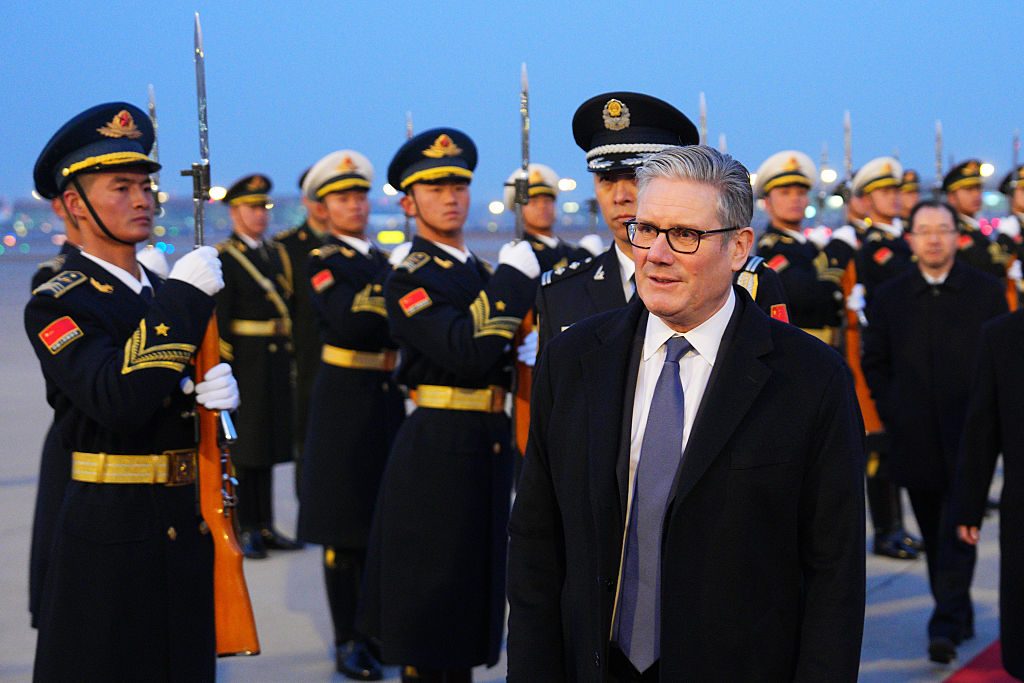
Eight years since Theresa May, the last British prime minister to visit China, hailed a “golden era” in Sino-British relations, Keir Starmer has arrived in Beijing with no grand visions to unveil. He promises only “pragmatism”, echoing the mantra set out in Labour’s manifesto and subsequent speeches: “cooperate where we can, compete where we need to.” This is a face-saving way of saying that, regardless of China’s transgressions in the time since May’s visit, Britain cannot afford to snub the Asian superpower. China may support the Russian war effort in Ukraine, dismantle the rule of law in Hong Kong, and wage a constant campaign of cyber attacks and espionage against British institutions, but its power is too great to pass over in principled silence. So eager is Starmer’s government to improve relations that it has given China permission to construct a potentially subversive, fortress-like embassy compound in the heart of London.
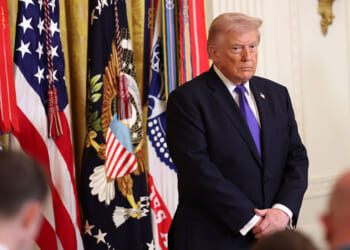
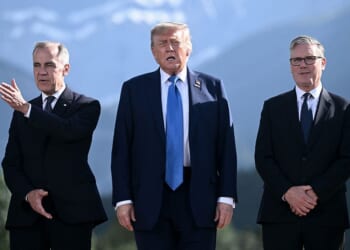
There are complications of course. Starmer has framed the visit as a careful balancing act, insisting there are “opportunities” for economic benefit, but that this “does not mean compromising on national security”. The third, unstated element in the equation is that any new arrangements with China must not offend Britain’s primary patron, the thin-skinned and capricious President of the United States. Donald Trump recently threatened Canada with swingeing tariffs after its own prime minister, Mark Carney, declared a “strategic partnership” with China. A similar reaction would be unwelcome for Starmer, who unlike Carney has staked his authority on his ability to appease Trump.
The Chinese leadership will no doubt reward Starmer’s deference with a token pledge of investment, perhaps a greater one than the paltry £600 million which Chancellor Rachel Reeves secured on her trip last year. But China neither wants nor needs British goods and services on any meaningful scale. It has two basic goals in Britain, and they are to ensure a growing market for its enormous surplus of manufactured goods, and to leverage its economic power to disrupt the American-led Western alliance system. It is on its way to achieving both aims without needing to offer any special inducements.
A country like Britain can only negotiate with China if it can plausibly threaten to reduce its dependence on Chinese supply chains and technology. Instead, under successive governments but especially under this one, Britain has shut down its industrial base and pursued policies which have pushed up the cost of living, stoking demand for cheap imports. China cannot prise Britain away from the United States, which is still the guarantor of British security, but it can slowly raise the cost of supporting the US where Chinese interests are at stake, and in a crisis, threaten to cripple the British economy. What is more, Starmer remains idealistically committed to a system of international law which Beijing is slowly bending towards its own ends. Even if Britain is the last nation to abandon America’s old global order, it can become a member of China’s new one long before that. The two are already overlapping.
None of this means that Starmer is wrong to reboot relations with China. The diplomatic “deep freeze” of recent years was the result of contingent circumstances which the march of history has already left behind. Starting in 2015, David Cameron and George Osborne launched an ill-timed strategy to deepen ties with China, touting the City of London as a putative gateway to the Western financial system. That plan was complicated by Brexit and the realisation that Chinese tech posed a threat to critical infrastructure. As American antagonism towards China hardened, Britain’s leaders prioritised fealty to the US. Then came Hong Kong, Covid, and Ukraine. During the Johnson and Sunak years, as the extent of Chinese espionage efforts in Britain became more difficult to ignore, the government’s China policy seemed to be largely dictated by a desire not to appear weak in front of hawkish backbenchers.
The problem is that, despite the British media’s strange habit of equating diplomacy with surrender, the country does not gain anything by keeping these channels closed. None of Britain’s key partners in security and intelligence have cut themselves off from Beijing to the same extent. Not Australia, despite its bitter disputes with China; and not even the US, which, for all the rhetoric of decoupling, remains firmly integrated with the Chinese economy at every level, from major tech companies like Apple and Tesla to the financial managers at the Federal Reserve.
Meanwhile, China continues to assume an increasingly dominant position in the global economy. As Kyle Chan has written, the era when China needed technology transfers from the West is over, and the flow of knowledge is now going into reverse. Western companies are buying access to China’s expertise in everything from electric vehicles and robotics to pharmaceuticals and even artificial intelligence; Mark Zuckerberg’s Meta recently acquired the Chinese AI startup Manus. China maintains a firm grip on the raw materials which underpin advanced technologies, as it demonstrated last year by using its chokehold on critical minerals to repulse Trump’s tariffs. Many British companies manufacture their products in Chinese factories, and the two countries have a strong partnership in scientific research.
Britain’s economic prospects therefore depend on its commercial relations with China as much as with the United States. Indeed, I’ve heard from businesspeople who much prefer working with Chinese counterparts than American ones that the former are more inclined to seek long-term relationships based on mutual benefit, while the latter, much like their property developer President, tend to see business as a zero-sum contest.
“Britain’s economic prospects depend on its commercial relations with China as much as with the United States.”
The problem, then, is not that Britain is engaging with China, but that it is doing so from a position of weakness and apparent desperation. Bowing to Chinese demands for a strategically located London embassy, and undermining the prosecution of two alleged spies, were the acts of an auditioning vassal rather than a sovereign partner. More importantly, a reliance on Chinese imports is increasingly baked into Britain’s economic model. Whereas most comparable countries are wary of China’s aggressive trade practices, Britain embraces them.
Since 2020, the Chinese leadership has pursued a strategy of dual circulation, meaning that it seeks maximum self-reliance in meeting its domestic needs, while also producing an enormous surplus of goods to export overseas. This is partly an expression of China’s own weaknesses: its society is submerged in debt, its once mighty property sector is bust, and its state does not want to undergo the painful readjustment that is required before its own consumers can grow the economy through spending. So it needs the world to continue buying its products in ever-larger quantities. But this model also serves to enhance China’s political power over other nations. Just as it uses investment and loans to gain influence over poor countries, it uses cheap exports, which are subsidised by the state, to undercut producers in richer ones, leaving them dependent on Chinese manufacturing.
Labour’s agenda has made Britain a willing accomplice in this strategy. A combination of wage increases and taxes on business has kept inflation high, putting upward pressure on both the cost of living and interest rates. This is a politically toxic situation for the government, and Chinese imports are an obvious solution, as a Bank of England official recently stated. Another Labour priority, Ed Miliband’s rush to bring down British carbon emissions, has similar implications. Not only does it rely on Chinese solar panels, wind turbines, electric vehicles and batteries; it is also accelerating the demise of British industry through high energy costs and regulations. Much of that production will relocate to China. Hence Britain’s imports from China grew by 6% last year; the roads are filling with “Temu Range Rovers” — as the Jaecoo 7 SUV is sometimes called — while Britain’s domestic car production has fallen to its lowest level since the Fifties; and David Lammy has celebrated a British company investing £800 million in a new plastics plant in Zhejiang, even as Britain’s own chemicals industry is collapsing.
Britain may be one of China’s more accommodating trade partners, but the EU, for all its clout on paper, faces a similar dilemma. Visiting China in December, French president Emmanuel Macron said of the trade relationship that “these imbalances are becoming unbearable”. The EU has tried to use tariffs to resist a glut of Chinese electric vehicles entering its market, but China has retaliated by targeting European agriculture and luxury goods, and it still has the ability to withhold critical resources from Europe as it did from the US. Germany is now haemorrhaging industrial capacity to China, and cannot intervene because it also needs access to the Chinese market. As in Britain, European governments presiding over febrile societies will not risk an inflationary shock caused by a disruption of trade with China.
There is an argument that Britain should simply write off the loss of its remaining industrial base and free itself to gorge on Chinese imports, thereby helping to raise its living standards. In fact, to a large extent this is already happening. But the lesson of China’s rise is that, while such tradeoffs can be beneficial in the short term, they will, in time, become dependencies to be exploited. The much vaunted rules-based order that Trump is now dismantling was not only a framework of American hegemony; it was a scaffolding that China ascended by treating every economic relationship as a vehicle for its political objectives. For the most part, Beijing’s coercive trade tactics have been much more subtle than Trump’s tariff blitzes, but not always. Mongolia, Australia and Lithuania have all suffered naked blackmail from China, due to their stances on the Dalai Lama, the origins of Covid, and Taiwan, respectively. The anti-coercion measures that the EU is now threatening to use against Trump were developed in response to China’s treatment of Lithuania.
The same instrumental approach can be seen in Beijing’s new Global Governance Initiative, announced in September, which advances a Chinese-led world order in the guise of a more democratic and equitable “global community” adhering to international law. This continues a longstanding Chinese campaign to expand its influence over international institutions. It is an unfortunate irony for Britain that Starmer, who would in many ways be at home in the Chinese Communist Party, given his preference for technocratic solutions and skill at operating his party’s machinery against his rivals, does not show the same ruthless nous in the international domain. Instead, he cleaves with an almost touching faith to the sanctity of rules and procedures, apparently blind to the agendas they might serve.
There is a possible future in which some of the nations trapped between the US and China finally make good their fantasies of “strategic autonomy”, radically changing their spending priorities and building up a degree of independence in technology, industry and defence. This would probably be a world where Britain cooperates more closely with its European neighbours, as well as other allies such as Australia and Japan. It is far more likely, however, that Europe’s “middle powers” will become a complicated space where American and Chinese influence mingles and collides. Both superpowers will exercise control over Britain’s infrastructure and economy in different ways, and both will impose their own limits on British sovereignty. If that is the case, an important question for the country’s future will be whether the United States and China can coexist peacefully in contested lands like this.