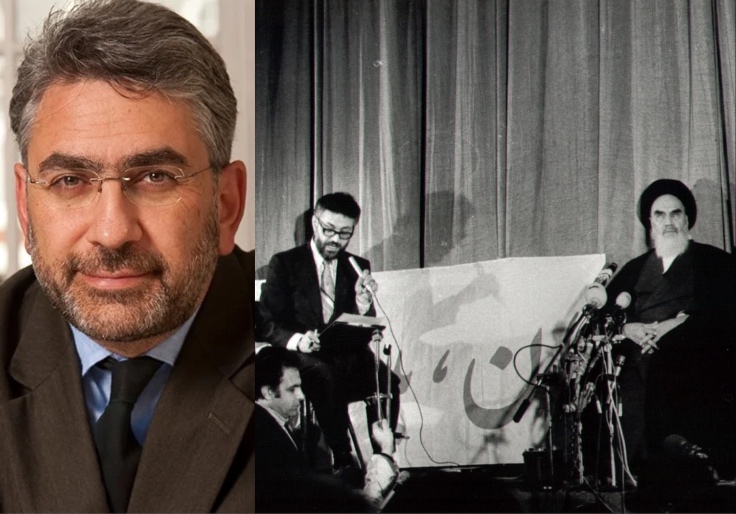
As reports began to emerge in mid-January detailing the extent of the brutality of the Iranian regime’s crackdown on protesters, NPR’s Morning Edition aired an interview with a guest, introduced as a Johns Hopkins professor and the “son of Iranian parents,” who offered a first-person account.
Host Steve Inskeep said the professor, Youseph Yazdi, had a “rare first-person account of the protests sweeping that country.” Inskeep did not mention to NPR listeners that Yazdi is also the son of the former Iranian foreign minister Ebrahim Yazdi, who served as one of Ayatollah Ruhollah Khomeini’s closest advisers and as the regime’s first minister of foreign affairs before becoming a dissident inside Iran.
Mark Bowden’s account of the Iranian hostage crisis, Guests of the Ayatollah, recounts that leading up to the revolution, Ebrahim Yazdi was “Khomeini’s man in America” and helped form “a brain trust around Khomeini when he was in the last months of his exile in Paris.”
Yazdi was meeting with American chargé d’affaires Bruce Laingen inside the Iranian foreign ministry in 1979 when revolutionaries stormed the American embassy and took American diplomats hostage. When Laingen pleaded with him to help save the embassy and said Yazdi was obligated to do so under the rules of international diplomacy, according to Bowden, Yazdi responded, “Calm down. I told you so”—that is, that the seizure of the embassy was a predictable response to the U.S. decision to admit the shah for cancer treatment. Laingen and two others were ultimately turned over to the hostage-takers and held hostage. Yazdi resigned from the cabinet the following day and went on to become an internal critic of the regime.
In his interview with NPR, Youseph Yazdi made no mention of the mounting death count and suggested that the protesters—or, as he put it at one point, “trained agitators”—had it coming. “They pulled some pavers up from the sidewalk and started throwing him [sic] at the riot police, and then the riot police responded with tear gas,” he said. Peaceful protesters, he said, are “no match for either trained riot police or trained agitators who want to escalate the violence.”
Of the regime’s forces, who we now know have murdered upward of 30,000 people, Yazdi said, “They have batons, and they have tear gas launchers, is their main thing. They have these, you know, CS gas, tear gas canister launchers, and they could fire them hundreds of feet. So they use those a lot. And one of the protesters picked up the tear gas and threw it back. And it’s hot because it has projectile, you know, stuff in it like a firecracker to make it fly in the air.”
He added that, if protesters merely kept things nonviolent, the government “will lose.”
“But if it’s a nonviolent protest, the government will lose,” Yazdi said. “The power will be more in the hands of the people.”
A spokesman for NPR did not respond to a request for comment.
Youseph Yazdi writes and speaks on Iranian affairs on a regular basis. Inskeep interviewed him during the protests in 2009, and he has written for the Soros- and Koch-backed outlet Responsible Statecraft, arguing that blowback for Trump’s assassination of IRGC commander Qassem Soleimani would be “swift and severe.”
“As the smoke from that burning Toyota and flesh at the Bagdad International Airport blows back in the direction of Washington, it will start to dawn on Trump, as it did on Bush, how he has been duped into something that will not serve him well at all,” he wrote in January 2020.
Responsible Statecraft noted that Yazdi’s father “served as Iran’s Foreign Minister, MP for Tehran, and Secretary General of the Freedom Movement of Iran.”
Top NPR anchors have reported from Iran, which is somewhat unusual for U.S. outlets. Inskeep visited Iran in 2015 and 2019, and Mary Louise Kelly, clad in a headscarf, visited in 2020 and 2023. An Iranian-Canadian photographer, Marjan Yazdi, took pictures for NPR on some of those trips. It’s not clear whether Marjan Yazdi is related to Youseph Yazdi or Ebrahim Yazdi.