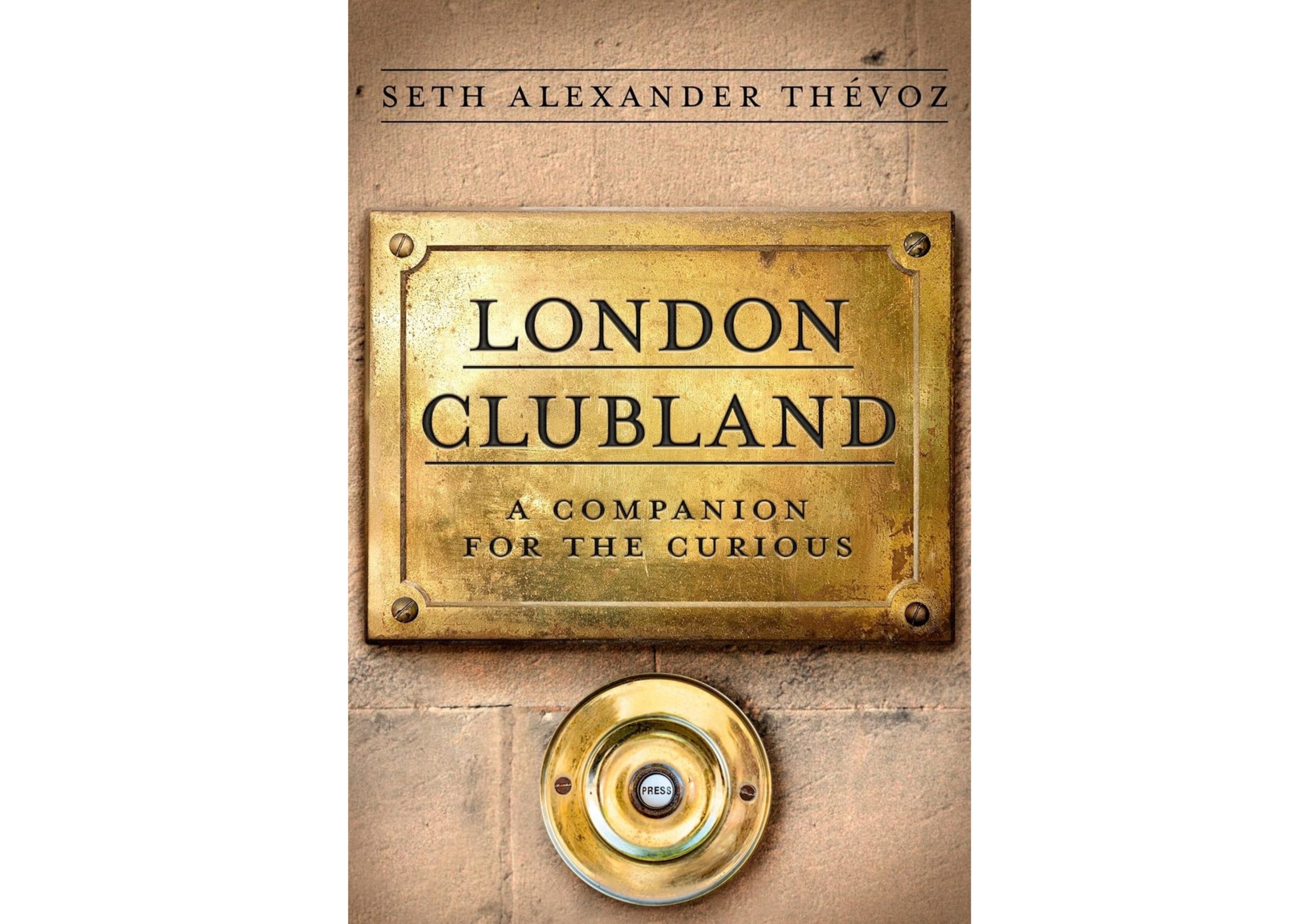
London Clubland: A Companion for the Curious, by historian Seth Alexander Thévoz, is the rare book that manages to be both reverent and sly: an impeccably researched directory of London’s private members’ clubs that understands, at a cellular level, which of these places want to be mythologized and which would rather die than be written about at all. The former are treated gently, the latter mercilessly. My favorite section, “What They Probably Don’t Want You to Know,” skewers this distinction perfectly, offering quiet mockery for the clubs desperate to be talked about—Soho House, for instance, which has built an entire business model on insisting it is still misunderstood—while maintaining gentlemanly discretion around those that still prize silence over clout.
Reading it feels less like consulting a guidebook and more like being taken aside by a well-connected friend, one of those older Englishmen who seem to possess neither a visible job nor any shortage of memberships, and being guided through the cobbled backstreets of London. This friend is the sort who walks confidently into a hotel lobby, tells the receptionist you’re staying there, and then ushers you downstairs to a hidden Art Deco cinema you were never meant to find. Thévoz writes with that same conspiratorial ease, informative, amused, and never, ever overeager.
That tone matters, because London Clubland is ultimately a book about institutions that do not exist to please you, and how rare, and fragile, that has become.
As a Brit living in the United States, I’ve learned to accept a hard truth: Americans do many things better. Their cars are enormous and often hideous, but they are also deeply comfortable. The cup holders are plentiful, the lumbar support aggressive, and five hours on I-95 passes without any pain at all. American service culture, too, is relentlessly accommodating. Waitstaff want you to be happy. They want to be liked. They want five stars, a generous tip, and perhaps to invite you to their book club.
British hospitality is the inverse. You may want the check; they may or may not feel like bringing it. You may be angry; this is not their problem. You are tolerated, not indulged.
Private members’ clubs sit squarely in this older British tradition of indifference, and that is precisely why they struggle to survive in a modern hospitality economy engineered around customer satisfaction. Clubs are not meant to be welcoming. They are meant to be exclusionary, awkward, rule-bound, and occasionally faintly hostile. Their appeal lies in friction: dress codes, blacklists, committees, waiting periods, the possibility of embarrassment. This doesn’t translate, and is why I’ve found myself having many conversations in Washington, D.C., that go like this:
“You can’t wear that, it’s against the dress code on the invitation.”
“It’s fine, nobody will even notice what I’m wearing.”
“B-but, they won’t let you in!”
The truth is they always let us in, because they do not notice and do not care how their guests are dressed, and even if they did, they are too nice to mention it.
It is no accident that Soho House has thrived in this environment: a private members’ club that promises exclusivity while bending over backwards to ensure no one ever feels excluded, offended, or insufficiently admired. Soho House is what happens when clubland accepts the logic of hospitality culture entirely, exclusivity without exclusion, and misbehavior that is carefully curated to appeal to twenty-somethings on Instagram and to remain brand-safe.
Thévoz understands this tension instinctively. The book walks readers carefully through application processes, house rules, and unspoken etiquette, but it also captures the psychology of clubland: what these places signal about power, taste, and self-knowledge, and what they say about the state of Britain in different decades. One of the most revealing sections is his catalog of club mottos, which are rare, but the ones that have them function as miniature mission statements for Britain’s ruling class. The infamous Garrick Club, whose leaked membership list caused such a scandal that it was eventually forced to (gasp) admit women, operates under the theatrical motto “All the world’s a stage.” White’s, the oldest club in London, still male-only and unapologetically aristocratic, opts for Cogit amor nummi—”The love of money compels him.” These are not slogans designed to flatter outsiders; they are blunt, self-aware, even faintly obscene declarations of what the club exists to do.
There is a similar, quietly devastating section on prime ministers and their club affiliations. It’s a hearty roll call—until you reach the current prime minister, Keir Starmer, whose entry sits sadly as “none known.” It goes some way toward explaining why so many people find him profoundly, incurably boring. Clubland, for all its sins, once rewarded personality. Whatever one thinks of private members’ clubs, they at least suggest a private self. Starmer’s blank space reads like the absence of one.
I learned the true function of clubland at 22, when I became improbably close friends with a 60-year-old English gentleman of mysterious means. One night, at a particularly small and cozy club with an arty membership, guests were ushered out at midnight. Cigarettes appeared. So did drugs. A form was placed in front of me, and I was invited—on the spot—to join, the fee waived for a penniless journalist because I was, apparently, “a hoot.” I was the youngest person in the room by about two decades. I said yes immediately.
It is then, I learned, when the nonmembers vacate the building that the party really begins. Thévoz gestures toward this world with British politeness. One of the book’s most delightful entries is a page dedicated to “Clubs That Stephen Fry Has Apologised To For Taking Drugs In.” It’s funny, but it also gets to what clubland is really about: These establishments survive not because they are safe or inclusive or morally hygienic, but because they are discreet containers for adult misbehavior—places where rules exist not to be enforced uniformly, but to be selectively ignored.
The tragedy is this model is increasingly untenable. Clubs cannot survive if they are expected to behave like hotels, restaurants, or coworking spaces. They cannot survive if every slight becomes a Yelp review, every exclusion a scandal, and every whisper a headline. Once clubs begin worrying about their reputation among nonmembers, they cease to be clubs at all.
London Clubland is not a nostalgia project so much as a quiet warning. These institutions are brittle. Once they bend toward popularity, they break. Thévoz documents them not as lifestyle accessories but as social ecosystems—messy, unfair, intoxicating ones—that offer something modern hospitality has almost entirely lost: the pleasure of not being catered to.
And for those who have experienced that pleasure, it is extraordinarily difficult to give up.
London Clubland: A Companion for the Curious
by Seth Alexander Thévoz
Robinson, 448 pp., $30
Kara Kennedy is a freelance writer based in Washington, D.C.