The Babylon Bee, a satirical news website with obvious conservative cultural and political preferences, has been targeted several times by a left-leaning establishment media that has become ill at ease with the very notion of free speech. “The Bee,” as it is often known, has managed to irk some conservatives at times, too, by making light of some things that, apparently, shouldn’t be made light of. But beyond the criticisms from those lacking a well-rounded sense of humor, the publication has found itself fighting legislative challenges to its irreverent takes on politics and culture.
Most recently, a federal judge for the district of Hawaii – a Joe Biden appointee, no less – ruled in favor of Babylon Bee, LLC and humorist Hawaii resident Dawn O’Brien in a challenge to the Aloha State’s Act 191.
This act, signed into law in 2024 – as described in a court docket in the case of The Babylon Bee LLC v. Lopez – “aims to regulate election-related content that is ‘materially deceptive.’” It states, in part, that “no person shall recklessly distribute, or enter into an agreement with another person to distribute, . . . materially deceptive media in reckless disregard of the risk of harming the reputation or electoral prospects of a candidate in an election or changing the voting behavior of voters in an election.”
One might be forgiven for thinking such language comes straight from a Babylon Bee article. Satire and general mockery of politicians and political agendas are as old as politics itself. While so many Americans today are constantly dismayed by the politically motivated dishonesty of most media outlets, Western World newspapers have for hundreds of years ridiculed, criticized, sneered at, dismissed, and even flat-out lied about whichever politicians and policies their respective editorial boards didn’t like or agree with.
Likewise, comedians and political operatives and pundits on television and radio have always done the same.
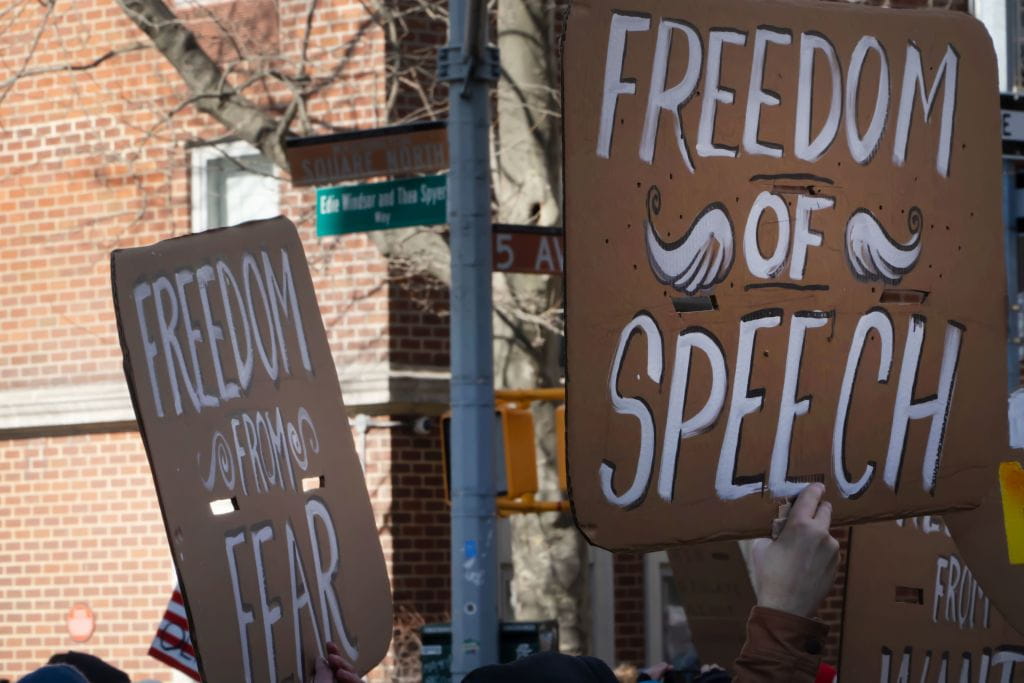
“[H]arming the reputation or electoral prospects of a candidate in an election or changing the voting behavior of voters in an election,” is nothing new; it’s a time-honored tradition, for better or worse. Most certainly, it is free speech protected by the First Amendment.
No Free Speech in Election Season
The disputed Hawaii law specifically targets such activity during election seasons. But that is defined as running from the first day of February up to election day in November for every even-numbered year. For nine months out of every other year, then, the quaint concept of free speech is sidelined so that undesirables don’t get to engage in electioneering.
Act 191 includes a stunningly broad definition of “materially deceptive media.” The law prohibits pretty much all conceivable political discourse, one might say. Though interestingly, there are exceptions for “broadcasters” and “certain service providers.”
The cherished guardians of the Fourth Estate, then, can still indulge in however much editorializing, deceptive editing, and even outright lying they wish to – thus influencing the same electorate and harming the reputations of the same candidates that are off limits to everyone else.
Judge Shanlyn A.S. Park ruled the Hawaii law violates the 14th Amendment in that it “imposes a risk assessment based solely on the value judgments and biases of the enforcement agency – which could conceivably lead to discretionary and targeted enforcement that discriminates based on viewpoint.” The result of this constitutes “a chilling effect on First Amendment speech.”
The state of Hawaii is now permanently enjoined from enforcing Act 191.
Such laws have often been referred to as “deepfake laws,” or “anti-deepfake laws,” created in response to the birth of “deepfake” videos generated using artificial intelligence. However, it seems quite apparent that the legislators who craft these measures are attempting to use the opportunity to outlaw political debate outside of the halls of power and establishment TV news studios and editorial offices.
It’s About More Than Deepfakes and Laughs
The Babylon Bee was caught up in a similar legal challenge to a California “anti-deepfake” law. On that occasion, Elon Musk’s X social media platform led the challenge, and in April of 2025, that law was struck down by a federal judge.