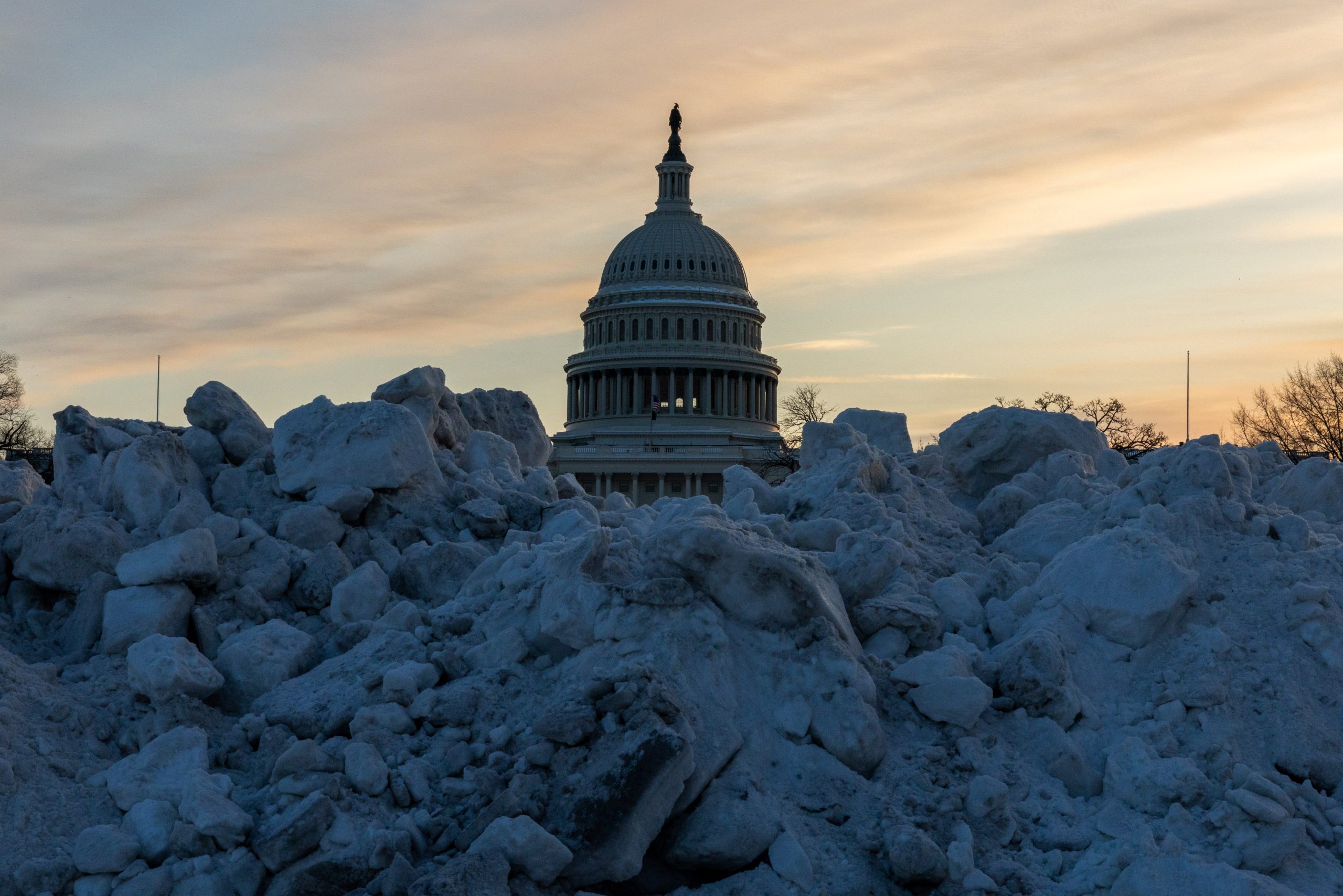
Temperatures in the district remained below freezing for nine straight days for the first time since 1989
Mainstream media outlets have long reported that climate change would bring “mild-ish” winters to Washington, D.C., that are “more like the South” than the Mid-Atlantic. Then D.C. experienced its longest cold streak in more than three decades.
Temperatures in the district remained below freezing for a nine-day period ending on Feb. 2, 2026, the longest streak since December 1989, according to the Washington Post. That may surprise the Post‘s readers: In February and December of 2020, the outlet reported that “global warming” and “human-caused climate change” were making D.C.’s winters “more Southern.”
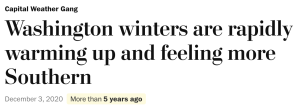
“Thanks mostly to a combination of human-caused climate change and urbanization, winters in Washington are warming hastily and taking on an entirely new character,” wrote “climate reporter” Ian Livingston and “climate editor” Andrew Freedman in their December 2020 piece headlined, “Washington winters are rapidly warming up and feeling more Southern.” “Our winter climate is on a southbound journey, with nothing in the way. … The frequency of bitterly cold winter days is in decline.”
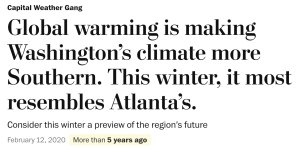
Months earlier, Jason Samenow, another writer on the Post’s climate team—which at its height was staffed by more than 30 people—came to a similar conclusion. He penned a piece headlined, “Global warming is making Washington’s climate more Southern. This winter, it most resembles Atlanta’s.”
“Since the winter solstice on Dec. 21, Washington’s weather has taken an excursion toward a far more southern clime,” Samenow wrote. “Because of human-induced climate warming, winters like this—characterized by a lack of extreme cold and spotty snowfall—may become the norm this century.”
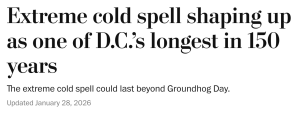
Six years later, such conditions are far from the norm in the district. High temperatures remained in the 20s or lower for five consecutive days in late January, with lows near single digits and subzero wind chills. Had the temperature not briefly reached the mid-30s on Feb. 2, D.C.’s below-freezing streak would have hit 10 days. There hasn’t been a 10-day streak since 1935.
The Post, with its prodigious climate team—recently rolled into a “futures” department—stands out for its aggressive coverage. But the Post was hardly the only liberal publisher predicting a rash of warm D.C. winters. In November, Axios, which has a large “Energy and Climate” vertical, predicted a “mild-ish” winter with less-than-average snowfall. In an example of the circular method of reporting common in Washington, Axios cited reporting from the Post, which in turn cited experts asserting that D.C. residents shouldn’t expect “loads of white stuff this winter.” (The record cold streak included nearly 10 inches of snow in D.C. and surrounding areas.)
Several news outlets have been quick to explain the weather away. The cause: climate change.
Inside Climate News proclaimed that the winter storm was “fueled by global warming.” Climate Central, a left-leaning research firm that pins extreme weather events on climate change and is often quoted in mainstream outlets, told its readers that “despite the size and severity of a recent U.S. winter storm, long-term trends show that the planet is overheating, winter is warming quickly, and the coldest days of the year are losing their chill.”
Had D.C.’s winter indeed resembled Atlanta’s, the cold streak would have been more mild. Temperatures in the Georgia city remained below freezing for a brief period between Jan. 31 and Feb. 1 before rising to 50 degrees on Monday.
Other national publishers have been spreading the fears of climate doom well past Washington, D.C. Twice, 10 years apart, in 2014 and 2024, the New York Times published a piece with the same title: “The End of Snow.” The 2014 version had a question mark at the end (“The End of Snow?” by Porter Fox, an editor at Powder magazine), while the 2024 version, by Gawker cofounder Elizabeth Spiers, dropped the question mark to flatly declare “The End of Snow.” Spiers, not a meteorologist, wrote that “a few years ago, when it was in the high 60s in Brooklyn for a few days in January, I wondered if I should increase my anti-anxiety meds.”
This past weekend, the last weekend in January, temperatures in Brooklyn dropped to the low teens. Thirteen hundred miles south, in “subtropical” New Orleans, in the middle of Mardi Gras, temperatures dropped to the low twenties, with wind making it feel more like single digits.