OAN Staff Cory Hawkins and Brooke Mallory
2:32 PM – Wednesday, February 4, 2026
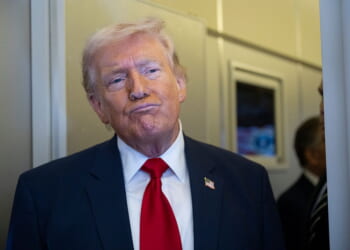
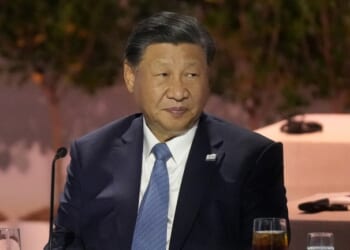
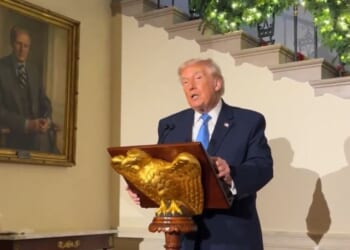
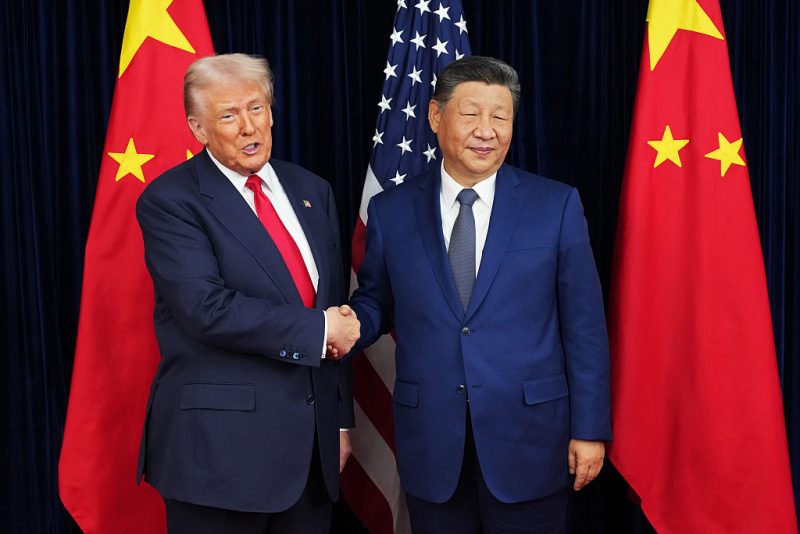
President Donald Trump described a Wednesday call with Chinese President Xi Jinping as “excellent,” noting that their discussions on trade and foreign conflicts served to pave the way for his upcoming visit to Beijing this April.
“I have just completed an excellent telephone conversation with President Xi of China. It was a long and thorough call, where many important subjects were discussed, including Trade, Military, the April trip that I will be making to China (which I very much look forward to!), Taiwan, the War between Russia/Ukraine, the current situation with Iran, the purchase of Oil and Gas by China from the United States, the consideration by China of the purchase of additional Agricultural products including lifting the Soybean count to 20 Million Tons for the current season,” Trump wrote in a Wednesday post on Truth Social.
The conversation appears to have balanced significant trade progress against deepening geopolitical friction.
During the call, the Chinese Foreign Ministry further highlighted the “sound communication” between President Xi and President Trump over the past year, pointing to their “successful” Busan summit in October as a cornerstone of the relationship.
Writer’s Note: In Chinese diplomacy, the Ministry of Foreign Affairs, or state media like Xinhua News Agency and China Central Television (CCTV), typically serve as the official voice for the president’s office. When reports say “The Chinese Foreign Ministry said…,” they are citing the official readout — a formal written summary released by the Ministry shortly after the call ends. Although Xi personally spoke with Trump, the Foreign Ministry often packages and presents his remarks as the authoritative public record — which is why the “sound communication” quote is attributed to the Ministry rather than Xi.
Building on their October meeting, where Trump agreed to a 10% tariff reduction in exchange for a Chinese government crackdown on fentanyl smuggling, the latest discussion focused on substantial agricultural gains. China has reportedly pledged to purchase 25 million tons of U.S. soybeans next season, up from the current 20 million tons.
Both leaders also highlighted recent airplane engine deliveries as a notable sign of stabilizing trade during the call as well — reflecting a critical economic truce within the broader U.S.-China rivalry, involving the CFM LEAP-1C engines produced by U.S.-based GE Aerospace and France’s Safran.
These engines are the sole power source for China’s homegrown commercial jet, the COMAC C919, which Beijing views as its primary competitor to Boeing and Airbus. After the Trump administration briefly suspended export licenses for these engines in May 2025, a move that threatened to cripple China’s commercial aviation ambitions, the ban was lifted in July last year as part of a wider de-escalation.
By noting the resumption of these deliveries in the call, President Trump and Xi signaled a commitment to maintaining high-value trade in sectors where they remain interdependent.
However, these economic breakthroughs were reportedly still overshadowed by the persistent friction over Taiwan, an issue China maintains is non-negotiable. Even as the two leaders discussed trade stability, during the call, Xi reiterated to Trump that Beijing views Taiwan as its own territory while criticizing the White House’s ongoing military support for the island.
In December, Trump approved a record-breaking $11 billion arms package for Taipei. This move triggered an immediate escalation in Chinese military drills and prompted Xi to warn that U.S. interference is actively destabilizing the foundation of the bilateral relationship.
Last month, the U.S. Department of Commerce also finalized a trade and investment agreement with Taiwan where, in exchange, the U.S. agreed to cap reciprocal tariffs on most Taiwanese goods at 15%, while applying a 0% tariff to key categories including generic pharmaceuticals, their active ingredients, aircraft components and certain essential natural resources.
“The Taiwan question is the most important issue in China-U.S. relations … China must safeguard its own sovereignty and territorial integrity, and will never allow Taiwan to be separated. The U.S. must handle the issue of arms sales to Taiwan with prudence,” Xi reportedly stated after the phone call with Trump.
While the official Chinese readout notably omitted any mention of Russia, Trump’s own post-call statements confirmed that his discussion with Xi covered both Iran and the Russia-Ukraine conflict. This omission stands in contrast to Xi’s virtual call with Russian President Vladimir Putin hours earlier, during which he promised that Sino-Russian relations “will keep growing with great vitality.”
Although China provides significant financial support to Russia, it is important to clarify that Russia is not a communist state, despite both nations sharing a strategic partnership centered on oil trade and the exchange of military components. While it has become more autocratic under Putin, Russia’s economy is based on state-influenced capitalism, not the Marxist-Leninist model used by the Chinese Communist Party.
Meanwhile, despite the underlying tensions regarding Taiwan, Trump described the exchange as “very positive” overall.
“The relationship with China, and my personal relationship with President Xi, is an extremely good one, and we both realize how important it is to keep it that way. I believe that there will be many positive results achieved over the next three years of my Presidency, having to do with President Xi, and the People’s Republic of China!” Trump’s post continued.
President Trump’s planned visit to Beijing in April has been described as a high-stakes “business trip” designed to solidify economic gains and address critical global security issues. A central goal of the summit is to finalize “massive” trade commitments, particularly regarding the export of U.S. oil, gas, and agricultural products like soybeans, alongside high-tech deliveries.
Beyond trade, the 47th president reportedly intends to leverage his personal rapport with Xi to pressure China into isolating Iran and playing a more active role in resolving the Russia-Ukraine conflict.
Additionally, Trump is seeking to draw China into a new trilateral nuclear arms control framework while simultaneously managing the delicate “Taiwan question” to ensure that ongoing military tensions do not derail the prospect of more stable bilateral relations.
Stay informed! Receive breaking news blasts directly to your inbox for free. Subscribe here. https://www.oann.com/alerts
What do YOU think? Click here to jump to the comments!
Sponsored Content Below