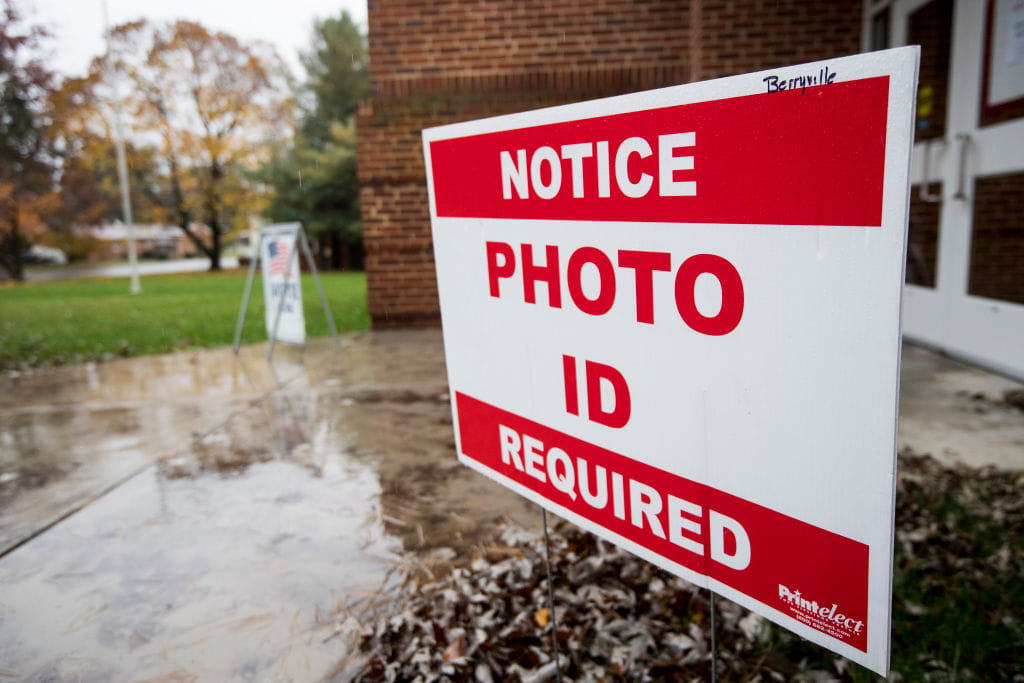
The concept of political unity is more honored in breach than in observance. Lip service is pro forma, and the power players in Washington, DC, rest their campaigns on a “unity” that tends to exist only within their own party. But when an issue arises that has not only a broad consensus but also overwhelming support, it seems that the nation’s politicos are content to defend a true minority position. Such is the case with voter ID laws.
Almost every major developed nation has voter ID laws that require people to present official identification when casting a ballot; indeed, showing a photo verification is considered essential to building trust in electoral systems. And yet, with the Safeguard American Voter Eligibility (SAVE) Act doing the congressional rounds, a startling division appears to be forming.
Voter ID – ‘If You Can Keep It’
On Monday (Feb. 2), Senate Minority Leader Chuck Schumer hailed the pending legislation as “Jim Crow 2.0.” He said, “It would disenfranchise millions of Americans. Every single Senate Democrat will vote against any bill that contains it.” And those 47 Democratic senators (including two independents who caucus with them) are enough to block the already-House-passed bill from becoming law. Just how democratic are Democrats being with their stance?
Pew Research Center polling shows that 83% of Americans want voter ID – an increase of 2% from last year and 7% from 2024. Of course, one might argue about differences in party affiliation or race, but even here, the numbers are overwhelmingly in favor of it.
Unsurprisingly, 95% of GOP voters want ID at the ballot box, but so do 71% of Democratic voters. Getting more granular, 85% of white voters support it, as well as 82% of Latinos and 76% of black voters. This topic is, by definition, an 80-20 issue.
When Schumer claims ID for voting is “Jim Crow 2.0,” he is not defending the will of black Americans, or at least not 76% of them. He may well disagree with the provisions in the bill or the various forms of ID that would be accepted. And yet, he is not making that case.
Bills should always be weighed, measured, and criticized. Deliberation is how a nation remains stable. But calling voter ID racist as his first line of defense is neither deliberative nor factually true. Indeed, some might accuse him of denying democracy for personal political gain. He and apparently “every single” one of his Democrat colleagues would do well to examine the data before reverting to identity politics.
A Case Study Across the Pond
A new British law in 2023 required that photographic identification be presented in order to cast a ballot. Perhaps unsurprisingly, Britain’s political left was simpatico with their ideological cousins in the United States and decried the move as denying the vote to the poor and minorities. But the data presented something quite different.
The first nationwide test was the 2024 general election. Turnout was around 7% lower than usual; however, this was most likely due to a political apathy brought about by a chaotic Tory government losing prime ministers at an alarming rate, and a deeply unpopular Labour Party that nevertheless went on to win a “loveless landslide.” But what of the data on Voter ID?
A study by the University of Manchester cried calamity in its post-election review, noting, “Around 1.3% of electors – or over half a million people – were turned away or didn’t show up at all because of voter identification requirements.” This figure, along with the study, has been widely cited in criticisms of voter ID laws. However, as always, the devil is in the details.
First, a valid ID was available to everyone upon request as part of a national campaign by the Electoral Commission. Those who wanted it could have gotten it. More importantly, the figures cited above are broken down by party affiliation, with the largest cohort being those who “would not vote.” So, there is a schism here. It appears that numerous people against the notion of voter ID chose to take a stand by not voting, and some who would not have voted anyway claimed that they couldn’t.
But here’s the rub: Confidence that elections are run fairly is up. And as a bonus, support for voter ID, since it was introduced, has gone up by eight points.
A No-Turning-Back Scenario
The data shows that once voter ID is introduced, the public gains more trust in elections and further favors the use of ID for voting. Once implemented, it seems that the electorate is loath to go back.