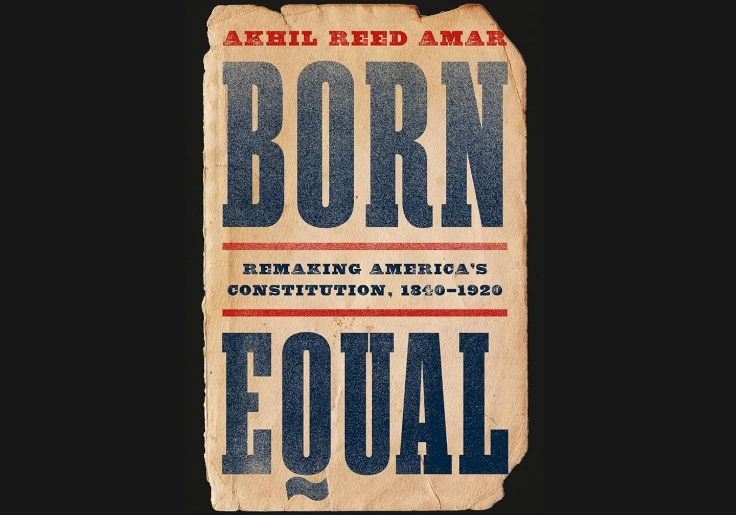
Akhil Reed Amar’s Born Equal: Remaking America’s Constitution, 1840–1920 covers a period of American history that most of us learned as a series of familiar episodes: the crisis of the 1850s, the Civil War, Reconstruction’s rise and fall, the boom of the late 19th century, and the reforms of the Progressive Era. In the standard telling, the Constitution is the province of officials in the federal government—amended in dramatic fashion after the war, interpreted by courts in a mostly linear fashion, grappled over by men with names like Clay and Calhoun until the Progressives came along to say they no longer had any interest in it. (In my family we joke that there were no presidents or Supreme Court decisions between the end of Reconstruction and the rise of Teddy Roosevelt—our high school and college U.S. history curricula pivoted hard to economic history for those three decades.) The business of the American people was business; obsession over constitutional text and foundational promises belonged to a small cadre of elites until it went underground and reappeared at the nation’s bicentennial.
Amar, a Yale constitutional scholar with wide-ranging interests and expertise, isn’t interested in the standard telling. That much was clear from The Words That Made Us, the first installment in the trilogy in which Born Equal sits in the middle position. His project is more ambitious and considerably more unsettling. He wants readers not merely to revisit these four-score tumultuous years, following the first 80 of independence and national identity, but to reconsider how constitutions change, who participates in that change, and how the 20th century inherited an order profoundly different from what the Constitution’s Framers crafted. Amar’s history isn’t about what law students generally study, which is courts unspooling legal doctrine from text or common law. It’s a story of popular mobilization, political struggle, and the cumulative redefinition of basic constitutional commitments. The Constitution that emerged by 1920—textually, structurally, in lived practice—had become something genuinely new.
The book’s central claim is that between 1840 and 1920 the United States experienced a prolonged constitutional transformation grounded in the principle that Americans are, paraphrasing the Declaration of Independence, “born equal.” President Abraham Lincoln, the most important figure of the period, turned that principle into a constitutional commitment by connecting our supreme law, the Constitution, to our national charter. The law was a silver frame; the Declaration was a “golden apple” to be adorned and preserved.
Lincoln was not alone. Indeed, Amar suggests, he was more a lagging indicator than leading. Amar traces how various movements—abolitionists, black activists, women’s rights advocates, immigrant communities, progressive reformers—pressed this principle into law, culminating in amendments that reshaped national identity. The Civil War Amendments form the book’s structural center: The 13th destroyed slavery and broadened federal enforcement authority; the 14th constitutionalized birthright citizenship, equal protection, and national civil rights; and the 15th enshrined racial nondiscrimination in voting. Amar then follows the thread forward, showing how later reforms—the 17th Amendment’s democratization of the Senate, the 19th Amendment’s guarantee of women’s suffrage, and the broader progressive concern with political equality—extended the logic Reconstruction set in motion.
Textual amendment is only part of the story. Amar emphasizes what he calls the nation’s “constitutional conversation,” the extended political and social processes that give amendments meaning over time. Even after Reconstruction faltered, the constitutional transformations it inaugurated continued to develop in political practice, popular debate, and incremental legal change. By 1920, Amar shows, the United States was governed by a refounded order—an equality-centric constitutional structure far broader than what earlier generations had envisioned. An egalitarian movement that had showed itself narrowly at first as a slavery-abolition campaign—so narrow that in 1840 women like Elizabeth Cady Stanton were kicked out of a sex-segregated abolitionist convention in London—came to put the Declaration’s primary stated principle at the heart of American law.
The revisionism here cuts in multiple directions. Amar pushes back against the tendency—common in legal academia and judicial practice—to treat courts as the primary agents of constitutional meaning. In Amar’s telling, popular movements and legislative acts often led, with courts following, resisting, or selectively confirming changes already made on the ground. Refreshingly, the Supreme Court is not treated as the primary constitutional actor. This undermines the tidy division between “politics” and “law” that dominates mainstream understandings of constitutional development, without falling into the legal realists’ nihilistic assertion that law is all power and no principle.
Amar is an exceptional stylist. He delights in patterns of parallelism, in unexpected symmetries between eras, in the serendipity of historical coincidence. He has a gift for recovering the personalities that animated the period—from recognized giants like Lincoln, Frederick Douglass, and Stanton to lesser-known figures whose activism shaped constitutional meaning from the grassroots. His prose makes these characters vivid, reminding us that constitutional change has always been driven by people with complicated motives, remarkable courage, and sometimes surprising blind spots.
The storytelling sometimes threatens to overshadow the argument. Amar’s narrative is rich—almost decadent—with intricately drawn episodes, political context, and biographical color. For readers trying to follow the major legal-historical threads, the density of detail occasionally obscures rather than illuminates his thesis. Amar writes like a historian intoxicated by the archive’s abundance. That exuberance is part of his charm, but it can make the intellectual through-line harder to track.
More substantively, Amar is an originalist, but his emphasis on “constitutional conversation” requires some originalist reinforcement. Constitutions derive authority not from diffuse social energies but from their embodiment in text—the fixed, publicly enacted compromises that survived deliberation and ratification. For originalists, the text is the Constitution; everything else is commentary. Of course, text without context is pretext. To understand what the text means, Amar’s history is crucial. But there is a risk that focusing on social history can undermine the foundation of originalism.
Once the focus shifts from enacted words to surrounding “conversation,” a critical question emerges: Who counts as part of that conversation? History’s vagaries distort the answer. Loud voices drown out others. Small but mighty coalitions appear to speak for the nation when they represent only a faction. Later interpreters can mistakenly treat lost political movements as constitutionally irrelevant, or perhaps unduly important. While constitutional history is illuminating, it has no authority of its own, not least because it is history, and history can afford endless contestation. Texts are durable and democratically ratified. Amar’s approach, however illuminating, risks diffusing constitutional authority into a fog of endless contextualization, derogating legal battles to arguments over everything but the law. To be clear, Amar does not argue that that is how his history should be used. One simply imagines unscrupulous readers using this wealth of material in reckless ways.
Still, Born Equal offers a valuable reminder that law and history are inseparable. Amar restores the social, political, and human context without which constitutional developments become sterile exercises in textual parsing. His elaborate narrative reminds us that constitutional text isn’t ink on parchment floating in the ether but a set of commitments fought over—sometimes figuratively, sometimes literally—until they became consensus. They also set the battlelines for future movements seeking to connect their view of the good, true, and just to the national story. That is Amar’s greatest lesson, whether he intends it, exactly, or not: America’s constitutional story is one of a nation striving, sometimes haltingly, sometimes heroically, to bring its practices into closer alignment with its loftiest principles. For anyone interested in how the United States became the more perfect union it is today, Amar’s history is as indispensable as it is adventurous.
Born Equal: Remaking America’s Constitution, 1840–1920
by Akhil Reed Amar
Basic Books, 736 pp., $40
Tal Fortgang is a legal policy fellow and adviser to the president at the Manhattan Institute.