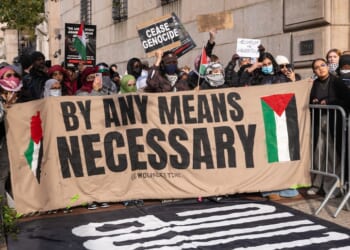
“I want to tell you, Gorsuch. I want to tell you, Kavanaugh. You have released the whirlwind, and you will pay the price. You won’t know what hit you if you go forward with these awful decisions,” —Sen. Chuck Schumer (D-N.Y.), referring to an abortion case, on the steps of the Supreme Court, March 4, 2020.
“On October 1, 2017, a shooter opened fire from a hotel room overlooking an outdoor concert in Las Vegas, Nevada, in what would become the deadliest mass shooting in U. S. history. Within a matter of minutes, using several hundred rounds of ammunition, the shooter killed 58 people and wounded over 500. He did so by affixing bump stocks to commonly available, semiautomatic rifles.” —Justice Sonia Sotomayor’s dissent in Garland v. Cargill, June 14, 2024.
What do these two statements have in common? They are both arguments that the outcome of a legal case should be paramount, and the reasoning to get there must be subservient to it. It is an argument John Adams faced head-on, as the lead counsel in the defense of the British soldiers on trial for their lives for the shootings in the so-called “Boston Massacre.”
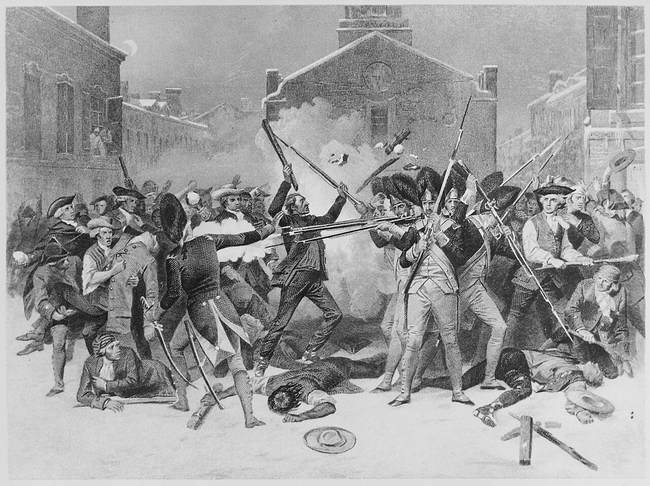
The evening of March 5, 1770, started out quiet and cold in Boston. The trouble began with a couple of barber apprentices mouthing off to a sentry. Having had enough of their lip, he gave one of the boys a stiff rap on the ear with the butt of his musket. Their cries drew a crowd, and throwing snowballs at the sentry escalated to clam shells and chunks of ice. A corporal’s guard, under the command of a Redcoat captain, came to the sentry’s aid, but soon sailors and rope makers arrived with cordwood clubs.
One of those sailors, an African American named Crispus Attucks, engaged one of the soldiers with his club and grabbed his bayonet. The soldier slipped on the ice and went down, then rose in red-hot anger and fired his piece. The other soldiers, perhaps thinking an order had been given, fired in ragged succession. Five civilians lay dead or dying, and another half-dozen were wounded.
Cries immediately rose to retrieve the muskets in Faneuil Hall and light a tar barrel on Beacon Hill. This signal would have summoned militia from the surrounding towns. Had that been carried out, the American Revolution would have begun five years earlier than it did. The acting governor arrived, spoke from the balcony of the townhouse just above the scene of the carnage, and managed to disperse the crowd, saying, “Let the law have its course. I will live and die by the law.”
As one can imagine, retaining adequate defense counsel for the Redcoats in that town would prove problematic. Two young, idealistic lawyers agreed to take the case on the condition that their mentor, John Adams, agree to take the first chair. Adams was persuaded to do so. Decades later, after a career culminating in the presidency of the United States, he wrote that it was “…one of the best pieces of service I have ever rendered my country.”
As “an officer and a gentleman,” the Redcoat captain was allowed to be tried separately from the enlisted men. His case would be the easier of the two for the defense, both in and out of the courtroom. The town’s bloodlust was less acute in his case than it was for those who pulled the triggers, and it was obvious that no British officer would give the command to fire when the men were at “charged bayonets” (musket butt beside the hip, bayonet angled upward) and while he was standing in front of them. When the “not guilty” verdict came down, the streets were relatively quiet.
The soldiers would be a different matter altogether, especially now that it was clear they had no orders to fire. “Blood requires blood!” was the watchword upon the streets, in the taverns and coffee houses, and in the newspapers. A wildly inaccurate and inflammatory engraving depicting the shooting in bloody fashion made its rounds:
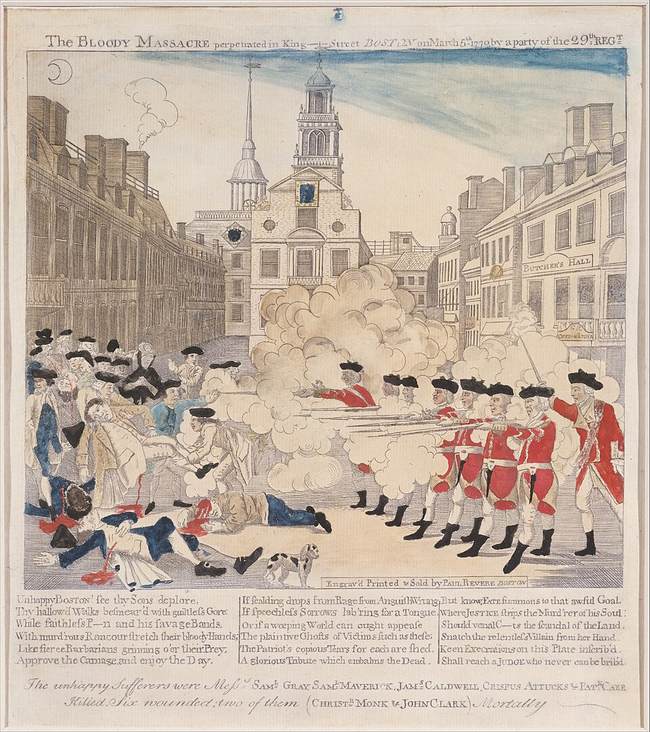
Its creator, Paul Revere, knew full well it was what we call “fake news” today, since he is also credited with the accurate drawing used in the trials.
“I am for the prisoners at the bar…” John Adams simply said, as he began his trial summation, which was followed by a thorough review of the testimony given over the course of several days (this was the longest trial in the colony’s history to that point). His conclusion is worth quoting from at length:
I will enlarge no more upon the evidence but submit it to you. Facts are stubborn things, and whatever may be our wishes, our inclinations, or the dictates of our passions, they cannot alter the state of facts and evidence, nor is the law less stable than the fact; if an assault was made to endanger their lives the law is clear, they had a right to kill in their own defense; if it was not so severe as to endanger their lives, yet if they were assaulted at all… the law reduces the offense of killing down to manslaughter, in consideration of those passions in our nature which cannot be eradicated. To your candor and justice, I submit the prisoners and their cause. The law, in all vicissitudes of government, fluctuations of the passions, or flights of enthusiasm, will preserve a steady undeviating course; it will not bend to the uncertain wishes, imaginations and wanton tempers of men. To use the words of a great and worthy man… Algernon Sydney… ‘The law,’ says he, ‘no passion can disturb. Tis void of desire and fear, lust and anger. Tis mens sine affectu, written reason, retaining some measure of divine perfection. It does not enjoin that which pleases a weak, frail man, but without any regard to persons, commands that which is good, and punishes evil in all, whether rich, or poor, high or low. Tis deaf, inexorable, inflexible.’ On the one hand it is inexorable to the cries and lamentations of the prisoners, on the other it is deaf, deaf as an adder, to the clamors of the populace.
The jury verdict came down that all but two of the soldiers were not guilty, and the remaining two were guilty of manslaughter only.
“Deaf, deaf as an adder, to the clamors of the populace.” Those words should ring in our ears every time we are confronted with the “Red Queen” logic of “sentence first,” especially in this unhealthy mixture of politics and jurisprudence we find all around us. Should that logic prevail, not only will we lose the guarantees of limited and separated political power, but also the ancient rights those Redcoats of long ago possessed, going back to the Magna Carta and beyond. All will be sacrificed upon the altar of outcome.
The culture doesn’t take a day off—and neither do we.
PJ Media VIP gives you exclusive access to original reporting, sharp commentary, and voices that won’t bend the knee. For a limited time, get 60% off your VIP membership with the promo code FIGHT.
Join PJ Media VIP and stand with independent conservative media.