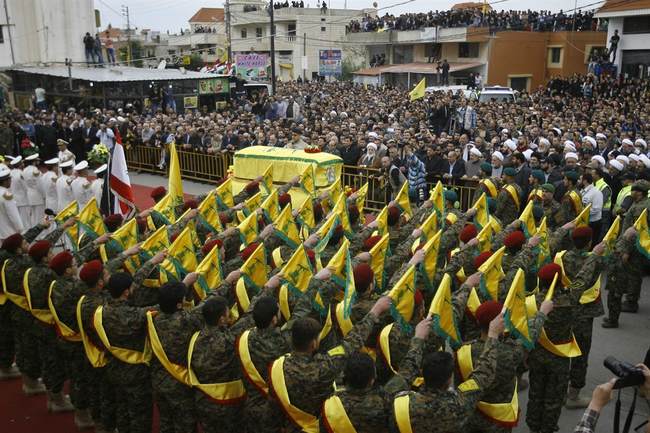
Last Monday, the Lebanese cabinet finally steeled itself and ordered Hezbollah, the social service /terrorist organization, to disarm.
It was a long time coming. The brutal and bloody Lebanese Civil War, fought between 1975 and 1990, killed 150,000 people and resulted in more than a million Lebanese, a majority of them Christian, exiting the country.
The 1990 Taif Agreement ended the conflict by ordering all of the sectarian militias to disarm and disband. The Christian Phalangists, the Sunni Lebanese National Movement (LNM), and the Shiite Amal (Hope), as well as several smaller militias, including the armed Druze militias, all obeyed the terms of the peace treaty.
Hezbollah, which had come into existence in 1982, emerged as a coalition of various Lebanese Shiite militias and groups, which Iran’s Islamic Revolutionary Guard Corps (IRGC), which aimed to export its revolutionary ideology, heavily supported and fostered. They weren’t taking their orders from the Lebanese parliament or anyone but the Iranians. They refused to disarm as long as Israel occupied Southern Lebanon.
Hussein Ibish, a senior resident scholar at the Arab Gulf States Institute in Washington, writes in The Atlantic, “Hezbollah’s rationale for maintaining its weapons in 1989 was that Israel continued to occupy a large chunk of southern Lebanon, and this was widely accepted even by many who did not care for the organization.”
When Israel left Lebanese soil in 2000, Hezbollah maintained that a few disputed areas, including Shebaa Farms in the south, are Lebanese soil, while the Israelis and the UN maintain they are Israeli. This was their justification for not disarming then.
Several times in the last 25 years, the Lebanese government politely asked Hezbollah to disarm. The terrorists refused, and the Lebanese people suffered as a result. Two wars, thousands of dead Lebanese, but Lebanon’s government could not muster the courage or the strength to force the terrorists to give up their weapons.
Until Monday. That’s when the Lebanese cabinet bestirred itself and issued a direct challenge to Hezbollah to disarm.
The Lebanese State declares its absolute rejection, with no room for ambiguity or interpretation, of any military or security operations launched from Lebanese territories outside the framework of its legitimate institutions, and affirms that decisions of war and peace are exclusively its own, which necessitates the immediate prohibition of all of Hezbollah’s security and military activities as being outside the law, and obliges it to hand over its weapons to the Lebanese State, and to confine its activities to the political domain within constitutional and legal frameworks, in a manner that enshrines the exclusivity of arms in the hands of the State and reinforces its full sovereignty over the entirety of its territories. The Government requests all military and security agencies to take immediate measures to implement the above, and to prevent the carrying out of any military operation or the launching of rockets or drones from Lebanese territories, and to apprehend violators in accordance with the laws and regulations in force.
The cabinet also ordered the Lebanese Army “to proceed immediately and firmly with the implementation of the plan it presented at the Cabinet session on 16-2-2026 in the part pertaining to confining arms north of the Litani River, using all means that ensure the execution of this plan.”
What emboldened the cabinet to draw a line in the sand? Israel’s bombing campaigns, the “cell phone attacks,” and an extremely effective campaign to weaken and destroy Hezbollah’s leadership finally turned the tide and gave the Lebanese government an opening to get the terrorists under control.
After Hezbollah’s previous escalation with Israel ended with the fragile cease-fire, the political sands in Lebanon began to shift. That conflict cost the group much of its arsenal and wiped out its military ranks. Frustration brewed among its largely Shiite Muslim support base, many of whom were displaced during the war.
The Lebanese state used that moment as an opportunity. With Hezbollah on the back foot, Lebanon’s Parliament overcame years of political gridlock that critics had attributed to Hezbollah and formed a new government. Momentum built to disarm Hezbollah and remake the power balance in a country where many believed that the government had been effectively hijacked by the Iranian-backed militant group.
In the year since, the government and the Lebanese Army have come under fire for moving too slowly in those efforts. Military leaders have argued that their cautious approach reflects the military might still held by Hezbollah and concerns that a more aggressive crackdown could prompt clashes between soldiers and Hezbollah fighters, potentially spreading into broader domestic unrest.
Another change that gave the Lebanese civil authorities confidence that they could be successful in disarming Hezbollah is the extreme unpopularity of the group.
This is a 180-degree change from the way the people of Lebanon viewed Hezbollah in previous decades. They were seen as the “resistance” to Israel, heroes for standing up to the Jews. Their social service outreach was the only help Lebanon’s legions of poor could get, since the dysfunctional government was paralyzed and unable to help.
Then, in 2020, an explosion of more than 2700 pounds of ammonium nitrate in Beirut’s harbor, considered one of the largest non-nuclear explosions in history, killed more than 200 people and damaged half the city of Beirut. An investigation revealed that port management had been extraordinarily lax in storing the nitrates, and the resulting political crisis destroyed the Lebanese government. Only recently have they been able to form a coalition to govern the country.
Hezbollah came under suspicion for the blast. A recent investigation revealed that a covert Hezbollah unit, known as Unit 121, carried out a series of assassinations of individuals who were either investigating the blast or had knowledge of the port’s operations. This includes the high-profile 2021 murder of activist Lokman Slim. The blow to the group’s credibility was huge.
Also, the constant attacks on Israel and their devastating response have sickened the population. While Hezbollah is still popular in the Shiite community, trust is nearly nonexistent in the Sunni and Christian communities, as Hezbollah frequently polls under 10%. These groups largely view Hezbollah as a “state within a state” whose actions have invited foreign intervention and economic ruin.
Can the government succeed in disarming Hezbollah?
The Atlantic:
Enforcing the ban is going to be a difficult and lengthy process. The government began this week by arresting 27 people on weapons charges. Hezbollah has already denounced and defied the ban, continuing to engage militarily with Israel, which has sent troops into southern Lebanon and is still pounding the organization from the air—including in a new round of strikes in Beirut this morning. The Lebanese state is going to have to proceed with both determination and caution. Much of the Shiite community is still traumatized from the most recent war with Israel and could overreact to any perceived threats to its security. Preventing Hezbollah from rebuilding systems and weapons that it has lost is one thing. Actively taking weapons away is another—but this is what the state has committed to doing. It has no choice. If the Lebanese government cannot reassert its monopoly on the use of force and decisions of war and peace, it will remain a failing state—the host of a cancerous growth that turns the body politic against itself.
Even if Iran orders Hezbollah to disarm, the terrorists are not going to give up their weapons. The guns are a huge part of their identity. And while they have lost some support among Shiites, they still get a solid majority to support them.
Lebanon may be doomed to fight another long, bloody civil war. Or, more likely, the government will give up its efforts to disarm the terrorists. Since the UN can’t enforce its own Security Council resolutions (1559 and 1701), no one else except Israel will try to disarm Hezbollah, either.
PJ Media will give you all the information you need to understand the decisions that will be made this year. Insightful commentary and straight-on, no-BS news reporting have been our hallmarks since 2005.
Get 60% off your new VIP membership by using the code FIGHT. You won’t regret it.