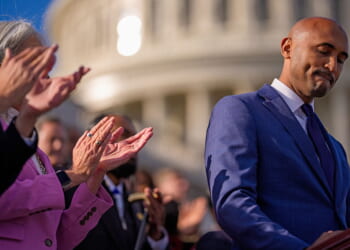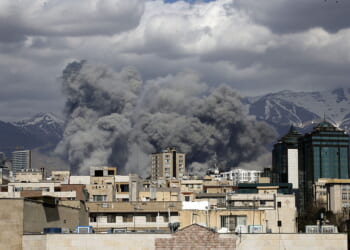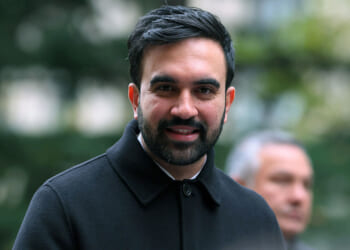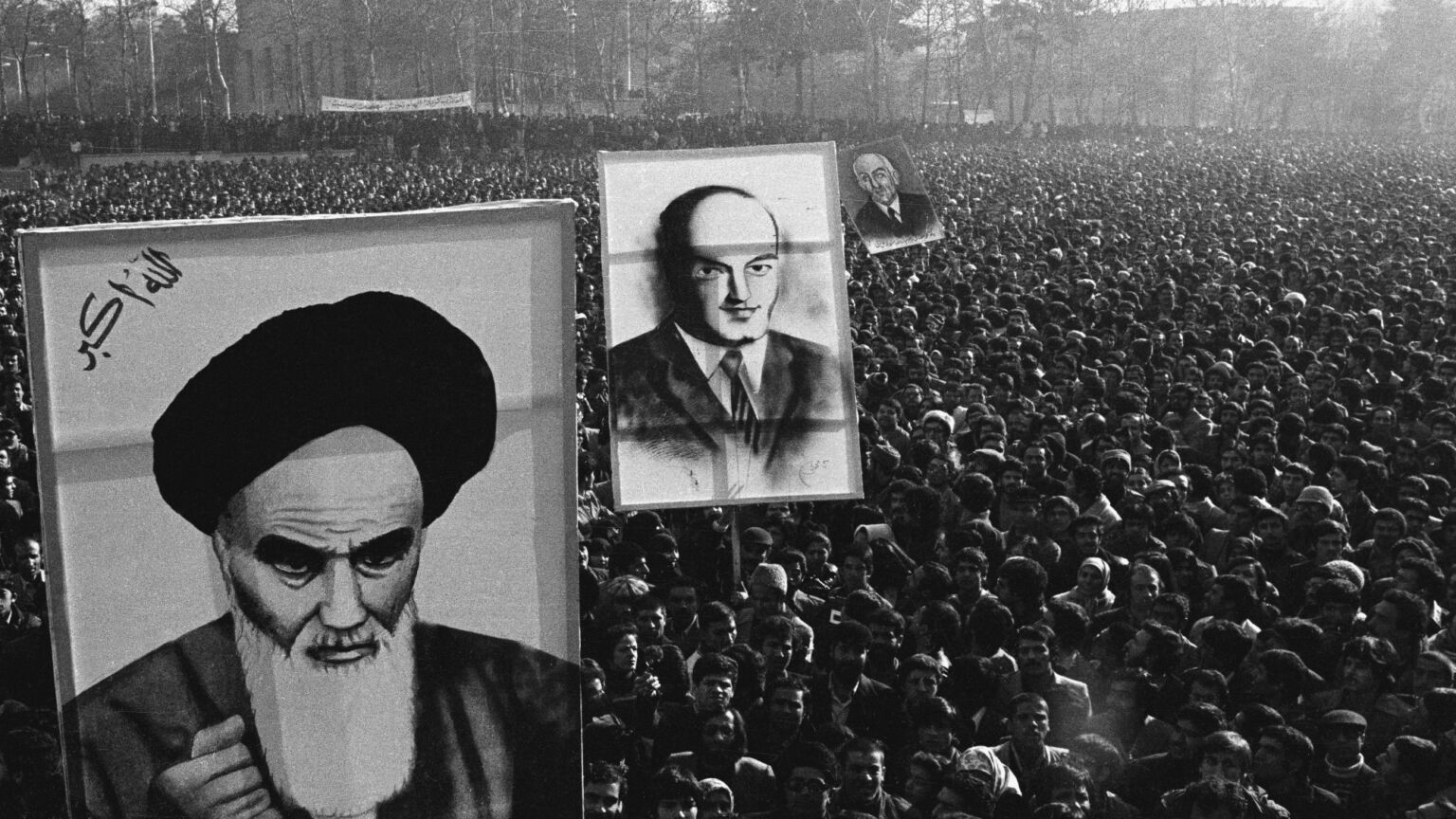
When Marxists and Islamists marched together through Tehran in 1978, or march together on elite university campuses today, many find it mystifying. Here are committed materialists and committed theists, ideological enemies by every reckoning, united in a single cause. Who is using whom, and who is fooling whom? A large supply of boxed clichés, such as ‘useful idiots’ or ‘Islamists hijacking the revolution’, has been needed to interpret the alliance and reassure Western observers. The problem is that the paradox is entirely in their mind. The relationship between the left and the Islamic Republic was never one of paradox but of shared genealogy – with both rooted in a shared, revolutionary vision of history. And the inability to read it as such was itself a symptom of the massive delusions we have been captured by, for well over a century.
A rival delusion exists in decolonial literature, a sophisticated body of work produced by a Western academy that has already surrendered to revolutionary kitsch. It insists that revolutionary movements in the non-Western world represent an authentic return, the recovery of suppressed identities, the colonised speaking at last in their own voice. On this account, the Iranian Revolution supposedly expressed something genuinely Islamic, reasserting its prerogatives; the movements carrying its banner today are indigenous, organic and rooted.
These claims are comically wrong about Iran – a country that has never been colonised, at least not by any Western power since Alexander the Great. But they’re deeply revealing about a Western university system that has become a Sovietised hub of resentment, mediocrity and dishonesty. The ‘liberation of Palestine’, which functions in contemporary left-wing culture as a type of revolutionary gnosis – a modern political form of the ancient, esoteric knowledge of the divine, of good and evil – is the current end point of these delusions. The ‘liberation of Palestine’, as the terminus of history, is thus a sacred horizon that consecrates any means and transforms opponents into metaphysical enemies. One does not negotiate with metaphysical enemies; one annihilates them. The observer who wonders why a movement invoking justice cannot produce a politics of peace has not yet grasped that it does not intend to. The liberation in question is really an eschatological event.
That so many Western writers and intellectuals have failed to see any of this is, on reflection, entirely predictable. ‘The literary mind cannot think politically’, historian Arthur Schlesinger never tired of proclaiming, and the evidence assembled over two centuries leaves the proposition beyond any serious dispute. The record is not, as many want to think, one of well-intentioned naïveté on the part of leftish Western intellectuals. It is a record of enthusiasm, Schwärmerei – the particular enthusiasm and excessive sentimentality of minds persuaded that they have finally found a subject equal to their gifts, a canvas sufficient for their rhetoric, a violence operatic enough to be aesthetically satisfying. Support for Stalinism was for decades practically a credential of seriousness among Western writers and artists; to have entertained doubt about it was to announce oneself as provincial, insufficiently tragic, congenitally unable to rise to the grandeur of history. When that enthusiasm exhausted itself towards the end of the 1950s, it found new objects.
And so even something as politically dreary and aesthetically kitsch as the Islamic Republic of Iran became an object of avant-garde admiration – even a young Salman Rushdie celebrated the revolution like a drunk lover before his beloved issued his death warrant. Such left-leaning, literary minds do not ask where a thing comes from. They ask how a thing feels, what it symbolises, and whether it rises to the occasion of their prose.
The Islamic Republic of Iran, which has drawn upon itself the consequences of a half-century of revolutionary ideology, was the unintended offspring of such a literary mind made even more dangerous by systematic philosophical education; a single, extraordinary and almost entirely misunderstood intellectual who translated Martin Heidegger’s work into Farsi, called Jean-Paul Sartre and Frantz Fanon his idols, spent his formative years in Paris, and proceeded to reconstruct the whole arc of Islamic sacred history as a mystified version of a Marxian theory of history, in which all events point towards an Islamicised, socialist ending. To understand Ali Shariati is to understand the Red-Green alliance, decolonialist narratives, and the ideological obsession with Palestinian liberation not as separate phenomena requiring separate explanations but as expressions of a single, revolutionary-cum-apocalyptic philosophy of history that has been operating, largely undetected, for the better part of a century.
Ali Shariati (1933-1977) was the son of an Iranian religious family. He was a romantic and intellectually ambitious young man who would produce a Marxist-Islamic synthesis that would indeed make history. Shariati’s childhood corresponded with a period of intense political and social instability. Before Shah Pahlavi consolidated power, and for a period after he did, Iran was a centre of Communist activity. Already in the 1940s and 1950s, Iranian radicals argued that Islam was quintessentially identical to socialism, and that 1,200 years before Marx, Muhammad had arrived at a rudimentary version of scientific socialism. As other Arab and Sunni revolutionaries were doing, Iranian Shia socialists, too, were rereading Islamic history in the light of revolution for social justice. The figure of Abu Dharr al-Ghifari, a 7th-century Muslim saint known for his vocal denunciation of the moral corruption of early Muslims, was reconstituted, as Shariati had it in his lectures, as ‘a committed, defiant, revolutionary Muslim who preaches equality, fraternity, justice and liberation’.
The Egyptian author and playwright, Gouda al-Sahar, had written a book about Abu Dharr that made a deep impression on the young Shariati, who was asked to translate it into Farsi by the Movement of God-Fearing Socialists society in 1954. Shariati’s translation provided an even more exaggerated, more fictitious and more radical image of Abu Dharr, transforming him into the forefather of the socialist egalitarianism of the post-French Revolution era. The operation was not unlike the European Marxist appropriation of Thomas Müntzer, the 16th-century German preacher and leader of the peasant revolt of 1525, whom Friedrich Engels recast as a proto-communist – the same revolutionary need producing the same historical falsification across entirely different cultural contexts. Shariati then spent years studying Hegel and Marx and their dialectical, revolutionary theories of history, and writing for radical publications.
In 1959, Shariati went to France to earn a doctorate at the University of Paris. In the French capital, with the Algerian Revolution as a backdrop, he encountered other Iranian radicals and convinced some of them to receive training in explosives from General Nasser’s revolutionary Egypt.
Shariati himself was a man of letters, not action. He loved books, philosophers, intellectuals; he loved Sartre and Fanon. He spent his years in Paris studying existentialism, Marxism and Islamic mysticism, and managed to translate Heidegger’s Being and Time into Farsi shortly after it was translated into Arabic in Egypt. Despite the fact that his doctoral thesis was in literature, Shariati manipulated the administrative system of the university to have his degree inscribed as ‘History of Medieval Islam’ – so that upon his return to Iran, he could teach history, not literature. This was not a minor bureaucratic manoeuvre. It was the first act of his larger project, one that Shariati understood was not literary but historical. What he intended was nothing less than the reconstruction of Islamic history along Marxian lines, as a history of mystified class struggle, and he needed the institutional credentials to do so.
After his return to Tehran in 1964, Shariati began writing and lecturing (at the Hosseinieh Ershad Institute), and gradually became the most dynamic and popular intellectual among Iranian youth. He provided something no one else could: a modern ideology built on socialism, existentialism and revolutionary zeal, yet completely and totally articulated in the language and symbols of Shia Islam. He merged Sufi esoteric mysticism with leftist revolutionary ideology more completely than anyone before him. In his lectures, Shariati advanced a sociological reading of Islamic history as a history of class struggle between the societies of shirk – an Islamic term for idolatry, which Shariati reinterpreted as bourgeois society – and the societies of faith, which were those of the proletariat. Between faith and disbelief, now filled with the content of Marxist class analysis, there was nothing but dialectical struggle. Islam, in Shariati’s thought, was the historical vehicle of this struggle. He had found an ingenious way to apply Marx’s analysis of the legal, cultural, ideological superstructure of society to Islam itself. He recast Islam not as a single tradition but as a site of class warfare – between true believers and religious authorities.
From this interpretive scheme, Shariati proceeded to provide a revolutionary re-interpretation of the entirety of Islamic knowledge – beginning with sacred history, from Adam and Eve through Cain and Abel, and ending with modern-day Iran. He effectively transformed the full Islamic sacred narrative into an Islamicised version of historical materialism, culminating in an Islamicised version of the communist end of history. Every stage of sacred history, every dramatic conflict, every prophetic figure became the marker of a new stage in the revolution of the faithful against the forces of disbelief. The emergence of Islam in 7th-century Arabia was the beginning of the final stage of struggle. The constitutive Islamic event of Hijra – Muhammad’s migration from Mecca to Medina – was rewritten by Shariati as ‘a revolutionary transition’ of social and economic organisation, ‘from the parasitic existence to a divine existence’. Every generation, Shariati taught, must undertake its own Hijra, its own transition from the religion of idolatry to the religion of true faith – in other words, its own movement from a bourgeois society, worshipping the false idols of wealth and consumption, to a society of communistic equality.
There are only two religions in Shariati’s cosmos: the true revolutionary consciousness, and the false consciousness maintained by orthodox religion and its authorities. As in Western Marxist historiography of the Christian church, the long history of conflict between Islamic religious orthodoxy and heterodox Muslims was reinterpreted as class struggle.
From this followed Shariati’s most consequential political move: he annexed Iran’s established Shia clergy to the forces of disbelief, accusing them of deceiving the people into acquiescence to the Shah’s regime. Democracy and liberalism were facades deployed by the oppressors. There was no solution but to follow the prophets, recast as Antonio Gramsci’s revolutionary organic intellectuals, and become revolutionaries and gnostics. ‘Islam invites the individual who wishes to experience God’, Shariati wrote, ‘to annihilate or negate himself in the people’. All prior mystical literature, he claimed, was merely an initiation for potential revolutionaries. Islam must be completely divorced from tradition and dissolved into revolution.
Shariati’s synthesis was almost identical in structure to Egyptian radical Islamist Sayyid Qutb’s shorter version in Milestones (1964), yet vastly more elaborate in its philosophical architecture. It remains the most extensive attempt to dissolve Islam into a revolutionary, fundamentally atheistic philosophy. His remarkable ability to use traditional Islamic images and symbols to articulate a fully Marxist synthesis is unmatched in its completeness, breadth and power.
The reason Shariati, Qutb, Islamists such as Yusuf al-Qaradawi and the Ayatollah Khomeini, playwright Ali Ahmed Bakathir and so many others understood the meaning of Islamic concepts (jihad, Hijra, Jahiliyyah, Sharia) in an identical manner is not that this is what Islam actually means. These thinkers arrived at identical interpretations because they shared the same thought structure – a structure produced by the decomposition of the Hegelian, Marxian theory of history in global culture. They all thought in terms of a quasi-historical, almost cosmic struggle with evil, invariably Western forces, culminating in an Islamicised version of a communist revolution. The revolutionary reading of Islam was not a discovery of Islam’s true essence; it was the inevitable product of a modern philosophical grammar that could only produce revolutionary meanings, regardless of the material upon which it operated.
Throughout his career, there was a gradual development in Shariati’s thought toward ever-deeper, more cryptic systems of revolutionary ‘knowledge’. His rhetoric was passionate, articulate and cultivated, yet like mysticism itself, it left the listener (he mostly lectured) less certain than before. One cannot extract from his lectures a coherent account of what his Islam actually means. It is an Islam that begins with socialism, existentialism and gnosticism – not to rest there but to combine them and undergo self-annihilation in them, arriving finally at something called Islam that bears no resemblance to any Islam that preceded it. When not offering mystical narcotics through his gifted oratory, Shariati called openly for vanguards and commended urban guerrilla warfare conducted by revolutionaries of every religion, for revolution was the authentic Islam. Channeling the convictions of the postwar French left, he told his followers that no revolution would come from Europe – the salvation of humankind was now the mission of the peoples of the Third World.
Shariati’s mobilisation of radical Iranian youth ultimately became a national security threat. He was arrested in 1973, imprisoned for 18 months, before eventually being permitted to leave for England, where he died in Southampton in 1977 – two years before he could see Ayatollah Khomeini leading the youth he had radicalised to the fulfillment of his dream. It was Shariati who had constructed the revolutionary language of modern Shia Islam; Shariati who had reconstructed the Shia imagination around the figure of the downtrodden Imam Hussein, the grandson of the Prophet Muhammad; Shariati who had fused social justice with sacred martyrdom into a single explosive compound. In his world, as in that of the most radical gnostic, there is finally no God – only a long process at whose end lies complete annihilation. For the traditional mystic, it is the self that is annihilated in the deity; for Shariati, it is the world that is annihilated in the revolutionary event.
Yet the revolution that Shariati, more than most, helped to ferment from the ground up ended by bringing to Iran and the Middle East not the liberation it promised but a revolutionary state of torture and terror ruled by a dictatorship – not of the Marxist philosopher-king but of the Islamic law-doctor-king. Where the secular left had filled the air with slogans of progress, the new regime filled it with martyrdom, death and the promise of total war for the liberation of Palestine. The philosopher had yielded to the jurist; the Paris café had yielded to the Shia seminary, but the revolution continued, unbroken and unrepentant, under a new name and always seeking death and destruction.