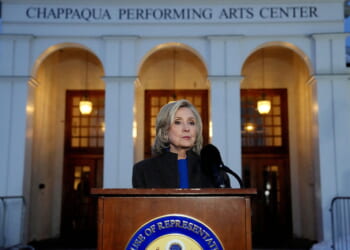
What happens when Americans choose to opt out of paying taxes? A 31-year-old lawyer in Chicago may have started a new resistance movement when posting an Instagram video declaring she wouldn’t pay her federal income taxes this year to protest the Trump administration. Rachel Cohen will file the paperwork, pay the state taxes, and put the $9,000 she is supposed to give the federal government into a savings account. She doesn’t want her money funding “concentration camps,” wars, and ICE operations, among other things. Numerous people online vow to do the same thing. It would be easy to label this as progressive theater for clicks, but there’s more than one side to this movement.
The Trump Agenda Sparks a Tax Revolt
Cohen’s video gained nearly 175,000 likes in the first ten days, with thousands of comments. A few warned her of the consequences; others said they weren’t paying either. “It’s worth the penalty,” one person wrote. “I can’t stomach the thought that our hard earned $$ is funding ICE, wars, and bailing out billionaires.” Another said he is also thinking about doing it because he doesn’t want his “tax dollars going for the malfeasance and destruction this administration is perpetrating.”
Cohen and her followers are not the first group to protest the president’s second term in this way. Lincoln Rice, head of the National War Tax Resistance Coordinating Committee (NWTRCC), said more people have been removing their money from the federal tax base since Trump returned to the Oval Office. In January, NWTRCC, a campaign group that encourages federal tax boycotts in the name of peace, held its largest-ever “War Tax Resistance 101” training. A few years ago, said Rice, it would’ve drawn a dozen or so attendees, but nearly 500 people showed up this year, and the group’s website gained over 110,000 unique visitors.
Rice said interest rose after the Department of Government Efficiency was created and again after the One Big Beautiful Bill Act was signed. Another spike occurred following the capture of Venezuela’s former dictator, Nicolás Maduro. But leftists are not the only people considering these boycotts.
Frustration on Both Sides
During the final days of 2025, numerous right-wing figures claimed they wouldn’t pay their federal taxes in 2026. “F*** it, I’m not paying taxes this year,” said Turning Point USA contributor Savanah Hernandez on X. “I’m not even joking, I am fully supporting Americans not paying taxes this year.” She said if the IRS came after her, she would turn it into a national story about the government chasing a couple of thousand dollars while billions are lost in fraud and spent on welfare programs for illegal immigrants. “I’m not paying for it anymore,” she said.
Even Marjorie Taylor Greene, nearly a week before she left Congress, chimed in. “Almost every Trump voter I see on X is so fed up they are planning a 2026 tax revolt,” she said. “Imagine if millions of Americans did this.”
Others posted similar sentiments around the same time. “What are the feds gonna do if we all just stop paying taxes?” said the Hodge Twins, conservative comedians who got their start on YouTube.
“THE WHOLE COUNTRY SHOULD STOP PAYING TAXES UNTIL THE CORRUPTION ENDS!!” said Rumble personality Graham Allen. “HIT THEM WHERE IT HURTS!! DEMAND ACCOUNTABILITY BY TAKING AWAY THEIR MONEY!!”
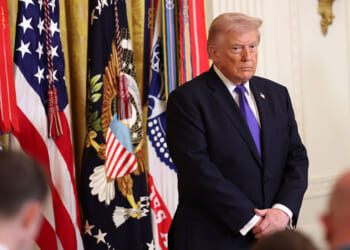
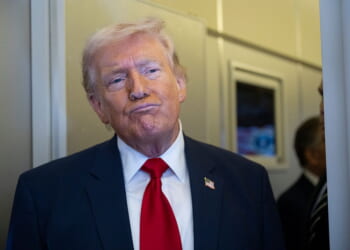
This all came just weeks after the president repeated his claim that income taxes might someday end because “the money we’re taking in is so great.” Apparently, some people don’t feel like waiting for that day to come.
So It Goes
Tax resistance in the United States is older than the Constitution. American colonists protested British taxation on tea imports in 1773 by tossing hundreds of chests of tea into the Boston Harbor. Taxpayers revolted during the Great Depression, and in the early 1970s, hundreds of thousands of Americans refused to pay the “telephone tax,” a 10% tax on phone bills to subsidize the Vietnam War.

Enthusiasm for tax resistance seemed to grow again when the country entered the first Trump era. In 2017, Ruth Benn, then a coordinator of the National War Tax Resistance Coordinating Committee, told The Guardian that visits to the committee’s website doubled earlier in the year. At the time, the committee estimated that about 8,000 people refused to pay federal income tax each year as an act of civil disobedience. Benn stopped paying her federal income tax around 1982, the year the committee was created, as a protest against the nuclear arms race during the Cold War. “I’ve never been taken to court,” she said.
None of this means it’s a good idea to quit paying the IRS. Let’s also keep in mind that just because a handful of people on the internet claim they will do something, it doesn’t mean they actually will. Besides, the nation is more than $30 trillion in debt, so a handful of protesters probably won’t make a noticeable difference. For such a resistance to have a profound impact, hundreds of thousands of Americans, if not more, would probably have to withhold their share.
Act or Action?
The Trump administration has reportedly decreased the IRS workforce by about 27% since last year. Some tax experts wonder whether the IRS will even be able to process taxes on time. Chasing after people who withhold a few thousand dollars might not be at the top of their list. These cases probably won’t even hit the IRS’s radar for a while – unless the agents spend time on Instagram.
Besides, the federal government can print more cash. Of course, that increases the money supply, leads to higher inflation, and decreases the purchasing power of the dollar. Prices rise, and paychecks don’t stretch as far. Who would that help? Not to mention, if anything took a cash loss from a tax revolt nowadays, it would likely be schools and social programs. The military will probably be funded one way or another. Deportations will continue; DHS is well-funded for the time being. And widespread fraud seems almost endless.
More than a few influencers would need to follow through with it for anything major to happen. How would the government even approach punishing, say, a million or more people for not paying their federal income taxes? At some point, with a high enough number of people, the resistance would probably be too big to fail. But for many, this trend seems more like cosplaying for status points than an act of civil disobedience.