The third set of indirect talks between the US and Iran in Geneva concluded on Thursday, February 26. According to CNN, “A key adviser to Iran’s supreme leader, Ayatollah Ali Khamenei, said today that an ‘immediate agreement’ between the United States and Iran could be within reach if the subject of talks is confined to Iran’s ‘non-production of nuclear weapons.’” However, from the US perspective, there are three elements to any peace agreement between the US and Iran: the end of all of Iran’s work to develop a nuclear weapon, the stoppage of production of long-range ballistic missiles, and the cessation of support to terrorist proxy groups. Iran has indicated it can be flexible if nuclear and non-nuclear issues are separated.
Discussions With Iran at the Technical Level
Though the Geneva negotiations are scheduled to continue at the technical level in Vienna through the week of March 2. Generally, at this level, there are no significant breakthroughs, as the discussions involve each side trying to understand what the other is actually saying. These talks will also put more granularity to the larger issues. Such talks are often referred to as confidence-building measures. Building trust and having confidence in conversations with the Iranians is no easy undertaking. Retired General Jack Keane, former Vice Chief of Staff of the Army, gave some indication of just how hard it is to negotiate with representatives from Tehran. He told Fox News Iranians are “diabolical, pathological liars that they don’t even admit that they are in pursuit of a nuclear weapon, despite the secret sites that they’ve had, despite the sites that we’ve bombed that are buried 250 feet underneath the ground.” However, over the last three meetings, the biggest sticking point seems to be the insistence by the Iranians that Tehran’s nuclear weapons development program and the refining of weapons-grade uranium should be negotiated first. Those discussions should be decoupled from negotiations on Iran’s ballistic missile development and production, as well as continued support for terrorist proxies in the region.
Reaching some agreement on the nuclear issue, apart from the ballistic missiles and terrorist proxies, would start to look like the flawed Obama-era Joint Comprehensive Plan of Action (JCPOA). The JCPOA was anything but comprehensive, making no mention of Iran’s ballistic missile program, developing a missile capable of carrying a nuclear weapon. Furthermore, it allowed Iran to continue being the number one sponsor of terrorism throughout the world. By not limiting Iran’s development and production of ballistic missiles, Israel and the rest of the Gulf States are at risk. Additionally, separating the nuclear issue from ballistic missiles and sponsoring terrorists is illogical. The US would be attempting to stop Iran’s development of nuclear weapon which it does not have…yet, in exchange for lifting economic sanctions. That would free up money for pursuing the development of longer-range, more effective ballistic missiles and continuing Tehran’s sponsorship of terrorists.

Iran would, over time, become an even more formidable enemy with conventional ballistic missiles and sending out its proxies than it is today. Afterall, the mullahs would get sanction relief in exchange for stopping a program that may or may not have been capable of producing a nuclear weapon in the near term. Negotiating the end to developing ballistic missiles and stopping state-sponsored terrorism, well, those could go on forever. And the threat of enhanced ballistic missiles and state sponsored terrorism are threats right now.
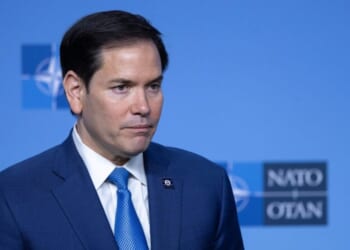
Of course, the sanctions could be reimposed, but the leverage they represented would be diminished. At the very least, negotiations would be stretched out over months if not years. Currently, the US refuses to entertain the notion of decoupling the nuclear and non-nuclear issues. “U.S. Secretary of State Marco Rubio called Iran’s refusal to discuss its ballistic missile program a ‘big problem’ and an ‘unsustainable threat’ to the American home front ahead of Thursday’s [February 26] indirect nuclear talks in Geneva, the third round this month between Washington and Tehran,” JNS news reported.
US Warship Armada Continues to Grow
Meanwhile, the US warship armada in the Middle East and Gulf Region continues to grow. It will eventually reach a size not seen since 2003. According to Defense News, when the USS Gerald R. Ford arrives, “This will bring the Navy’s presence in the region to at least 16 ships, and it will dwarf the 11-ship fleet that was, until the Ford’s departure, stationed in the Caribbean Sea.” Other accounts place the US flotilla slightly higher, including two aircraft carriers, a minimum of 13 guided-missile cruisers and destroyers, and three small combatants. According to the Center for Strategic and International Studies, the number of US naval combatants in and around the Middle East is 18, a 60% increase in naval presence from the June 12-Day War.
So, where do the talks stand? Technical-level officials from Iran and the US will hash out detailed language in various iterations of an agreement. However, that is not necessarily good news. As the Institute for the Study of War explained in its Iran Update, February 26, 2026, “Iran is unlikely to accept reported US demands to destroy its nuclear facilities, send its highly enriched uranium to the US, and commit to a permanent deal. US officials have previously stated that the US would strike Iran if the two sides cannot reach a deal.” And that’s what the armada is for.
~
The views expressed are those of the author and not of any other affiliate.