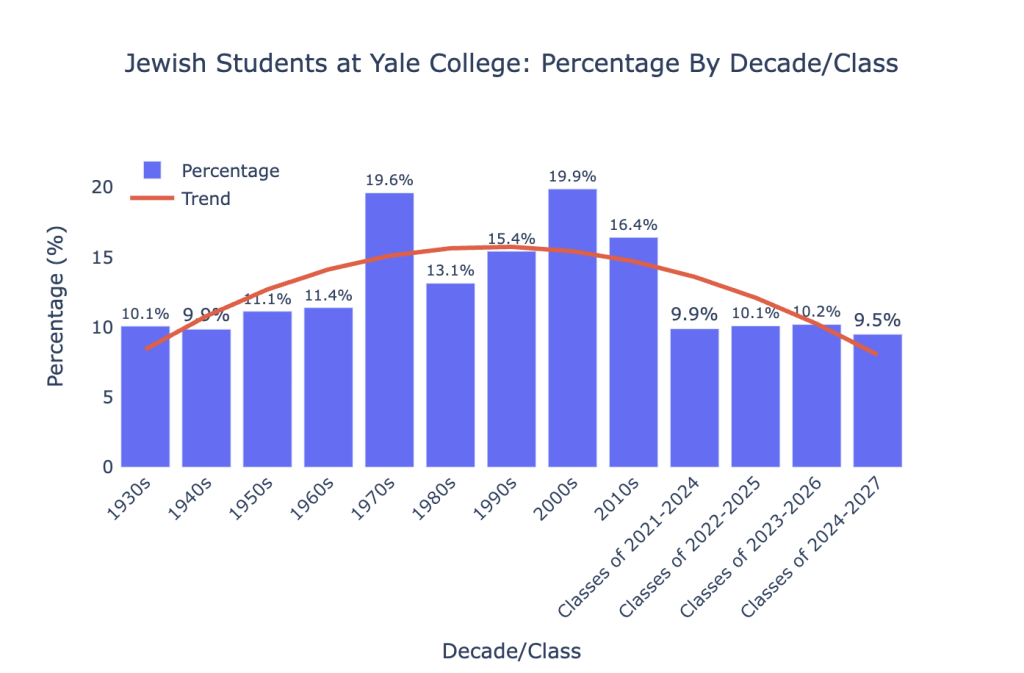
Yale College’s Jewish enrollment is down from 16.4 percent in the 2010s to just 9.5 percent in 2024, a level comparable to the 1940s, when the Ivy League school imposed quotas aimed at excluding “alien” Jews from campus, according to data from the Yale Chaplain’s Office. Yale leaders said they aren’t concerned by the figures and that the school’s diminished Jewish community is “thriving.”
The comments from Yale College dean Pericles Lewis and University Chaplain Maytal Saltiel came in wake of a new report from the Harvard Jewish Alumni Alliance titled, “A Narrowing Gate: Jewish Enrollment at Harvard and Its Peers,” that identified the decline in the Jewish population at Yale as particularly troubling, given that Yale has increased the size of its undergraduate classes in recent years and has seen a decline in the number of Jewish undergraduates nonetheless.
While Lewis told the Yale Daily News that the school has a “thriving” Jewish community, he said the numbers would be “very hard to measure”—though that’s exactly what the university Chaplain’s Office does, with data tracing back to the 1940s.
Lewis also said that “So many students—like, I’m half Jewish—a lot of people might consider themselves Jewish but not answer the question in a particular way,” though the Chaplain’s office indicates that it accounts for that. “When students cite multiple religious identities, we count each student once (i.e., if a student identifies as Methodist and Muslim, they would be counted as 1/2 of a person in each category).”
The “Religious Diversity at Yale” survey found that 9.5 percent of undergraduate students identify as Jewish, a 42 percent decrease from the 16.4 percent of students who identified as Jewish in the 2010s and a 52 percent decrease from the 19.9 percent of students who identified as such in the 2000s.
A spokesman for Yale, responding from a nameless university email account, downplayed the school’s own data, telling the Washington Free Beacon that the Chaplain’s office survey is intended “to give an overall view of the religious diversity at Yale, not to report on the exact percentage of a particular community.” A spokesman for Yale University president Maurie McInnis, who took office in 2024, did not respond to a request for comment.
The 9.5 percent mark is the lowest in decades—even below the 9.9 percent of undergraduates who identified as Jewish in the 1940s, according to the survey, a time when the university imposed ruthless quotas on the number of Jews admitted. At that time, Yale intentionally rejected Jewish students in an attempt to address what university leaders described as the “Jewish problem,” according to Dan Oren’s history of anti-Semitism at Yale, Joining the Club: A History of Jews and Yale.
While Yale passed a resolution banning quotas on race or religion in 1946, the Jewish quota continued informally into the late 1950s, according to Oren. It came to an end around 1960 thanks to geopolitical pressures stemming from the Cold War.
“The academic establishment started to ask itself, ‘How has Russia accomplished so much?’ We had been on top of the world militarily in 1945 with the atomic bomb,” Oren said on the Tablet podcast Gatecrashers. “And it became very clear that the American educational establishment, including Yale, was excluding many of its best and brightest, and that was not just having a consequence at Yale, but potentially threatening all of Yale life.”
The informal quota was an outgrowth of Yale’s decision in the 1920s to cap Jewish enrollment around 10 percent under the direction of then-admissions chairman Robert Corwin, who—in response to Yale’s 1921 freshman class, which was 13 percent Jewish—compiled a folder labeled “Jewish Problem,” Oren writes.
Corwin wrote at the time that Jewish students lacked “attributes of refinement and honor,” did not “share the ‘ethical code’ of their peers,” and “take all that is offered or available and give little or nothing in return,” according to a separate 2006 book on the topic, The Chosen: The Hidden History of Admissions and Exclusion at Harvard, Yale, and Princeton, by University of California, Berkeley, sociology professor Jerome Karabel.
“So the faculty and deans privately worked out a scheme specifically to limit the number of Jews who were the most visible of the unwelcome or the undesirables at that time,” Oren told the Gatecrashers podcast. Admissions officers, he explained, filtered applicants based on in-person interviews and “started asking questions about parental ethnic background.” Then, “at least once a year, the dean of Yale College and the dean of admissions at Yale College would sit down, and they would go through the list of admitted students and make their best guess, and they would compliment themselves when they found that the eventual enrollment came pretty close to 10 percent,” Oren said.
The practice continued into World War II even as it generated financial problems for Yale. While the war meant that fewer young men were applying for college, Jews were an exception because they “apparently finish secondary school at an earlier age than Gentiles” and thus applied for and started college before they were drafted, Yale’s then-chairman of the board of admissions, Edward Noyes, lamented in the Board of Admissions’ 1943-44 Report to the President and Fellows, according to The Chosen.
Noyes’s solution was “to adopt standards of selection from this group more severe than in the past, in order to prevent [the number of Jews] from reaching an undue proportion in the residential colleges,” as he wrote in the report. Yale refers to dormitories as residential colleges, and the policy continued even as the war pushed down enrollment numbers.
The Chaplain’s Office survey is not comprehensive but does track trends over time. Data “is self-reported by incoming students,” and the survey notes it has a 32 percent response rate. It is an “imperfect system that is intended to provide a broad sense of the extent of religious diversity on campus.” But the methodology has been consistent for decades, and the office indicates it has “highlighted notable shifts in the religious affiliations claimed by Yale College students” over the years.
Lewis and Saltiel did not respond to requests for comment. The Yale spokesman, responding on Lewis and Saltiel’s behalf, said the school is “deeply committed to fostering a thriving Jewish community and that is evident in students’ increasing engagement with Yale’s many Jewish student organizations, as well as with the Slifka Center at Yale and Chabad at Yale.”