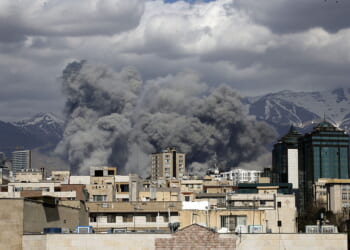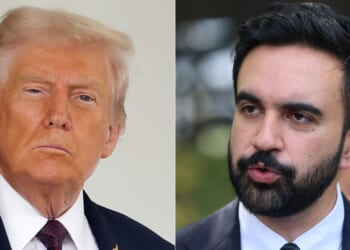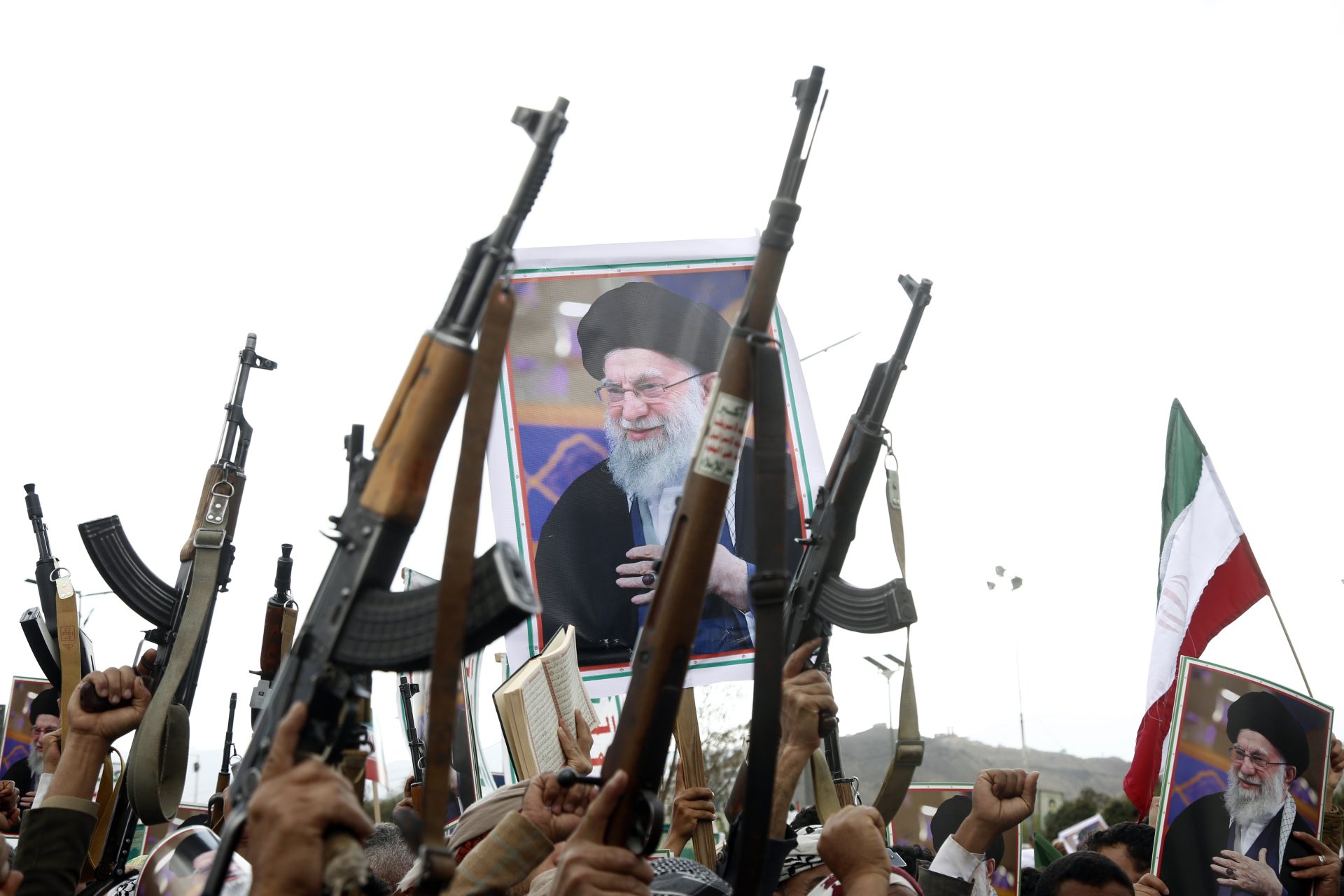
On 1 March 1976, US President Gerald Ford’s ban on assassination went into effect. Fifty years later, nearly to the day, the CIA communicated intelligence to the Israeli military — or so The New York Times reports — which led to the supreme leader of Iran, Ayatollah Ali Khamenei, being killed in his residence in the first strike of an immensely risky and regime-change war. Numerous high-ranking Iranian officials died with him in the strike. This has been widely reported. But many others died too, including members of Khamenei’s family.
In the days since, Israel’s minister of defense has said that Khamenei’s son and likely successor, Mojtaba, will be targeted in the future. At the same time, Western governments have expressed well-grounded fears that Iran might stage its own retaliatory assassinations. What should we make of all this?
The first thing to note is that Ford’s ban was subsequently confirmed in executive orders signed in 1978 and 1981, respectively. Reagan’s 1981 prohibition is still in effect. It reads: “No person employed by or acting on behalf of the United States Government shall engage in, or conspire to engage in, assassination.” Significantly, this appears in a document that is meant to govern “United States Intelligence Activities”. US agencies are not permitted to conspire in the assassination of foreign leaders.
It seems that Israel, which launched the fatal strike and with it, the current war, takes a colder view. It is not remotely controversial to state that, since the year 2000, Israel has “embarked on a policy of targeted killings”. Political discourse in Israel has been altered to reflect this new policy. “Assassinations” are out; “targeted killings” and “decapitation strikes” are in. Questions of legality are marginalized.
“Whenever we degrade trust between states, we sow chaos.”
This is unfortunate. The concept of assassination, and prohibitions against it are important. But before we ask why, it really must be stressed that Israel’s decision to strike Khamenei in his own compound, in the absence of a formal declaration of war, marks a drastic geopolitical escalation. This is because, as The Guardian reports, Israel has “never before killed a head of state”. To dismiss the extremity of this move — to simply call Khamenei a terrorist, a fanatic, and so on — is to miss something of deep and lasting significance.
Khamenei was not merely a radical cleric and commander-in-chief of the Islamic Republic of Iran. He was the head of a state, legally recognized by all the great powers in its hemisphere — by China, Russia, and the European Union. The US seems to recognize Iran’s government in an opportunistically de facto way. In short, Khamenei was the head of a state which belongs to the system of states. This is an assertion of geopolitical fact. And it is true however much one detests Iran’s “revolutionary” regime and Khamenei’s political legacy.
Contemporary Iran belongs to the system of states. The fatal strike made in Tehran is therefore significantly unlike the one that killed hardline cleric and secretary-general of Hezbollah, Hassan Nasrallah, in Beirut in September 2024. A case can be made that Nasrallah was a lawless non-state militant. He was certainly not a head of state. His death can be construed as a “targeted killing” by a legitimately aggrieved state. But Khamenei belonged, in his person, to the system of states.
What is this “system of states”? The phrase seems dated, Westphalian even. We can all see that the postwar system is in disarray — and that many of the states are in disarray, too. An international system presupposes the reality of international law, and we can all feel the temptation in the chaotic, accelerationist 2020s to despair over international legal norms (on the Left) or to simply despise them (on the Right).
This is what makes it intriguing to me, at least, that Ford — a Republican — signed his ban on assassination in the rough-edged Seventies, in the depths of the Cold War. Ford’s ban was not formulated by international treaty or imposed by international tribunal, but self-imposed by the United States. Why?
One way to answer this question would be to look at lurid revelations made by the US Senate’s Church Committee in 1975, and to catalog the cynical practices — or “intelligence excesses” — that it brought to light: the wiretapping and drugging of US citizens, the Byzantine plots to kill Fidel Castro, and so forth.
But perhaps it is more interesting to take a deeper historical view. A civilizational perspective.
What I mean by this is that Ford and his contemporaries recoiled from CIA assassination plots; and Ford made his order that US entities should not “engage in, or conspire to engage in, political assassination”, in part because he and they felt that the practice was uncivilized. It was not merely a question of black-letter law, for them, but of something like honor.
With that in mind we can glance at how assassination is handled in one of the modern West’s basic legal texts, Emer de Vattel’s The Law of Nations (1758). In the decades of the high Enlightenment, hot revolution and systemic reform, Vattel was read closely by diplomats and politicians — revolutionary and reactionary — on both sides of the Atlantic. The Law of Nations is a seminal text in the creation of the modern system of states. And Vattel thinks that assassination cannot be evaluated without consulting certain “ideas of honor, confused and indefinite as they are”.
Law has its intuitions, and Vattel finds that assassination offends the intuitions of honor. Of course, he accepts that “nations may do themselves justice sword in hand, when otherwise refused to them”. What he means by this is that war is justified in extremis. But Vattel then asks, doesn’t it matter how nations conduct their wars? How they undertake to “do themselves justice”? And he thinks it does matter. So again, he asks:
“Shall it be indifferent to human society that [some nations] employ odious means [of waging war], capable of spreading desolation over the whole face of the earth, and against which, the most just and equitable of sovereigns, even though supported by the majority of other princes, cannot guard himself?”
The question is rhetorical. For Vattel, assassination is an “odious means” of waging war. It is a tactic that even “the most just and equitable of sovereigns… cannot guard” against. It therefore has no place in the modern system of states.
Now, Vattel defines assassination as “treacherous murder”. He sharply differentiates this sort of treacherous behavior from what he calls “surprises”. Surprise attacks, he writes, “are, doubtless, very allowable in war”. However, one fundamental legal condition must first be met: hostilities must have been formally declared.
A treacherous surprise, a surprise attack in the absence of declared war, Vattel finds to be dishonorable. For him, a strike like the one that killed Khamenei would therefore constitute an assassination. And assassination, Vattel concludes, is “contrary to the laws of war, and equally condemned by the law of nature, and the consent of all civilized nations”.
It is not a post-Cold War ideal, then, but a sharply reasoned eighteenth-century determination that assassination is, by its very nature, a threat to all who operate within a system of states. As such, we could say that it is a de-civilizational practice.
Beyond the question of assassination’s legality, it is important to ask what assassinations reveal about those who practice it. What does it say about the state of politics in the US and Israel that they chose to bomb a head of state (and his family) in his own residence without first declaring the commencement of hostilities? That fatal strike in Tehran was the declaration of war.
If Vattel and the basic Enlightenment tradition had been consulted, Khamenei and his cabinet might have still been targeted — but only after hostilities had been adequately declared. This is the sequence that civilized nations have always found to be “allowable in war”. (For this, Vattel even appeals to the customs of ancient Rome.) By way of contrast, the strike that killed Khamenei was “contrary to the laws of war” in the very civilization to which both Europe and the Americas are heirs — or so Secretary of State Rubio argued in his much-discussed Munich Security Conference speech last month.
Of course, Iran is a liminal case. The US justifiably broke off diplomatic relations with the Khomeinist regime in 1980; Israel and the Islamic Republic exist in a perpetual state of simmering hostility. But none of that rises to a conventional state of war, and we will of course recall that Reagan’s ban on assassination, signed in 1981, postdates the Iranian Revolution.
Though many hard questions might be asked about the actual stance of the Iranian regime vis-à-vis war and peace, it remains true that the strike on Khamenei occurred before hostilities had been declared by the US and Israel. And there is a further aggravating factor; namely, the US had chosen to conduct negotiations with Iran in Oman, Rome, and Geneva immediately before it made strikes in concert with Israel — first on 13 June 2025, and then on 28 February 2026.
These negotiations suggest a “good faith” posture made by the US towards the Iranian regime (which the US does not recognize). To have been a party to Khamenei’s assassination immediately after conducting negotiations in Geneva with his government suggests a measure of duplicity. Not only towards the state of Iran, but towards the states that hosted and facilitated US–Iranian negotiations.
Classical international lawyers such as Vattel would have condemned this sort of sequence. Precisely because international law is hard to enforce — and is rarely enforceable, even today — it is especially reliant upon trust between states. The ban on assassination is largely rooted in protocols of trust. Whenever we degrade trust between states, we sow chaos. And chaos is a war of all against all; a war in which no one is, in principle, off limits.