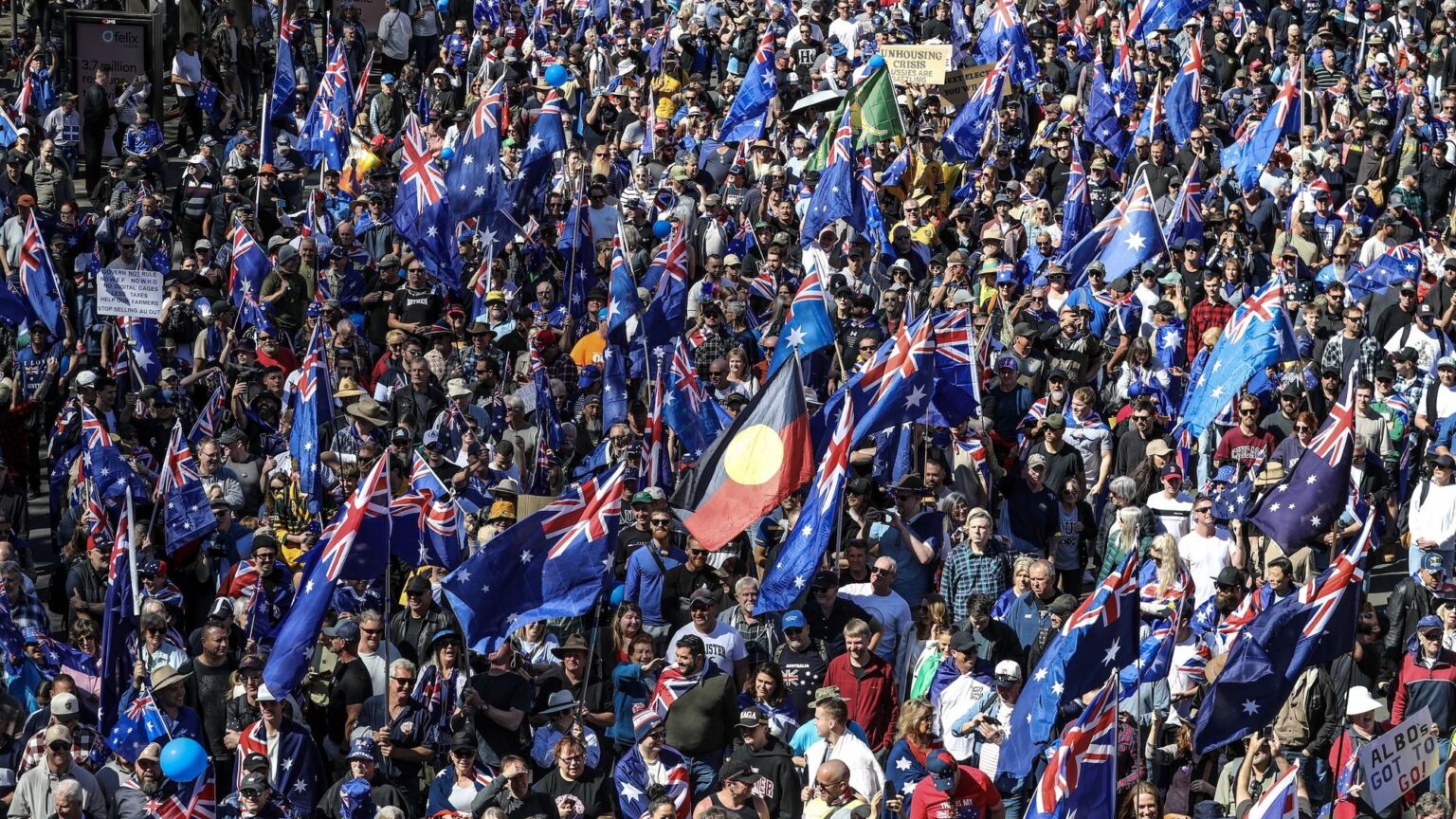
Australian politician Pauline Hanson has been kept largely at arms-length by the electorate ever since she declared, 30 years ago, that her country was ‘being swamped by Asians’. But her exodus to the political fringe appears to have ended. A recent poll put her party, One Nation, in second place, which has rocked the political establishment.
According to a Newspoll survey published this week, One Nation has the support of 22 per cent of Australians – its best performance by some margin in its 28-year history. The party’s surging membership – up 500 per cent since May’s election, according to Hanson – suggests that this support may not be a flash in the pan. Perhaps most significantly, more Australians would be inclined to vote for One Nation than the centre-right Liberal-National Coalition, the most successful party in Australian history.
Hanson’s rise is as significant as it would have once seemed unlikely. Australians are not one to rock the boat – in the eight decades since the end of the Second World War, Australia has only known a Labor or Coalition government. It is a sign of how inept both have been lately that Hanson is being looked on favourably by swathes of the public.
The slow death of the Liberal-National Coalition, which appears to be in its final stages, is the biggest factor in One Nation’s rise. This week, the Nationals split from the Liberals for the second time in less than a year. The latest wedge between the historic allies was the ‘hate group’ legislation, passed by parliament this week in response to December’s anti-Semitic massacre in Bondi. The Nationals said the law’s broad definition of ‘hate’ posed an unacceptable threat to free speech, while the Liberals ultimately voted with Anthony Albanese’s Labor. Every member of the Nationals has since quit the shadow ministry.
The fallout from Bondi offered further proof, if any more were needed, of how incoherent this once dominant political force has become. The Liberals demanded Albanese convene an emergency sitting of parliament to pass some laws – they weren’t clear what – in the wake of the massacre. Then, they prevaricated as soon as Labor produced the hate-group legislation, insisting at various stages that it was both too weak and too powerful. Then, after securing minor amendments, they voted with the government.
Australians witnessed a similarly confused spectacle in November, when the Coalition ruptured over Net Zero. The Nationals insisted that the Coalition abandon Australia’s 2050 decarbonisation target, which was set by former Coalition prime minister Scott Morrison in 2021. This led to frantic negotiations between the parties, at the end of which Liberal leader Sussan Ley agreed to dump it – all the while insisting that Net Zero would remain a ‘welcome’ outcome. The right decision was reached eventually, but it was arrived at by compromise rather than conviction.
A party that cannot make up its mind over an issue as fundamental as Net Zero really has no business as the official opposition. Mining royalties contributed more than $20 billion to the state’s coffers in 2024. Mining may be carbon-intensive, but without it, there is no Australian welfare state (one of the world’s most generous), nor public healthcare. It employs close to 250,000 people in well-paying, meaningful work. Something so fundamental to the welfare and prosperity of Australia should never have been put at such risk in the first place.
Hanson is also a beneficiary of the low standing of the Labor government. Here, the role of Albanese is impossible to ignore. Like in the UK, Australia witnessed an extraordinary rise of anti-Semitism after 7 October 2023. Albanese did not cause this but he certainly abetted it. Before Bondi, he consistently failed to draw a clear moral distinction between Hamas’s attack and Israel’s war for self-defence, and led a government just as critical of the former as the latter. Then Australia experienced its own anti-Semitic pogrom.
Albanese’s response to the Bondi attack, in which two Islamist terrorists brutally murdered 15 Jews, was in many ways a measure of the man. His first instinct was political. All too aware that he had ignored the warnings of Jewish Australians for more than two years, he immediately sought to push the focus away from anti-Semitism and on to gun control.
It was one trick too many for the Australian people. Albanese was excoriated by former treasurer Josh Frydenberg, himself Jewish, in a moving speech in Bondi days after the attack. Albanese rejected calls for a royal commission into anti-Semitism for the same reason that he tried to tie the massacre to gun control – namely, he wanted to evade accountability. He has since caved to pressure, and has looked a very diminished figure since.
Hanson does not deserve to be the beneficiary of this strange confluence of events. Yet she appears to be the only politician in the country that possesses that elusive and valuable quality: authenticity. Hanson, despite her flaws, ‘stands for something’ in the eyes of an increasing share of the public. For years, she has railed against immigration, Net Zero and the elite consensus that Australia is irredeemably racist, that its past could never be anything other than a source of shame. In other words, she has had principles and stayed true to them.
Nonetheless, it would be a grave mistake to make simple parallels between One Nation and anti-establishment parties elsewhere, like Reform UK. Hanson’s consistency should not be mistaken for decency. Her 1996 claim that Australia was being ‘swamped by Asians’ was not only racist, it has also been proven to be idiotic. Asian Australians – many of whom came as refugees from the Vietnam War – are among the most proud and indeed high-achieving Australians. She isn’t simply against mass immigration – a perfectly reasonable concern. She is against non-white, non-European immigration.
Arguably, the rise of One Nation could almost certainly do more harm than good to the cause of Australian populism. Would a politician as canny as, say, Nigel Farage proudly welcome into his party someone like One Nation’s Malcolm Roberts, who believes that Net Zero is a conspiracy by bankers to control the world? Or Barnaby Joyce, Australia’s former deputy prime minister, who impregnated a staff member with whom he was having an extramarital affair, and who sometimes gets so drunk during parliamentary sitting weeks that he has been filmed prostrate on the pavement outside a Canberra bar? These are not the calibre of politicians needed to undo years and decades of elite failure.
Still, there is a reason that Labor and the Coalition are now viewed, largely, as two cheeks of the same arse. They will only have themselves to blame if Pauline Hanson, of all people, is the one to kick it on behalf of the Australian people.
Hugo Timms is a staff writer at spiked.