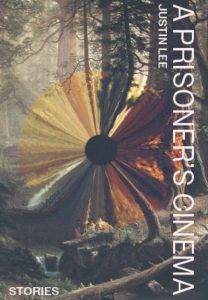
“Hell is empty,” declares Ariel in Shakespeare’s The Tempest, “and all the devils are here.” To imagine that evil actors will receive no eternal punishment is blasphemy, perhaps, yet it does often seem that life on earth is punishment enough. This is a suggestion made by A Prisoner’s Cinema, Justin Lee’s debut collection of religiously inflected horror stories. Lee’s deeply disturbing tales blend the short-form surrealism, popularized by writers like Aimee Bender and Donald Barthelme, with the American Gothic tradition of Poe, Lovecraft, Faulkner, and Flannery O’Connor. The stories are violent, powerful, and original in their melding of horrific content, subtle formal devices and Christian imagery.
This is a book of fiction that performs the service for which fiction is uniquely suited — detailing the contours of consciousness — while performing a rather unusual bracketing in a context of higher truth. It comes amid a wider renaissance in horror cinema and literature, with some of the best work often described as “post-horror.” Beginning in the mid-2010s, artists have taken up the genre as a means for exploring the irrational and ineffable dimensions of human life — or to poseideas that, stated overtly, would be seen as tactless or impolitic. This, even as they break its conventions or, as in Lee’s case, blend them with other forms.
A “prisoner’s cinema,” as we learn in the title story — its longest and best — is the series of hallucinations a person’s mind will produce after he is kept for a prolonged time in complete darkness. In this story, a child rapist waiting on death row engages in a series of verbal jousts with the demon who encouraged him in his crime, and who continues to mock him as he waits out his last days. The moral lines seem clear here, yet the unconventional structure of this long story confounds the reader’s expectations, offering no easy resolution, and a twist toward the end adds a sci-fi element to horror that was previously mostly psychological or ontological. The result is terrifying: the suggestion that the human mind is the most fearsome demon of all.
As the line from G. K. Chesterton goes: “The madman is not the man who has lost his reason. The madman is the man who has lost everything except his reason.” The rational mind unbalanced, overheated, and off its tether is the true protagonist of these stories. Characters reason and use logic; they follow a flow of linked theses and fateful decision trees; they rationalize, or they victimize where they have been victimized. The result, far from making sense, is the most fetid tangle of human flesh this side of Hannibal Lecter’s pantry.
In “Gods and Spiders,” a hypnotist returns a young man to the primal scene of his mother’s violent death at the hands of the Bosnian paramilitary. In “Lovecraft,” a philosophizing butcher allows a tenant who lives below him to tenderize some very suspicious meat as a form of stress relief. In “Lightning in a Cloudless Sky,” a disgruntled son of two newly dead parents bashes in the head of an intruding hoodlum. But the real brutality for this young man, Lee suggests, is internal: an animus between the protagonist and his brother that simply can’t be fixed.
Lee’s compendium of gore is accomplished with subtlety and literary grace. “Never Find Us Here,” a story about a narcissistic young man who decides to volunteer for a day at the Salvation Army, keeps us on tenterhooks by sliding seamlessly between surrealism and psychology. And, as in the most crafty of short stories, an anticlimax serves as the perfect ending. Lee also has a knack for a good metaphor. He writes, for instance, of “the dark lips of ditches”: precisely the right word for the little mounds that might circumscribe a hole one has dug, turning it into a yawning black mouth. And the virtuoso vitriol that opens “Lightning in a Cloudless Sky,” — “They always have sallow skin, these whores, these meth-heads, wasted high-school beauties, soma-addled slack bodies, all with the same seeping sallow skin carrying Christ-knows-what proud strains of plague in their milky sebum . . .” — is mellifluous bile indeed.
But it is the moral stakes that set Lee’s writing apart. Literary fiction is a genre on the wane — like contemporary art and independent cinema. We suffer from a glut of writers and a dearth of readers, from a surfeit of publicity and a paucity of art. It is no coincidence that the successes over the past few decades have been the products of writers such as Michel Houellebecq, Karl Ove Knausgaard, and Elena Ferrante, who are earnestly grappling with the morality of how one ought to live in a society that offers fewer answers by the day.
In this sense, the contemporary writer of fiction is no different from the pundit on X (formerly Twitter), but whereas the online pundit is incentivized to provide extreme approbation or condemnation, the novelist may take a longer view. Today the craft of the novelist may not be as remunerative as the pundit’s — a few mega-writers excepted. But by making abstract problems concrete and by playing both sides, so to speak, the novelist offers wisdom no pundit can match.
“Beginning in the mid-2010s, artists have taken up the genre as a means for exploring the irrational and ineffable dimensions of human life.”
One can, for example, argue all one likes about what it means for society that some men rob, rape, or kill. But Lee, an editor at the religious journal First Things, has done something much more difficult and important: he has, through imaginative exercises, made such actions concrete. He has told us their tastes and smells. Only a moralist would bother to tease out the thread of immorality with such care. Who else would bother with the mental anguish of such people? Lee thus does the reader the service of taking him somewhere he never wanted to go. Complacency, that most common 21st-century sin, is not an option once you’ve entered Lee’s fictional world.
None of it is easy to read, and Lee has written of an author’s struggle with his subject, in the form of dialogues with the demon “Paul” in three linked stories that make up the series “A Briefer Epic.” In these stories, the demon taunts the author, sophomorically questioning his sexuality, or suggesting that his preoccupation with the dark constitutes evil in itself. The back-and-forth is often amusing, but the scaffolding feels unnecessary, since many of the issues come through in the stories. Moreover, a writer allowing a clever demon to argue against his project may tempt a few too many readers to side with the devil and put down the book.
But this is a quibble. In an age where art veers between empty entertainment and empty formalism, it is a pleasure to find a new voice deeply interested in how we ought to live. For Lee, that question manifests as a preoccupation with what in our world is most horrific. As in the ancient tragedies, Lee offers a chance to purge ourselves by following his characters down the long path to hell, before we return to the blessed freedom of our day-to-day lives. It is a bracing and, in the end, ennobling trip. I look forward to the next time Lee will lead me to a place I don’t want to go.