‘Dean Chemerinsky’s email is wrong, and we will be addressing the issue with the university,’ Brandeis Center lawyer Paul Eckles says
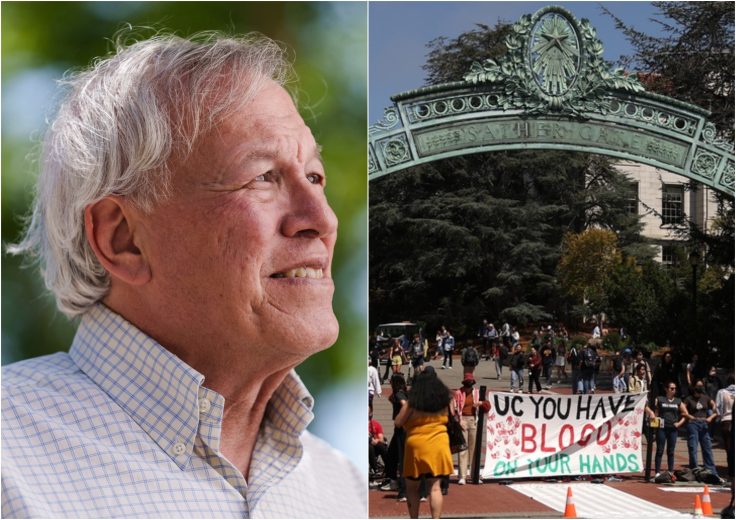
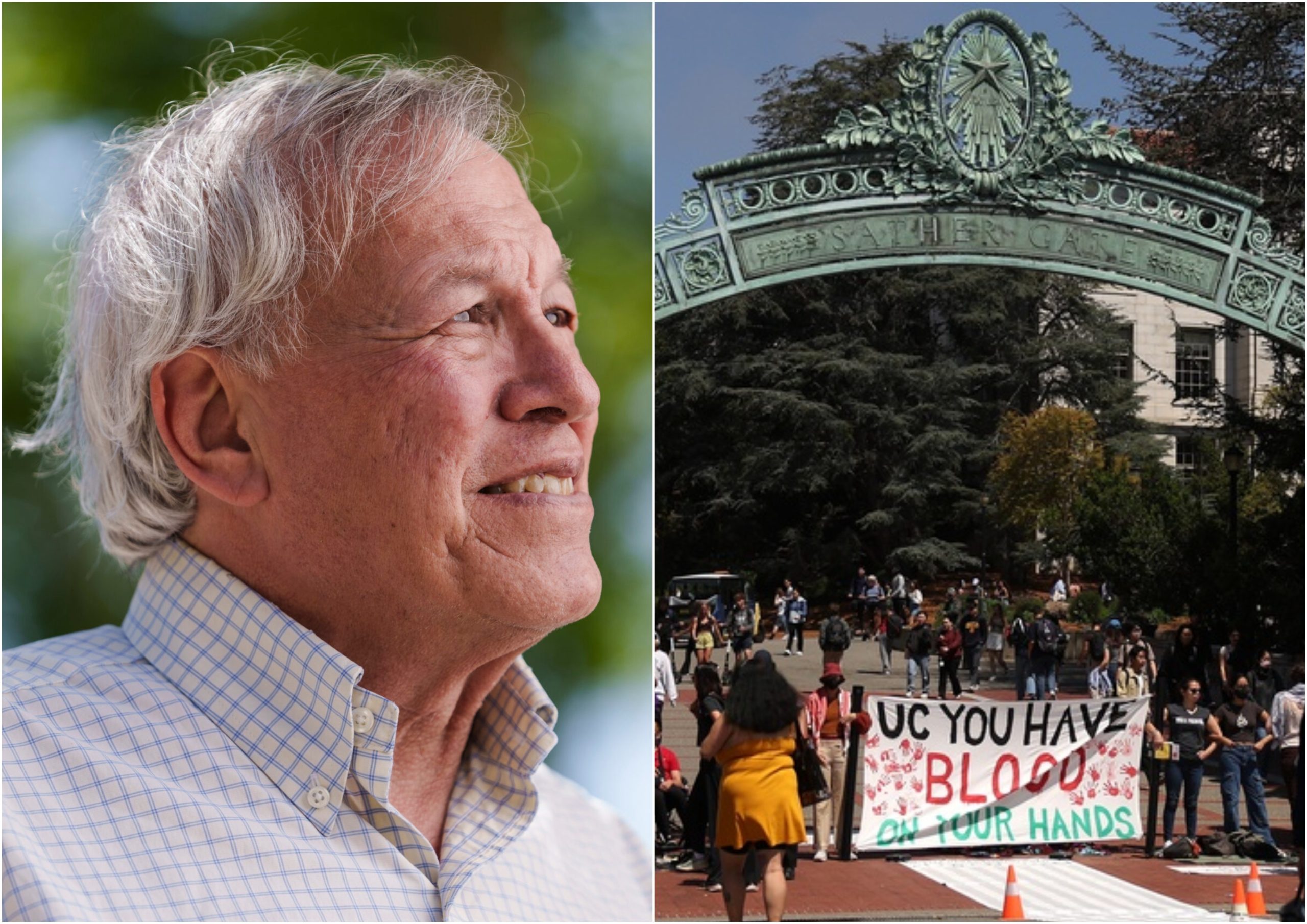
A Jewish legal advocacy group is accusing the University of California, Berkeley’s law school dean of violating the terms of a just-announced settlement that resolved a lawsuit challenging student group bylaws that barred speakers based on their Jewish, Israeli, or Zionist identities.
The Louis D. Brandeis Center for Human Rights Under Law announced Thursday that Berkeley agreed to settle the lawsuit, which the group filed in November 2023 alongside the center’s Jewish Americans for Fairness in Education organization, whose members include Berkeley Law professors and Berkeley students. They accused the school of allowing student organizations to pass bylaws that banned speakers who supported Israel or Zionism.
The settlement, obtained by the Washington Free Beacon, states that the law school’s registered student groups cannot “include prohibitions on speakers” in their bylaws and constitutions, nor can they “limit officers, board members, or speakers based on a category that is protected under federal or state law.” Berkeley agreed to implement mandatory faculty training on anti-Jewish and anti-Israeli discrimination and publish a statement on its website noting that “bans on Zionists have historically been used by some individuals and institutions as a pretext for excluding Jews.”
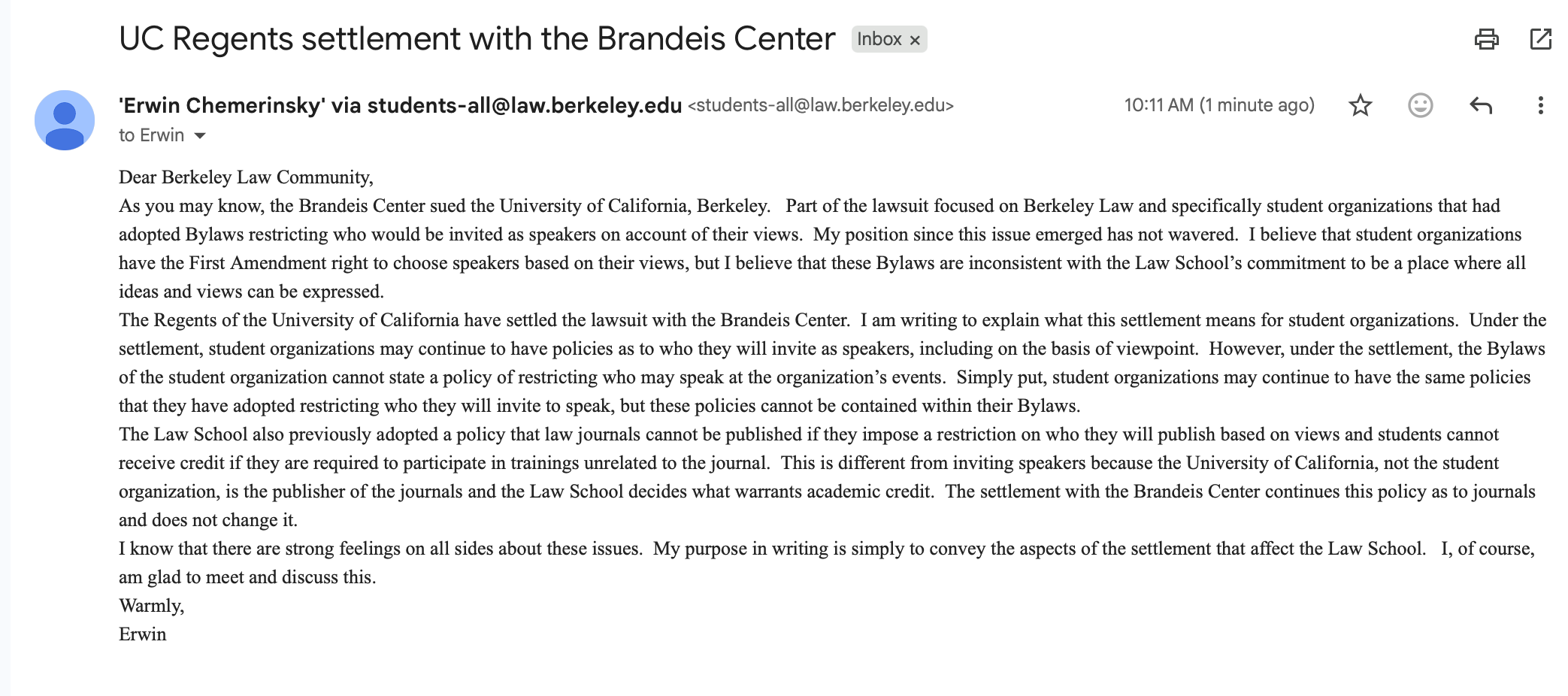
Shortly after the settlement’s announcement, Berkeley law school dean Erwin Chemerinsky told the law school student body in an email obtained by the Free Beacon that the bylaws must change, but restrictive speaker policies could remain.
“Under the settlement, student organizations may continue to have policies as to who they will invite as speakers, including on the basis of viewpoint,” Chemerinsky wrote. “However, under the settlement, the Bylaws of the student organization cannot state a policy of restricting who may speak at the organization’s events.”
“Simply put, student organizations may continue to have the same policies that they have adopted restricting who they will invite to speak, but these policies cannot be contained within their Bylaws,” he added.
Paul Eckles, who led the Brandeis Center’s legal team, disputed Chemerinsky’s claim.
“It’s really inconsistent with both the plain language of the agreement, especially read in context, as well as just the entire tenor and intent of the agreement, and the fact that he would put out that email literally moments after the agreement was entered is very disappointing,” Eckles told the Free Beacon. “The whole purpose of the agreement is to make clear that anti-Zionism can be and is often used as a pretext for discrimination. And when it is done so, it violates the law, it violates UC Berkeley policy.”
“Putting out a statement that the organizations that had anti-Zionism policies could essentially continue what they were doing is just plainly wrong and inconsistent with the agreement,” Eckles added. “Dean Chemerinsky’s email is wrong, and we will be addressing the issue with the university.”
The dean’s email comes as colleges and universities across the country, under pressure from the Trump administration, make efforts to crack down on campus anti-Semitism. Berkeley has taken a more permissive approach: The school recently said it would allow its Students for Justice in Palestine chapter to sport a logo on its website featuring an inverted red triangle—a symbol Hamas uses to denote Israeli targets—and wouldn’t force the group to stop promoting violence against Israel.
Berkeley Law spokesman Alex Shapiro said Chemerinsky’s email “simply conveys the aspects that affect the Law School.”
Berkeley law professor Steve Davidoff Solomon, who advises the anti-Semitism task force within the Department of Justice, called for Chemerinsky’s termination. The school’s chapter of Law Students for Justice in Palestine “regularly harass me and other Jewish students and faculty,” he told the Free Beacon. “I personally need extra security at the law school, and Erwin’s response to a settlement is to send an email encouraging the students to continue doing the same thing. He should be fired. This is outrageous.”
The Brandeis Center filed its lawsuit in response to nine student organizations amending their bylaws to prohibit Israel and Zionism supporters from speaking at their events. More than 20 organizations, including academic journals and clinical programs, eventually adopted similar bans. Berkeley, according to the Brandeis Center, excused the bans as “viewpoint discrimination.” But Chemerinsky signed a letter condemning the student groups’ bylaws as “wrong” and “antithetical to free speech and our community values.” He acknowledged that they would exclude 90 percent of Jewish law students—and himself.
Chemerinsky has faced criticism over seemingly dubious legal claims before. In June 2023, he was caught on tape describing how Berkeley gets around California’s ban on affirmative action in faculty hiring, joking with students that “if ever I’m deposed, I’m going to deny I said this to you.” A month later, during a legal conference he moderated, Chemerinsky brainstormed with University of Michigan general counsel Timothy Lynch ways to circumvent the Supreme Court’s ban on race-based admissions.