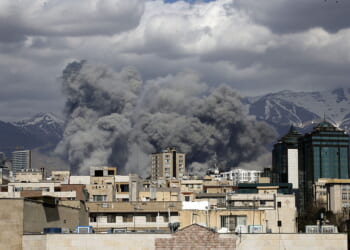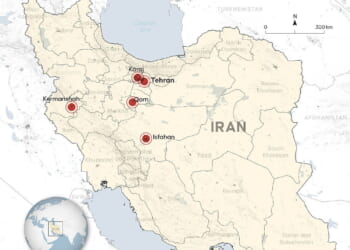
Israel’s retaliatory attacks on Iran in October 2024 were carefully designed to avoid hitting Iran’s nuclear program or destroying its energy infrastructure. They did, however, prove to Tehran that Israel had the capability to hit targets inside Iran virtually at will and to take control of Iranian airspace.
This is what we call an “off-ramp.” It was recognized as such at the time. “Israel’s Calibrated Attack On Iran Gives Both Countries An Off-Ramp,” pronounced Radio Free Europe. Jonathan Schanzer, contributing editor to COMMENTARY and executive director of the Foundation for Defense of Democracies, concurred: “I think the Israelis are, from what I can tell, listening to the Biden administration, allowing for that off-ramp to its enemies. Even though they have the upper hand from what we can tell, we’ll see whether the Iranian regime and we’ll see whether its proxies are willing to comply.”
So did the Atlantic Council’s Jonathan Panikoff, who said Iran would probably take the out: “Israel’s attacks, which may continue in different guises, were clearly calculated and targeted. Their impact may be significant. But if Iranian officials downplay them—and reports they claimed to have successfully countered the attack are a good start—consider it a signal that Tehran is looking for an off-ramp, even if it claims otherwise.”
Giving Iran an off-ramp after October 7 was extraordinarily kind. Iran, as we know, didn’t take that latest of many, many, many chances to “de-escalate” its forever war against the Jews. Its continued pursuit of nuclear weapons and its continued use of proxy militias to attack Americans and Israelis and hold global shipping lanes hostage necessitated action. (Iran also rejected diplomatic solutions to the crisis.) The U.S. and Israel did what had to be done, destroying nuclear infrastructure and taking out terrorist figures.
Iran didn’t take the hint that time either. So here we are: The ayatollah is dead, and the remnants of his regime have more punishment coming.
At work here is a very simple principle: Those who start wars don’t retain the right to decide when they end, with the exception of accepting the other side’s terms of settlement.
The reason that Israel’s earlier strikes were considered “off-ramps” is because they demonstrated that Israel had capabilities to hit Iran in ways the Iranians perhaps didn’t realize. Therefore, the strikes served as a warning: Push this war too far and you will pay a high price.
It shouldn’t need to be said but it apparently does: The fact that Iran ignored repeated warnings isn’t America’s fault. The fact that Iran rejected an off-ramp offered by the country it has been trying to destroy for decades isn’t Israel’s fault.
Yet years and years of the international community’s warping beyond repair terms like “proportionality” have gotten bad actors used to the idea that they can choose not only to start a war but also to determine how far its victim can go in response—especially when the victim of the attack is Israel.
This dynamic has launched a thousand and one “I abhor the attacks on Israel, but…” declarations. Now that Israel isn’t fighting this conflict alone, those statements fall by the wayside because nobody wants to apply such equivocations to their own population. Thus we have Keir Starmer’s initial reluctance to help the war effort and then suddenly discovering his moral compass when British targets came under Iranian missile attack.
Starmer announced yesterday that he will now allow the U.S. to us British bases to launch counterattacks against Iran for a very simple reason: “The only way to stop the threat is to destroy the missiles at source, in their storage depots or the launchers which are used to fire the missiles.”
Suddenly even those who don’t want to get involved in this conflict abstain from making self-degrading, pusillanimous statements about proportionality, or “just taking the win,” or other such euphemisms for permitting one’s attacker to remain on his feet. Now that Britons are being threatened, Europeans find clarity: You must neutralize the threat, not because you like war but because you have an obligation to neutralize the threat.
Suddenly even Keir Starmer knows he cannot settle for some point-making retaliatory strikes and call it a day.
Welcome to the real world, everyone. You’re late.