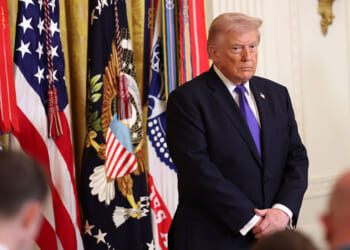
A moment comes in everyone’s life when they first perceive their father as old and frail. We see, perhaps before he does, that he is unable to do what once came so easily; his strength is fading and his judgment often lacking. So it is with the United States, which has become increasingly erratic and aggressive in the dotage of its empire. Given the European handwringing which greeted Trump’s threats to annex Greenland from Denmark, his threats to intervene in our internal politics and the bullying over tariffs, there is something pathetic in the desperation with which the Trump administration now alternately cajoles and pleads for our help with its current mess. America has stumbled while undertaking an unwise course of action in which we were not consulted, which will negatively impact us all, and its evident frailty and feebleness of mind is a rightful source of concern. Even at the height of its powers, the American empire did not countenance such a risky and self-destructive gamble. When it does so now, at this late stage, it is hard not to feel the end approaching.
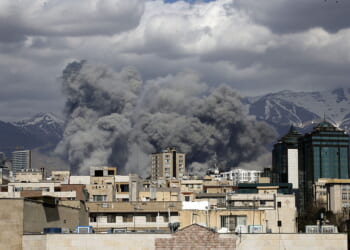
For all the genuine and awe-inspiring might of America’s war machine, geography has given Iran an advantage in the Strait of Hormuz to which there is no obvious military solution. It is difficult to imagine what the Marine Expeditionary Unit, currently steaming toward the Gulf from the Pacific where it had been deployed to deter China, can do to unblock the Strait. Even if the 2,500 deployable Marines seize Qeshm island, on the Iranian side of the strait, they and the shipping they are being sent to guard will still be within range of weapons systems located within the mainland city of Bandar Abbas — and among its half-million population — and in the craggy and desolate mountain ranges behind. Senator Lindsay Graham’s proposal of seizing Kharg island, more than 300 miles away at the other end of the Persian Gulf, would still require the taskforce to sail through the very same strait from which, fearful of losses, the US Navy chooses to steer well clear.
It is all very well for Trump to demand that European, or even Chinese, warships escort oil tankers through the narrow waterway, but there is a reason that the US Navy has refused the same task. What America cannot do without bearing politically unsustainable risk, and very little prospect of success, Britain certainly cannot, and it is petulant and ultimately risible of Trump to demand we try. As Germany’s defense minister Boris Pistorius rightly observed this week, “What does Donald Trump expect from a handful or two handfuls of European frigates to achieve there in the Strait of Hormuz, which the powerful American Navy cannot manage alone?”
In these inauspicious circumstances, the idea that Britain should be doing more to help does not seem compelling, whatever confused and rambling outbursts emanate from the imperial center. The single drone that hit the American hangar in RAF Akrotiri may have been an embarrassment for Whitehall, but it was hardly a catastrophe. The seeming absence of a ground-based air defense system may be a mysterious oversight, but as Israel and the Gulf kingdoms show, even the most modern and extensive GBAD installation does not provide total defense. The carrier that many Fleet Street hawks demanded should immediately sail for Cyprus is already busy in the High North. Indeed, its current deployment, announced last month, came after Trump’s own declarations that Europeans were paying such insufficient attention to Arctic security that America has the right to seize Greenland, and perhaps Canada too. It is not Britain’s responsibility to chase after every military whim, reasonable or otherwise, of our imperial patron. In any case, the whole purpose of Britain’s Sovereign Base Areas is to act as our unsinkable carrier in the Levant: in Cyprus, and in the skies over Jordan, Iraq and the Gulf states, the RAF is already active shooting down missile threats to regional allies, and there is no obvious logic in seeking to do more.
Macron’s European flotilla, led by France, and assembling in the Eastern Mediterranean, displays more than a touch of overkill: for the level of threat it faces, Cyprus must now be the best-defended country in the world. It is certainly an impressive sight, and a galling one for British observers of our own naval decline — yet competing with France is not in itself a vital national interest. Rather than being driven by strict military necessity, this is an act of political theater in which European leaders can signal both their capacity to act decisively in concert when one of their number is threatened, and their willingness to maintain a certain distance from the United States in doing so. Dismissively quashing Trumpian suggestions that it might sail eastwards to the arena of America’s muddled war, Macron’s government clearly sees the deployment, coming so soon after the announcement that France will expand the defensive umbrella of its independent nuclear deterrent across vast swathes of Europe, as tangible proof of the latent power that a French-led Europe, independent of Nato, can muster in defense of its own interests. We are less weak than we tell ourselves, the flotilla says, and our erratic overlord less strong.
Politically, the implications of all this for Britain are unclear. Starmer’s government has, correctly, chosen not to commit itself to this war, which is unfortunately not quite the same thing as remaining entirely detached from it. There is not, after all, much difference between Britain’s Sovereign Base Areas in Cyprus, unwillingly hosted by Cypriots for use in wars of no interest to them, and the notional RAF bases here in Britain from which American long-range bombers set off to and return from their missions over Iran. For the Greens and Scottish Nationalists to condemn the use of these bases is entirely expected. Yet when we see the keen populist bellwether of liberal centrist opinion Ed Davey demand a fully independent British nuclear deterrent, something has surely changed. It is hard, now, not to palpably feel the tide of empire retreating, though this time round with us as the natives observing, with mixed feelings, the crumbling power of their imperial master. Living through a time of historic changes is a more disorienting and ambiguous experience than the confident hindsight of historians later pretends: we can expect our politicians to struggle with the new realities struggling to be born.
“We can expect our politicians to struggle with the new realities struggling to be born.”
It is reassuring then, at a moment in which Britain’s Right-wing parties have not covered themselves in glory, that Reform’s initial gung-ho enthusiasm for America and Israel’s war was so swiftly backtracked by Robert Jenrick, a long-standing skeptic of foreign entanglements. If his colleague Andrea Jenkyns remains keen to commit British boots on the ground, this is at least beyond the power of the Mayor of Greater Lincolnshire to effect. Yet the spectacle of Reform’s headlong advance to war, and the party’s hurried retreat when faced with polling data, has perhaps obscured the Conservative Party’s own, and perhaps worse, stance on Iran, a position seemingly derived equally from recklessness and a shaky grasp of detail.
Badenoch’s insistence, perhaps extrapolating from her experience of World of Warcraft, that Britain should “stop the archer” by joining in strikes on Iranian underground missile bases, rather than merely “catching the arrows”, would seem an odd and escalatory response to a UAV launched from Lebanon. Bombing an entirely different weapon system in an entirely different country would not prevent any recurrence of such attacks, presumably undertaken by Hezbollah, unless Badenoch also intends to bomb Lebanon. Yet doing so would require deconflicting and therefore coordinating with the Israelis in a bombing campaign that even the United States is steering clear of, against UAVs launched from mobile and most likely civilian vehicles, in the wooded and heavily-populated landscape of southern Lebanon. The moral, legal, and political risks of accidentally killing civilians, in an aerial campaign that has already killed hundreds, would be unacceptably high for little obvious gain, the product of a soundbite in search of a strategy.
In its latest and even more confusing iteration, published in the Daily Mail, Badenoch’s stance on the American-Israeli campaign is that she is “clear that Britain shouldn’t have joined in – I remain concerned that there isn’t a clear plan behind the strikes – but Britain should also not be neutral” and should “strike the missile and drone sites at source”. The Conservative Party’s apparent position on this urgent question of national security is that Britain should conduct its own entirely independent retaliatory bombing campaign, in the same airspace as American and Israeli jets and against much the same targets. Given the American aircraft losses already to friendly fire, we must presume that Badenoch intends the RAF to coordinate and deconflict with its American and Israeli counterparts, as well as, given Britain’s military shortcomings, leaning upon their support for surveillance and targeting data. How this is considered “not joining in” is hard to discern: the advantage for the nation, even harder.
It seems unnervingly clear that, rather than starting “from first principles,” according to her characteristically high estimation of her own intellectual rigor, Badenoch had settled on a political strategy of marketing herself as stronger on defense than Starmer, in which the outbreak of war initially seemed a useful backdrop. That the war she initially chose to back proved both chaotically mismanaged and domestically unpopular has now led her to defend, alone, this tenuous and isolated political outpost. On a matter of the utmost gravity, the only principles apparent seem to be feeding the needs of the Westminster media grid, and a desire to cosplay the Iron Lady for her dwindling audience.
If we are to truly start from first principles, they must be that Britain has its own interests, distinct from those of our allies in Europe and the United States, and it is only to those interests British leaders should attend. If the Iran War is an American party to which we have been invited but do not wish to attend, so is it the case that the European effort is something Starmer may wish to join, but to which we have not been invited. Greece did not send its jets and frigates to Cyprus to defend Britain’s SBAs, as British commentators affected to believe, but to reassure and protect its ethnic kin, maximizing the country’s political influence. In the same way, the broader, European effort has its own French political rationale, of advancing a Macronian vision of strategic autonomy, in which Britain serves little if any role. Rather than joining the war at arm’s length, as Badenoch may wish, our current refusal to take part is itself carried out with a certain insular detachment.
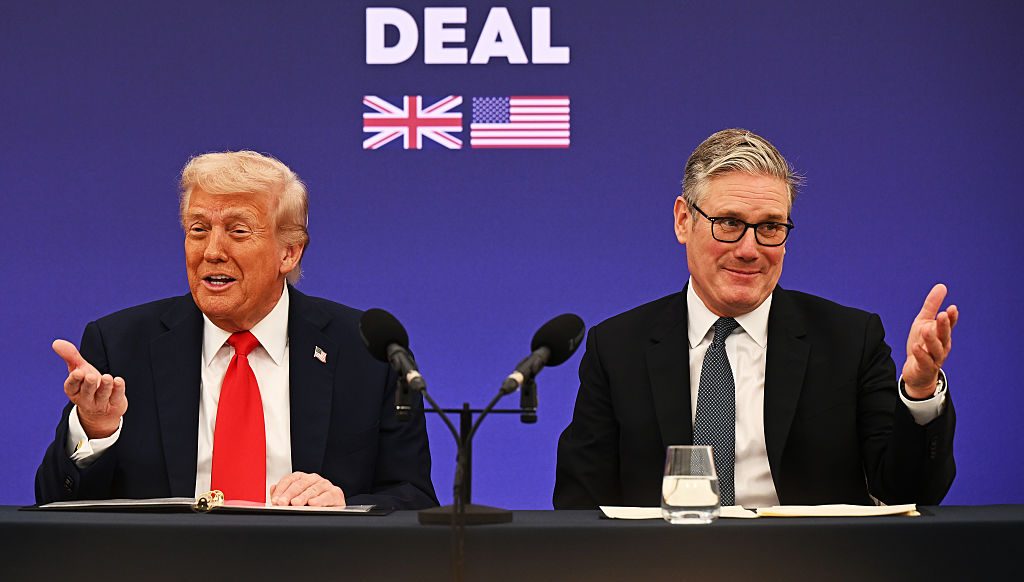
Yet the European consensus on this war’s regretful pointlessness, now uniting even the most Trumpian of continental governments, like those of Italy and Hungary, with the liberal center, provides Starmer with the political cover to stay out. At the beginning of this conflict, it was a contrarian position in the British press to unequivocally state that joining the fight is not in our interests: now it is, correctly, the mainstream political opinion in Westminster as across Europe as a whole. What a few weeks ago appeared an unusually bold stance from Starmer now seems boringly, obviously sensible: Trump’s increasingly erratic jibes to the contrary now inspire pity rather than deference. There may well be a case, when the shooting stops, for taking part in convoy escort and minesweeping duties in the Strait of Hormuz, but we and other Europeans should demand a reasonable price from this most transactional of American administrations. Above all, surely, we should require that Trump firmly and publicly commit himself to the territorial integrity and self-determination of both Greenland and Canada, the New World extensions of our European civilization: he may be a boomer, but Trump has no right to consume our rightful patrimony.
At this moment of historic American weakness, so swiftly following Trump’s intimidation of our home continent, we Europeans must be a little more ambitious in renegotiating the terms of our relationship. Yet instead, the Conservative and Reform politicians who would have blindly leapt into war now tie themselves in knots justifying arcane and incoherent positions, isolating themselves from both domestic opinion and the broader European Right. That they find themselves in this position seems almost more pathetic than lamentable, so devoid is it of any political or strategic sense. Like parents, all empires age, wither and then eventually die. Filial loyalty does not generally extend to jumping into the grave alongside them.