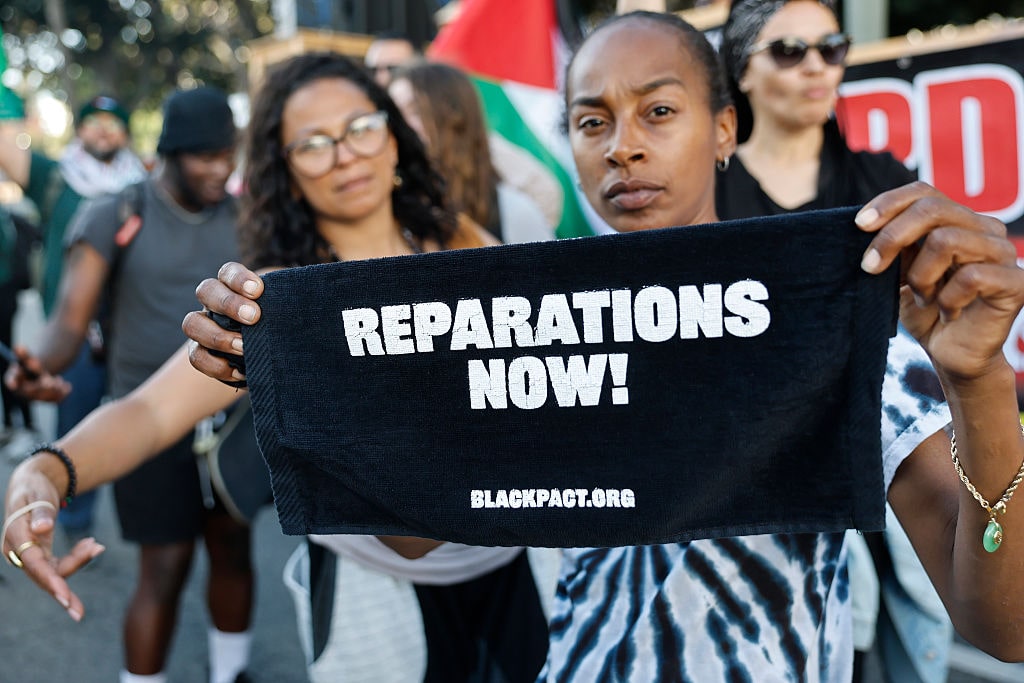
California has spent years insisting that colleges should stop obsessing over race in admissions. Now, thanks to Senate Bill 437, the state is preparing to pay universities to do something even stranger: help design a system to trace bloodlines so the government can officially decide who descends from enslaved people and who doesn’t, all to sort out who gets counted in the reparations debate.
Tracing Your Roots for Reparations
SB 437, authored by Democratic state Sen. Akilah Weber Pierson and signed into law in October 2025, directs the California State University (CSU) system to spend up to $6 million “to conduct research in furtherance of the recommendations of the Task Force to Study and Develop Reparation Proposals for African Americans with a Special Consideration for African Americans Who are Descendants of Persons Enslaved in the United States.” The law orders CSU to “explore options to determine how to confirm an individual’s status as a descendant” and to create a process for genealogical verification of eligibility for reparations. In other words, the state’s largest public university system is now in the business of designing a government-approved ancestry test.
Weber Pierson has been clear about her intent. In a state hearing, she explained, “Senate Bill (SB) 437 utilizes the California State University to explore options to determine how to confirm if an individual is a descendant of a person who was a victim of American chattel slavery.” Later, she argued that “SB 437 builds on these findings by requiring the CSU to develop an accurate and evidence-based eligibility standard for reparative claim.” That standard would also “aid AB 7” — the priority admissions bill — by clarifying “who is a descendant of American chattel slavery.”
AB 7 is important because it exposes the ultimate goal. That bill, by Assemblymember Isaac Bryan (D-CA), would permit public and private colleges to apply an admissions preference to applicants descended from people enslaved in the United States before 1900. Gov. Gavin Newsom vetoed it in October 2025, writing that “this bill clarifies, to the extent permitted by federal law, that California public and private postsecondary educational institutions may consider providing a preference in admissions to an applicant who is a descendant of slavery,” but that colleges “already have the authority” to do so without a new law.
If you’re imagining a future CSU application checklist that goes, “transcript, test scores, personal essay, FAFSA, and documentation proving your great-great-grandfather was enslaved before 1900,” you’re not far off from what the architecture is being built to support. Even if colleges never formally adopt preferences, the entire point of the new bureau and the CSU research is to create a government-approved mechanism for saying who qualifies for reparations, admissions advantages, or special access to state programs.
But once you get past the rhetoric, the practicality problem hits hard. California banned race-based admissions in 1996 with Proposition 209, and the US Supreme Court shut down affirmative action nationwide in 2023. So now the Golden State is trying to design ancestry-based preferences that aren’t “about race,” while simultaneously building a state-run system to sort people by lineage. It’s a little like swearing you’re done with junk food, then paying a panel of nutritionists to define “cheeseburger” in a way that still lets you hit the drive-thru.
Some critics oppose the entire framework on constitutional and fairness grounds. In a letter to the Senate Judiciary Committee, the American Civil Rights Project argued that SB 437 would require CSU “to create a system for dividing Californians by ancestry.” The group warned that “the entire program this measure is intended to further appears constitutionally dubious, practically unworkable, and deeply unfair. It would further entrench a system of hereditary entitlements that contradicts the principle of individual equality under law.”
Attorney Andrew Quinio of the Pacific Legal Foundation, a conservative legal group, took aim at the now-vetoed AB 7, saying the admissions bill “has a very clear racial intent and racial purpose and it will have a racial effect.”
Even supporters admit this is going to be messy. As UCLA professor Gary Orfield noted when discussing AB 7, “All Black people weren’t slaves and all slaves were not Black.” California’s own history includes enslaved Native Americans and forms of Asian indentured servitude that were explicitly labeled “human slavery” in the state constitution. That means any state system for verifying ancestry will have to reach across racial categories, patch together incomplete records, and navigate adoptions, name changes, and family secrets. It’s complicated for historians and genealogists. Now imagine trying to introduce that complexity onto a college admissions office that struggles to roll out a new online portal without having it crash.
Reparations also must confront a basic reality that can’t be ignored. No one alive today was a slave, and no one alive today owned slaves. Asking people in 2025 to financially atone for the actions of people who died more than a century ago puts today’s families in the impossible position of carrying guilt or responsibility for events they never lived through. It doesn’t bring communities together; it risks turning modern neighbors into stand-ins for long-gone ancestors and turns a historical tragedy into a fight over who owes what to whom.
And here’s another truth that rarely makes it into the political speeches: The United States already has numerous government programs specifically designed to help minority groups – including blacks – that white Americans generally cannot access. For example, the federal Minority Business Development Agency, a branch of the Department of Commerce, exists specifically to “promote the growth and global competitiveness of Minority Business Enterprises,” including black-owned firms. Its network of business centers and programs provides capital access, contracting help, and market support for minority-owned businesses, not for white-owned firms in general.
The Small Business Administration’s Business Development Program also gives special contracting access and federal set-aside opportunities to groups presumed to be socially disadvantaged, including black Americans. White applicants cannot participate unless they prove individual social disadvantage through a separate, stringent process.
With programs like these already in place – some that have existed for decades – it’s hard to argue that today’s challenges stem from a lack of targeted support. The problem isn’t a shortage of race-based initiatives; it’s that these initiatives can’t rewrite the past. And no amount of ancestry paperwork, payouts, or bureaucratic sorting is going to resolve something as deep as the legacy of slavery. Turning one of the darkest chapters in American history into a modern eligibility test doesn’t heal old wounds. It just turns history into another government form and grief into another line item.