“This was a Shoezone. This was a barber’s. This was a fruit and veg shop. This was a butcher, he retired and his daughter didn’t want to take it on…” I’m walking through Stanley with Darren McMahon, and it’s not especially heartening. As the community activist explains, the only businesses that now seem to thrive in this County Durham town are “nail bars and the hairdressers” — because you can’t buy these services online.
With his ponytail and bushy grey and brown beard resembling a Regency-era portrait, McMahon looks like he belongs to another century — until, that is, you see the metal band t-shirt tucked into his jeans. It reads: “Therapy?” Stanley certainly needs some, its old signage crumbling, its Edwardian town hall abandoned for so long it’s begun to sprout trees. The particular stretch we’re walking down is, technically, the 41st most deprived of England’s 34,000 “super-output areas”: these “SOAs” are how Westminster census-takers parcel up the nation’s small communities.
At last, this despair is being registered back in London. Stanley is one of around 250 communities that will receive funding as part of the Government’s new £5 billion “Pride in Place” scheme. McMahon is precisely the sort of figure you’d hope such a scheme would empower — part of England’s informal social militia, battling against a decline so severe that The Guardian now suggests the most deprived parts of the country could be even poorer by the next election.
When I arrive in Stanley, McMahon is on his lunch break. He runs Pact House, a kind of all-purpose social fishing net, helping people here to do everything from IT training to learn how to care for their newborns. McMahon is particularly proud of the fact that people who come here initially to seek help often then stay on as volunteers. “We see people who’ve gone through domestic abuse, addiction, and mental health trouble,” he says. “They come out the other side and then help.” It’s a model of social triage that shows people at their best in the most challenging circumstances.
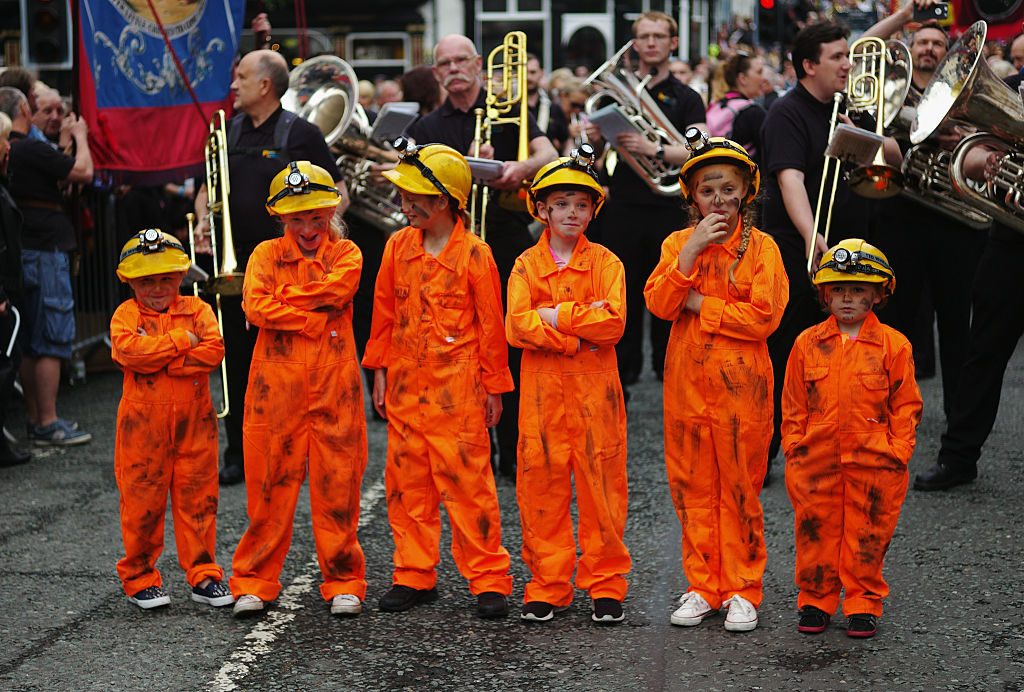
Expansive, all-purpose social hubs like a Pact House are now a common feature across post-industrial Britain. A substitute social infrastructure where the state has frayed. Stanley is reflective of County Durham’s history in other ways too. Once synonymous with organised labour, heavy industry and the industrial revolution, Durham mineworkers pioneered the Friendly Societies that were prototypes of National Insurance and the NHS. The Durham Miner’s Gala has been held almost every year 1871. I grew up nearby in Sunderland in the Nineties and 2000s and I’m a regular Miners Gala attendee. As teenagers, my friends and I frequently visited Durham to watch hardcore punk gigs at a venue called The Fishtank.
By then, Durham was already a shadow of its former self. There were around 230 collieries operating in England in 1944, making Durham the country’s industrial heartland. As the war ended, the nation’s keenness to move on saw Durham condemned. In 1951, Durham County Council designated around a third of its villages as “Category D” settlements — meaning they had “outlived their usefulness.” Support was cut; development discouraged; residents advised to move on.
That was 75 years ago now, a full lifetime, but the effects of this managed decline echo to this day. Child poverty rates in the region remain extremely high: 38.7% of children in County Durham are in poverty compared to 27% nationally. This long history of adversity also helped forge the area’s distinctive political culture. Chopwell, one of Durham’s Category D villages, was nicknamed “Little Moscow” for its radicalism. Touring the North East in the Thirties, the Labour intellectual Harold Laski found an impoverished miner’s home containing only William Morris books. The tenant had sold all his furniture before them.
But ancient loyalties shifted markedly in the “Red Wall” election of 2019, when two Durham constituencies elected their first ever Conservative MPs. Keir Starmer’s Labour reclaimed the seats in 2024, but last year’s council elections highlighted how tenuous his hold was. Durham became one of the country’s first Reform-majority councils. The party’s celebrity Northerner, Darren Grimes, is now a councillor in the ward just across from Stanley. His campaign platform, centered around which flags to wave on buildings and on cutting Durham council’s largely nonexistent DEI jobs, had little to say about the business end of poverty in an area that has been neglected for decades.
In her 1939 book, The Town That Was Murdered, the Jarrow MP Ellen Wilkinson wrote about the ups and downs of life in an interbellum industrial Britain that regularly shed its workers and rehired them broken and impoverished. Even in the glory days of coal, Durham miners were in and out of employment as surely as the tide. Wilkinson was keen to honour them in a way largely absent from politics today, writing that “the history of a town is not that of its famous men only, but the story of the tenacity of its unknown fighters in the struggle for existence”.
Darren McMahon is one of those unknown fighters. Another is Linda Kirk, who runs Just for Women, a wellbeing and advice centre on Stanley high street, from an office decorated with artificial pink flowers and a cabinet containing several of the “Heart of the Community” awards she has won over the years.
Kirk is clear that a lack of jobs has crippled Stanley. “In the Sixties and Seventies, we had a lot of businesses that came in,” she says. “Big businesses. Through the Eighties and the Nineties we saw that decline.” Stanley once had its own department store, Doggart’s, a family-owned retail chain that closed in the Eighties. “It was the John Lewis of Stanley,” Kirk adds, the pride in her voice palpable. “You used to be able to go and buy all your lovely clothes and housewares. The street was vibrant.”
Kirk runs a mother’s group, and hears everyday how the disappearance of social infrastructure is affecting the younger generation. “They call their children as you would a cat that didn’t go outside,” she explains. “They’re ‘house’ children. They come from school and they’ve got nowhere to go. They’re just hemmed in. Literally hemmed in. Where can our children go? Where can they go?”
“They’re ‘house’ children. They come from school and they’ve got nowhere to go.”
Strong social ties were once the real wealth of working-class life, but these are vanishing. According to the Government’s Community Life survey, the North East is now the loneliest part of Britain. Especially deprived areas, like Stanley, have double the rate of loneliness and isolation of the wealthiest. An ONS study published last October said that 33% of 16-29 year olds feel lonely “often, always or some of the time”. The loss of jobs has been compounded by a loss of social spaces: no pubs, no youth centres, no well-kept parks to hang out in.
When I ask Kirk what a rejuvenated Stanley might look like, her ambitions are modest. “We’ve got another town centre that’s not too far away from us: in Consett.” Consett is another County Durham town, characterised by steep hills lined with miner’s terraces and Persimmon new builds. It’s bisected by the River Derwent and sits on the edge of the North Pennines National Landscape. Boasting better transport links than Stanley, Consett also attracts commuters from Sunderland and Newcastle. “You can see that it is just absolutely thriving,” Kirk says of the town. “We’re hoping this is what’s going to happen in Stanley. That’s what we’re looking forward to.”
What’s striking about my conversations in Stanley is that when I raise the idea of local pride, people talk about things that those in other places take for granted. The opportunity to have a pint with some friends; to buy a knickknack from a local shop; to push their kid on a swing with some other parents. “We look at Consett,” Kirk says, “and think ‘Why can’t we have the same?’”
It’s a question decades of trickle-down dogma has never really solved — and yet it’s one that could transform our political life far beyond the North East. Luke Akehurst, the Labour MP for North Durham, watched Reform win a landslide at the local council elections in 2025. For him, the results are less a protest against Durham Labour and more about anger at national decline. People “felt their town was suffering from a failure of government,” Akehurst says. “Whether that’s on the issue of failure to control borders — which there’s no point pretending that my constituents don’t care about — or a failure to provide the basics.”
To that extent, Pride in Place can hopefully move decision-making away from Westminster — to let local people decide how to spend their millions, whether on crumbling village halls or dormant youth clubs. Akehurst sees this particular pot as the last chance to evade the slow death of local traditions. “Craghead Colliery Band practice in a band room at the Craghead Victory Club.” he says by way of example. “The ceiling there is cracked. It’s leaking and dangerous. They have a cadet band, bringing kids in to play instruments. They can’t run sessions for young people because it’s not a safe environment. Pride in Place could literally give them a new ceiling.”
It would seem an easy decision to make. Yet since Johnson won his landslide, Whitehall has offered a stream of overly complex, heavily centralised, and impossibly bureaucratic redistribution policies: The Towns Fund, Levelling Up, Build Back Better. All have spectacularly failed to deliver on what voters in places like Stanley were promised. In early 2024, Durham County Council even took it upon itself to sue the Government for rejecting five bids for Levelling Up money on which it had spent £1.2 million. They abandoned the legal case the same year, citing a lack of money.
Pride in Place may yet avoid these pitfalls. But Labour is meanwhile keen to avoid the charge of being “as bad as the Tories” — who, predictably, siphoned their own Towns Fund into Tory constituencies. As is often the case with Starmer’s Labour party, the logic here seems self-defeating.
Labour’s army of special advisors in Westminster appear to have convinced themselves that such “pork-barrel politics” is at the heart of political distrust. The Tories, by contrast, understood the more basic political rewards of giving the people what they voted for, the kind of political patronage Ronald Reagan once referred to as “dancing with who brung ya”. Labour, by contrast, arrive at the dance floor nervous that to cut some rug on behalf of their voters is somehow unfair.
Pride in Place’s architects do seem sincere in their desire to empower places like Stanley. Ben Glover of the Independent Commission on Neighbourhoods (ICON), which helped develop the scheme, sees it as a successor to Big Local — the Lottery-funded programme giving 150 neighbourhoods across England £1 million each to make improvements with minimal bureaucracy.
Glover argues that the cash would be better spent on interpersonal initiatives like knitting clubs more than high streets. In the least well-off neighbourhoods, a trip to the high street is far less important than the social connections that were once sponsored by employers and trade unions.
When I spoke to Linda Kirk, however, the technicalities of Westminster funding formulae seem far from her mind. “We’re trying to hold on to dignity and respect and all of that,” she says. “My take on it is about leaders. I’ve got a thing about leaders and we really do need strong leaders that we can believe in.”
Walking around Stanley, I can’t avoid the sense that all Whitehall’s handwringing arguments about the best way to deliver levelling up-type projects are missing the point. Labour will invest £36 billion over a plethora of schemes while in office — three times what was pledged under Boris Johnson. Yet it still might not make a difference large enough to win these communities back, with one recent report suggesting Labour risks an electoral wipeout if it fails.
In 2021, the Centre For Cities released a study that claimed that closing the North-South divide would cost £2 trillion and take decades. To make real progress would take a nationwide effort similar to the post-Cold War reunification of Germany, where a solidarity tax on the West was levied to rejuvenate the East. Labour hasn’t promised anything like this. Indeed, it isn’t clear that the money markets, whose permission the Government needs to rebuild these parts of Britain, would even allow such an effort.
After so many failed projects to address regional inequality, then, Pride in Place feels like a step in the right direction — but a small step. Large swathes of the country are aging and have been in decline for decades, propped up by transfers from London’s economic surplus. There has been no serious attempt by any Western government to change the economic paradigm of the last two generations, a paradigm that has swept Britain clean of the kind of industrial jobs that once made County Durham so prosperous.
Where once there were mines, shipyards, factories and refineries, Britain made a desert of call centres, betting shops and Deliveroo bikes and called it peace. Millions of us live in “Category D” Britain — just as those old condemned mining villagers did, where residents feel their best days are long behind them. By the time the next election comes round, people like Darren McMahon are likely to still find themselves battling tirelessly at the frontline of British malaise, providing hope where others have given up years ago.