Why Americans should care about the country’s identity crisis.
Chile rarely captures sustained American attention. It is distant, orderly, and often portrayed as a reliable outpost of stability in South America. But this image is vanishing—and the shift matters far more to the United States than many realize.
Chile is a crucial democratic partner in a region where China and Russia are expanding their influence. Its economy is tightly linked to U.S. markets, its copper and lithium reserves are central to American technological and defense supply chains, and its politics influences the balance of the entire Southern Cone.
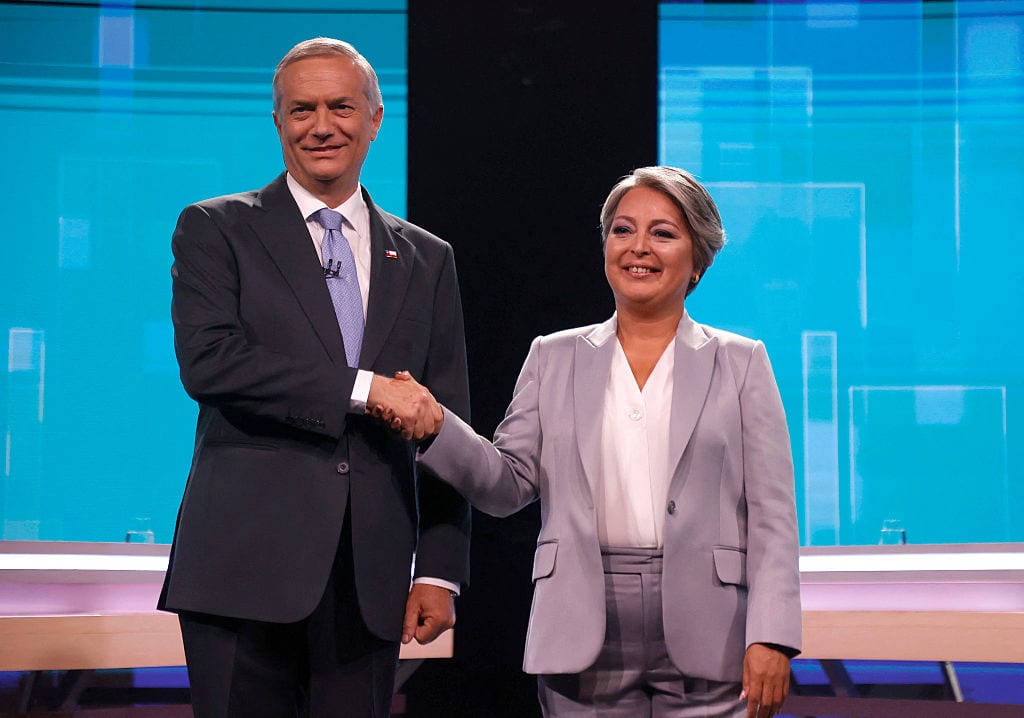
The country features a two-round system for its presidential elections, the second round of which will be held on December 14. Two candidates are running: one from the Right and the other from the far left-wing. A Communist victory in Chile—or a prolonged period of instability—would affect U.S. geopolitical, economic, and security interests.
But the deeper reason Chile matters to Americans is that its current crisis illustrates a broader lesson: economic success without a strong cultural foundation cannot sustain a free society. The United States faces its own internal cultural fractures. What is happening in Chile is not only a regional concern—it is a cautionary tale.
To understand how Chile arrived at this fragile moment, one must look at its origins and the long-standing tensions that have shaped its national identity.
Unlike the United States, Chile was not a colony that broke free from an imperial power after forging its own civic institutions. The Spanish Crown supported the conquistadors and created a society anchored in administrative hierarchy rather than local self-government. When Chileans formed the First Government Junta on Sept. 18, 1810, they did not declare independence. They swore loyalty to King Ferdinand VII, then a captive of Napoleon. Their act mirrored how juntas were formed in Spain itself. Chile’s political birth was a gesture of fidelity to a monarchy threatened by the revolutionary ideas of Europe.
By contrast, the United States emerged from a colonial experience in which settlers had long practiced self-government, built churches, and developed civic habits independent of the Crown. When Americans declared independence in 1776, they acted from a culture formed by religion, local democracy, and a deep commitment to ordered liberty. Tocqueville famously saw this moral foundation as the lifeblood of American democracy. Independence in the U.S. was not a left-wing revolution but the political expression of a mature civil society.
Chile’s path was the opposite. Its elites were molded by Spanish administrators, and after independence, they began to imitate French revolutionary forms. Chilean nationalism blended a conservative legal order with a constant fascination for radical political change, a tension that became part of the Chilean ethos and has resurfaced repeatedly throughout its history.
Religion underscores the contrast. Catholicism arrived in Chile before the state, shaping culture long before the republic existed. But in the early 20th century, Chilean conservatives themselves pushed faith into the private sphere. A right-wing conservative government enacted the separation of church and state in 1925, aligning Chile with Europe’s secular republican model rather than with the vibrant religious life of the United States. While religion has always been a major influence in American public life, in Chile religion became culturally weak, leaving the public square open to radical ideological projects.
These roots help explain the instability that would erupt decades later. In 1973, the armed forces removed the socialist President Salvador Allende, who came to power in alliance with the Communist Party and other groups influenced by Marxist-Leninism. There were documented concerns about arms trafficking, the formation of paramilitary militias, and Fidel Castro’s extended presence in the country. The military intervention was demanded by the National Congress, the Supreme Court, the Constitutional Court, and significant sectors of the population.
The military government that followed attempted to shift Chile toward American notions of markets and individual liberty. It suppressed Marxist propaganda and fostered admiration for the United States. Despite this, it could not completely erase the revolutionary impulse that had been seemingly seared into the country’s DNA.
When democracy returned through elections that Pinochet called in 1990, the Left regained its cultural footing. Their central political goal became destroying the 1980 constitution. After the violent 2019 riots—what I have called a “Red October,” which was strikingly similar to recent unrest in American cities—two constitutional conventions attempted a complete rewrite of the constitution between 2021 and 2023. Voters rejected both proposals by overwhelming margins (62% in 2022), but the revolutionary narrative persisted.
In 2021, Chile elected Gabriel Boric, a young leader under 40 shaped by student activism and the far-left. His government oversaw a rapid deterioration: crime surged, narcotrafficking expanded into territories once unthinkable, and organized groups intensified attacks in the southern region of La Araucanía, targeting forestry companies and infrastructure. Nearly 300 Catholic and evangelical churches have been burned in recent years. Economic growth slowed, foreign investment declined, and public confidence plunged.
Today, Chile faces a close presidential race in which the leading left-wing candidate, Jeannette Jara, is the Minister of Labor in the Boric government. And until days before the first electoral round in October, she was a lifelong member of the Communist Leninist Party—a party that reaffirmed its Leninist identity recently in January 2025. The right-wing candidate, José Antonio Kast, now campaigns behind a bulletproof shield due to credible threats against his life.
Once one of Latin America’s strongest democracies, Chile will soon decide whether it will resume its democratic course or elect a Communist as president. There is no alternative like a moderate or social democratic-left, or even merely a democratic one.
Why has this happened? The answer is cultural. The Chilean Right embraced economic reform but neglected the realm of ideas. As James Davison Hunter observed, culture is shaped by institutions, not by markets. Universities, media, museums, and the arts were dominated by the Left in the democratic era. The Right largely focused on GDP instead.
The consequences are visible. A former cultural official from a center-right government once recounted an exchange after the short film Historia de un Oso (The Story of a Bear) won an Academy Award. When the film was showcased in public museums, a conservative leader protested that it was left-wing propaganda. The official replied, “Without investment in film schools and cultural institutions, the only works available for public display would inevitably be those created by the left.” The anecdote captures Chile’s cultural asymmetry: the Left creates culture; the Right reacts to it.
For Americans, Chile’s experience is not an exotic story. It is a warning about what happens when cultural institutions erode. A society cannot defend liberty with economics alone. Free markets require universities that teach truth, artistic communities that nourish the imagination, and civic institutions that form citizens rather than activists. When these are ceded to radical ideological projects, politics becomes a battlefield of resentment.
Chile now stands at a crossroads. It can renew the cultural foundations that were built during the 1990s when democracy returned or sink deeper into conflict. Its decision will shape not only the Andes and the Pacific Rim but also the strategic interests of the United States. Americans should watch carefully. Chile’s crisis is a signal. Its renewal would be a model.