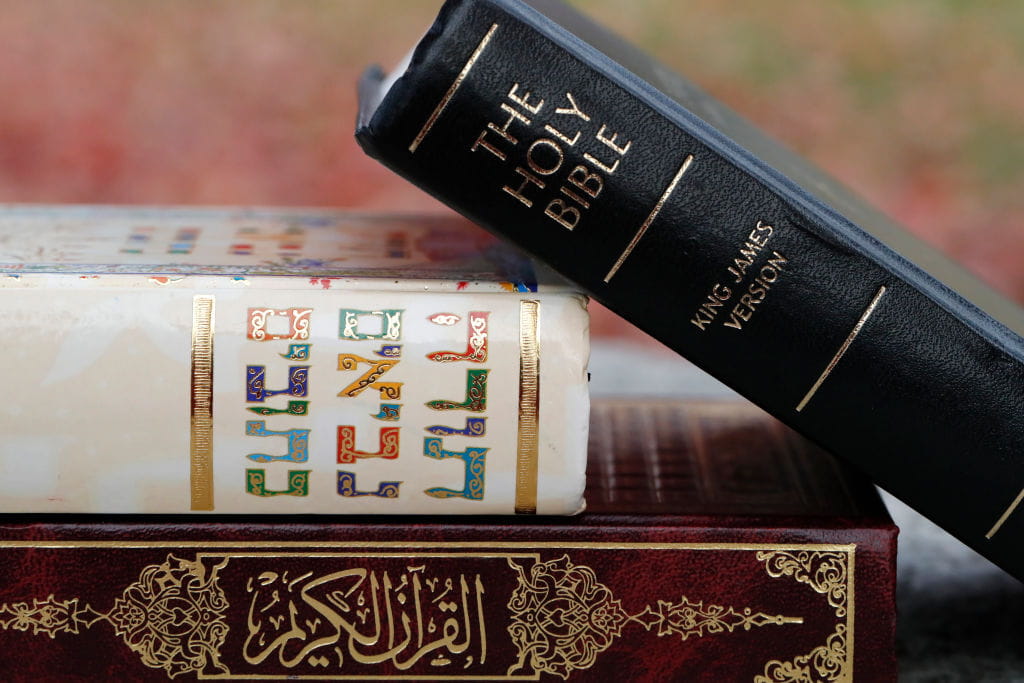
Christianity has been the largest religion in the world for centuries – but is that streak coming to an end? A new study by MyCross shows that, while Christians still greatly outnumbered Muslims in 2025, Islam dominated the internet. Does this trend foreshadow a future in which Muhammad claims more followers than Jesus, or is it all just coincidence?
Religion Online: Curiosity vs Conviction
Online religious jewelry store MyCross recently analyzed the most common faiths in the world using a variety of factors to determine online visibility. The results? Christianity has the most followers around the world, with Islam trailing by almost half a billion. Hinduism comes in third with just over a billion adherents, followed by Buddhism, Sikhism, Judaism, Jainism, Spiritism and spiritualism, Shintō, and finally Zoroastrianism rounding out the top ten. According to the study, there were 2.52 billion Christians globally compared to 1.9 billion Muslims. Hinduism is the only other religion on the list to break a billion. Buddhism comes in at just over 530 million, and all the rest lag far behind, from 29.25 million for Sikhism to just 205,000 or so for Zoroastrianism.
When it comes to online popularity, however – at least as judged by online searches – Islam tops the list. But searches for (and information about) a religion don’t necessarily always accurately represent the population. An average of 36.1 million searches for information about Islam compared to 20.8 million for Christianity would seem to imply there’s more interest in the former than the latter – and a Google Trends search for the terms “Islam” and “Christianity” for the year 2026 shows the former has been about twice as popular a search term as the latter this year so far. Expand that to the whole world, and Islam becomes close to five times as frequently searched.
But curiosity does not equal conviction.
Consider this: Those actively participating in a faith – especially those born into religious families – already have some degree of a knowledge base as a foundation. It’s not your own religion you need to Google, but the foreign one you don’t understand. When looking at the actual queries, it turns out the top search is “What is Islam,” a question that has grown 10% in popularity this year. The second is “Islam meaning.” These aren’t the kinds of questions Muslims are likely asking the internet.
The Rapid Rise of Islam
On the other hand, a good portion of that search interest very well may represent change on the horizon. In June of last year, the Pew Research Center came to the conclusion that Islam was the world’s fastest-growing religion from 2010 to 2020. It remained the second-largest religion behind Christianity, but the gap was beginning to close.
During that decade, the number of Muslims in the world rose by 347 million people to an estimated total of about two billion. In that same span, Christianity grew by just 122 million to an estimated 2.3 billion in total. In fact, Muslims added more people across that time period than all other non-Muslim groups combined (248 million), and Islam’s growth alone outnumbered the entire population of Buddhists worldwide (324 million).
So, the gap is shrinking. In 2010, Muslims made up just 23.9% of the global population compared to Christianity’s 30.6%. By 2020, those numbers were 25.6% and 28.8%, respectively.
Barring some unexpected world-changing event, it will likely be many years yet before Islam supplants Christianity as the world’s top religion – if, indeed, it ever does. Some studies suggest this will happen by 2100. Others say 2070. Even those proposing 2050 as the tipping point don’t expect the shift to occur for another quarter century, though. So, while Muslims seem to rule the web (at least for now) and account for more growth than any other group, Christianity’s place in the lead seems secure – for now.