I’m not sure what Max Weber would make of this time of year. He described the modern world as being “disenchanted”, insisting that “we no longer need to rely on magic as a device for mastering spirits or pleading with them — unlike the savages for whom such mysterious forces used to exist. Calculation and technical equipment do the job.”
How strange then, to see, even in our world dominated by technology, that around mid-December, swathes of the population grant themselves permission to cosplay ancient dreams of a magical and enchanted world. Basically, for the whole of advent, the world is teeming with elves and wizards and winged creatures singing good tidings.
But it is not just modernity that supposedly sets itself against the enticements of the magical. For centuries, the religious establishment sought to destroy magic. The Bible, particularly the Hebrew scriptures, prescribed the death penalty (by stoning) for those meddling in the occult. To be accused of witchcraft and wizardry was to be assuredly burnt at the stake. And the Inquisition crushed all such nonsense. Today, conservative Evangelicals ban their children from reading Harry Potter. And some even attack Christmas itself. Too much Hocus Pocus.
This ambivalence towards magic probably seems rather strange to the secular imagination — which deems religion to be the most powerful purveyor of magical thinking in human history: a fantasy world of dangerous ideas and superstitious nonsense. Yet there is absolutely a way of thinking about magic that is not dangerous or fanciful, but taps into some of our most understandable human concerns. As Joan Didion wrote 20 years ago in A Year of Magical Thinking, powerful life events — for her, the death of her husband — can create unexpected eddies of thought. As with the secular observing the religious, these might seem bizarre. But from within the experience of loss, they have an irresistible persuasion. Didion refuses to throw her husband’s shoes away, for example. Not for sentimental keep-sake reasons. But because she believes he will need them when he returns. On one level, she knows this is ridiculous: he is dead; he is not coming back. But holding on to his shoes, in the hope of his return, is an expression of the kind of magical thinking that captures exquisitely the depth and power of her grief. Sometimes, magical thinking is an expressive interruption of what is sensible and rational; it says things the sensible and the rational cannot begin to articulate. A baby in a manger, God come down to earth from heaven, angels singing “fear not”, kings following stars — perhaps all this, too, is an expression of hope. I trust it, but not in a way I can rationally justify. It’s magical thinking.
“I am re-fortified — not just by the whisky — to keep on fighting for that powerful white magic of love and peace.”
This is expressive magic; hopes and dreams magic; it’s white magic. And some justify this way of thinking by comparing it favourably with the more sinister aims of black magic. It was in the 16th century that Edmund Spencer first used the term black magic as something deceitful and dangerous in his Faerie Queen. Black magic is all about the thirst for power. It, too, seeks to harness the power of what we do not understand — but for personal advantage. Cast a spell and she will love you. Prayer will make you rich.
This is the kind of magic that Prospero has to relinquish at the end of The Tempest in order to become a decent human being again. “Now my charms are all o’erthrown, and what strength I have’s mine own.” It’s a bit like almighty God giving up his power and becoming a weak and pathetic child rather than an omnipotent super-deity. White magic, on the other hand, knows that the mystery takes the time it takes. White magic does not seek to overwhelm with its force. White magic is love.
Unusually, I hold the view that technology is the dark magic for our age. It is where people look for a quick fix and where they are prepared to accept things even when they have no idea how they work. I don’t understand nuclear power or Artificial Intelligence or crypto currency or metformin. No idea. If I use them, I have to trust that others are aware, and that they are using their enormous power for the greater good.
Just as the average lay person in the Middle Ages believed that so-called experts in the unknown — mainly priests — were using their power for good (and often they weren’t), today the man on the Clapham omnibus must trust our current high priests of science and technology. But I am nervous about all their raids into the unknown because their power can cross certain boundaries, interfering in things that are properly beyond our reach. My wariness is not because I do not “believe in” science, but rather because I do not believe in people. Just as there is black and white magic, so is there black and white technology.
Christmas says little that is interesting to science and doesn’t really try to. It’s a very different mode of thought that reaches for a different kind of truth. For the average semi-secular Christmas consumer, magic is part of the feel-good mood — a spiritual titillation, rather than pertaining to anything real. But might it be more than this? The dark streets, nights closing in — at this time of year we live more up close and personal with the unknown. This is the time for ghost stories, where the fear of the unknown is brought alive.
Saying things about the unknown is a human compulsion. Of course, we risk saying things that are foolish, strange, magical. But however much science pushes back the boundaries, it cannot eliminate the unknown, and so whatever the advancements of science, we must live with it, paint a face on it, tell stories about it. As T.S. Eliot wrote, we have to make “a raid on a inarticulate”.
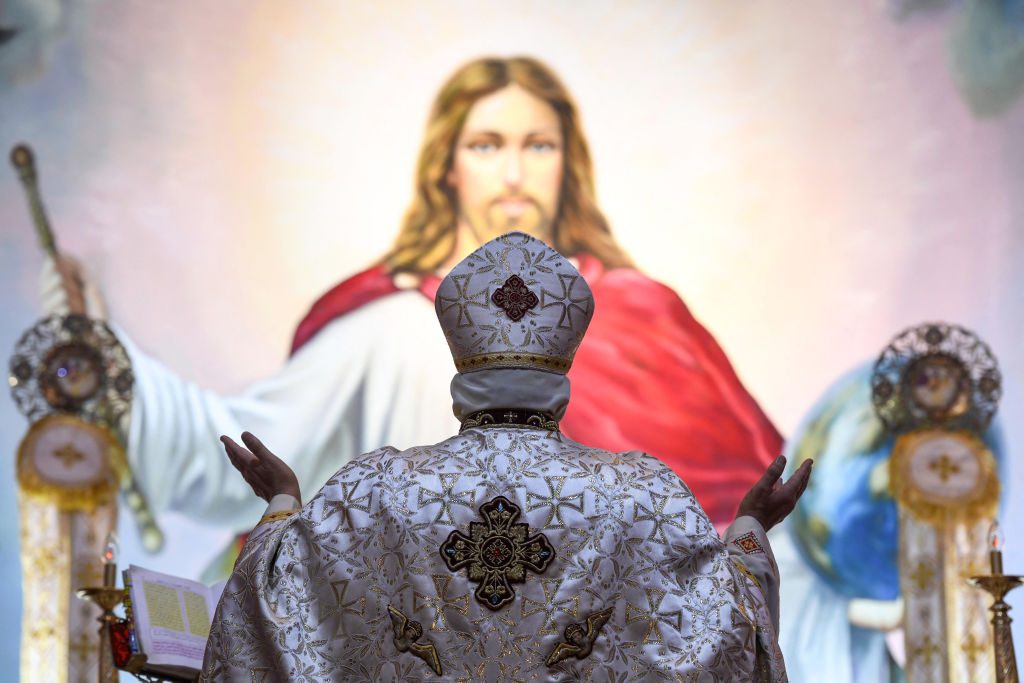
Letting the light in helps us illuminate the unspeakable. And we’ve been burning a lot of candles in our household of late. Hanukkah and Christmas both love all that light-in-darkness imagery. For Christians, it radiates from a child born in a stable 2,000 years ago. As we sing at midnight mass: “Yet in the dark streets shineth, the everlasting light. / The hopes and fears of all the years are met in thee tonight.” God enters our world and offers us a hope that pushes back against the terrifying darkness of Bondi, Kharkiv, Gaza…
After presiding over the coming of the light at that Mass, we clergy have developed a singularly new tradition. At 2am, during “Clergy Malt Club”, hundreds of knackered vicars pour a glass of whisky and join in a moment of peaceful solidarity on social media. In the stillness of the night we sit at home, usually on our own (families in bed), reflecting on the extraordinary events of the past few hours. Thousands of people have been in church; but now we are alone with the magical message of the angels and the virtual friendship of our colleagues. How silently the wondrous gift is given.
These moments of communion remind how much I love the church of which I am a part, despite all that is thrown at it. And I am re-fortified — not just by the whisky — to keep on fighting for that powerful white magic of love and peace. He is born. Happy Christmas.