Real journalists are supposed to challenge the status quo—not carry water for lobbyists.
When the United States Senate actually deliberates, it remains undefeated.
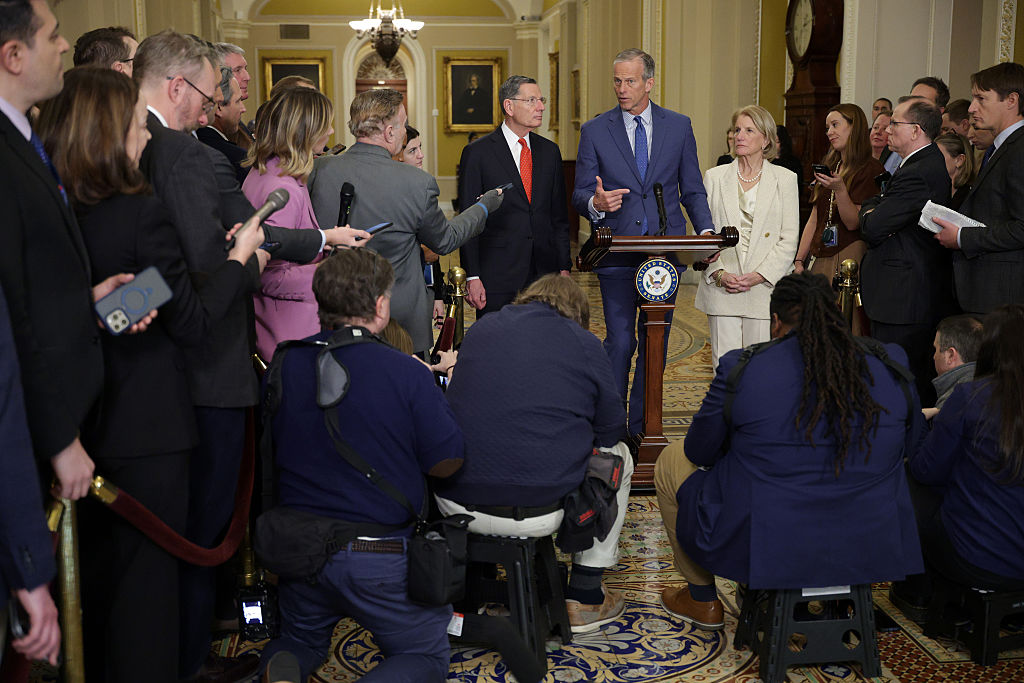
Last Tuesday, mere hours after Senate Republican Leader John Thune finally acquiesced to conservative calls for an open-ended floor debate on national voter ID legislation, Senate Minority Leader Chuck Schumer—who for months condemned the SAVE America Act as “Jim Crow 2.0”—told reporters that, lo and behold, Democrats are fine with requiring voters to show a photo ID. Days earlier, Senator Dick Durbin, the Democratic Whip, also admitted as much.
If you followed the debate over floor strategy for the SAVE Act over the last six weeks, you know that Schumer’s admission was supposed to be impossible. With Olympian certainty, leadership aides and former ones-turned-corporate-lobbyists dismissed conservatives’ proposal for an open floor process. After all, everyone knew that the Democrats’ opposition to voter ID was absolute; that debating the SAVE Act was a waste of time and a threat to the sanctity of the filibuster; and that voter ID was dead on arrival in the Senate.
It turns out that all of the things “everyone knows”…are false.
One cannot fault leadership and K Street for their faux-sophisticated posturing. Their livelihoods depend on affecting possession of double-secret insider knowledge and gaslighting everyone else about the futility of questioning “the experts.”
The same cannot be said about journalists covering the debate on Capitol Hill. For the last month, supposed “reporters” have repeatedly leapt down from the press gallery and into the debate, presenting the opinions of their establishment sources as facts, outing themselves as anti-democracy corporate shills.
Leading the pack has been Punchbowl News’s Andrew Desiderio. On February 26, SAVE Act sponsor Senator Mike Lee posted on X that “the Senate is perfectly able to pass this bill,” which was and remains objectively true. Apparently frustrated that Lee’s Senate colleagues had failed to answer his point, Desiderio himself chimed in: “As we reported this morning, the Senate is far from ‘perfectly able’” to pass the bill. When challenged for conflating his opinion with fact, Desiderio insisted he was “using empirical evidence to show that [Senate passage] is literally not possible.”
Except he was doing no such thing. Desiderio—who was in middle school when Lee began his Senate career—did not have a whip count. His “empirical evidence” was background spin from biased sources desperate to keep Lee’s bill off the floor.
Other reporters—parroting the same sources—adopted the same tone. NBC’s Sahil Kapur claimed that a talking filibuster had never historically worked as a mechanism to break the filibuster. Yet it did in 1893. Moreover, reporters including Kapur have refused to acknowledge Senator Lee’s repeated insistence that the talking filibuster is a strategy designed to force a negotiation that would otherwise be avoided, even one that achieves cloture (as opposed to moving directly to a simple majority), and that the outcome would be determined by the variability of political forces these reporters apparently assume do not exist.
The Senate Rules Allow a Talking Filibuster
All this time, the Senate’s rules have not changed: a filibuster can be broken in one of two ways, either mechanically through cloture, which requires 60 votes, or through physical exhaustion. Breaking the filibuster through either process would result in the Senate passing a bill by a simple majority.
Forcing a talking filibuster was the only way for determined majorities to break a filibuster before 1917, when the cloture rule was instituted (a two-thirds majority of senators present and voting was required to break a filibuster, later changed to 60 votes in 1975). As a practical matter, Senate filibusters were vanishingly rare until roughly the last 20 years. In other words, unlike today, it was much more common for bills to pass with just a simple majority.
For example, in 1893 a Senate majority pushed by President Grover Cleveland forced the Republicans to stand and voice their opposition to the repeal of the Sherman Silver Purchase Act. After 46 days of filibustering, the opposition collapsed, and the filibuster was broken through exhaustion, pressure, and political pressure. In other words, the opposition gave up. The repeal bill passed by a vote of 48 to 37.
In modern times, the talking filibuster has been used to force negotiation on issues where the proponents and opponents (not always evenly distributed between Republicans and Democrats) were fiercely at odds. The most famous example of the 20th century is the passage of the 1964 Civil Rights Act. By forcing opposing senators to talk, Majority Leader Mike Mansfield began a process that mixed physical exhaustion with fast-moving public political dynamics, and the opposition eventually recognized that a substantive compromise was unavoidable. Sixty-seven votes were needed to break the filibuster through cloture; 71 senators ended up voting for it.
This is the point of a talking filibuster: it forces a public political spectacle, an internal negotiation, and a physically grueling exercise that drags the two sides together to do battle and, when the process becomes unsustainable, potentially to agree.
Lobbyists All the Way Down
Capitol Hill reporters, however, are interested in none of these historical facts. They mix their glee in bashing conservatives with ignorance about Senate rules into a stew of misinformation, presented not as “Leadership aides tell me…” but as holy writ, immune from challenge.
Indeed, as Lee’s strategy gained popularity on and off Capitol Hill, congressional reporters condemned it in starker terms than even Senator Thune. To his credit, Thune never slandered Lee’s talking filibuster idea as impossible, because he is intimately familiar with Senate rules and knows it’s not. He resisted it, for sure, but did so honestly.
There is nothing wrong with policy advocacy. Many people in D.C. do it for a living! But Desiderio and other reporters work for news media outlets, not as pundits but as reporters. They are supposed to inform the public about political debates and describe the parameters of what the Senate rules allow, not ignorantly prejudge them. What Capitol Hill’s lollipop guild did while “covering” the SAVE Act debate was not journalism—it was lobbying.
And given their role in our constitutional order, it was irresponsible. When trusted reporters palm off elite opinions as facts, it has a chilling effect on the democratic process. That many of their outlets are openly funded by the same K Street interests whose spin they amplify only further taints their “reporting.” It tells the American people that their democracy doesn’t really belong to them. Their in-the-know posing turns people away from the civic engagement the Constitution encourages, and on which the republic’s health depends.
If you’re a reporter who spent the last month falsely asserting that a policy supported by 85% of the country has no chance of passing the Senate, and you wonder why Americans are drifting toward cynicism, despair, and conspiracism, look in the mirror. Especially now that every one of your baseless assertions has been discredited by events. When Leader Thune called up the SAVE Act, the Senate did not erupt in the derisive laughter that “everyone knew” to expect. The senators voted to proceed with the bill, just as Lee said they would.
When Schumer faced reporters a day later, he didn’t pound his chest in triumph over Republicans’ tactical stupidity. He admitted for the first time that Democrats could support one of the bill’s key proponents.
Now, maybe Schumer misspoke. Maybe he stepped on a rake. Or maybe—just maybe—it’s easier to talk tough in hallway interviews with 26-year-old stenographers with pick-me-girl energy than it is to oppose an 85% issue on the Senate floor in an election year.
I don’t know. But that’s the point. The Senate is unpredictable. It is supposed to be. It has defied expectations and beclowned prognosticators for more than two centuries. This week, the world’s greatest deliberative body did it again.
The only fact about the SAVE Act floor debate is that no one knows how it will end. What if Thune proposed a clean photo ID bill that Schumer now says Democrats could support? Would it get 90 votes? 51? 30? Could other elements of the SAVE Act be patched together with other popular proposals for a different kind of compromise? I have no idea. Neither do Thune or Schumer. And neither do their bylined courtiers.
The debate over the SAVE Act this week is the most open Senate floor process we’ve seen in a decade. And in less than 24 hours, it yielded a major political surprise, and possibly a legislative breakthrough. If this process ends up passing a bill that a week ago “everyone knew” was DOA in our gridlocked Congress, that’s a pretty strong endorsement of the process.
Hopefully, it serves as an overdue reminder to the Capitol Hill press gallery that they might salvage some of their profession’s evaporating credibility if they spent more time challenging the self-interested spin of leadership staffers and corporate lobbyists and less time passing it off as fact.
Real journalism is supposed to speak truth to power, not lie for it.