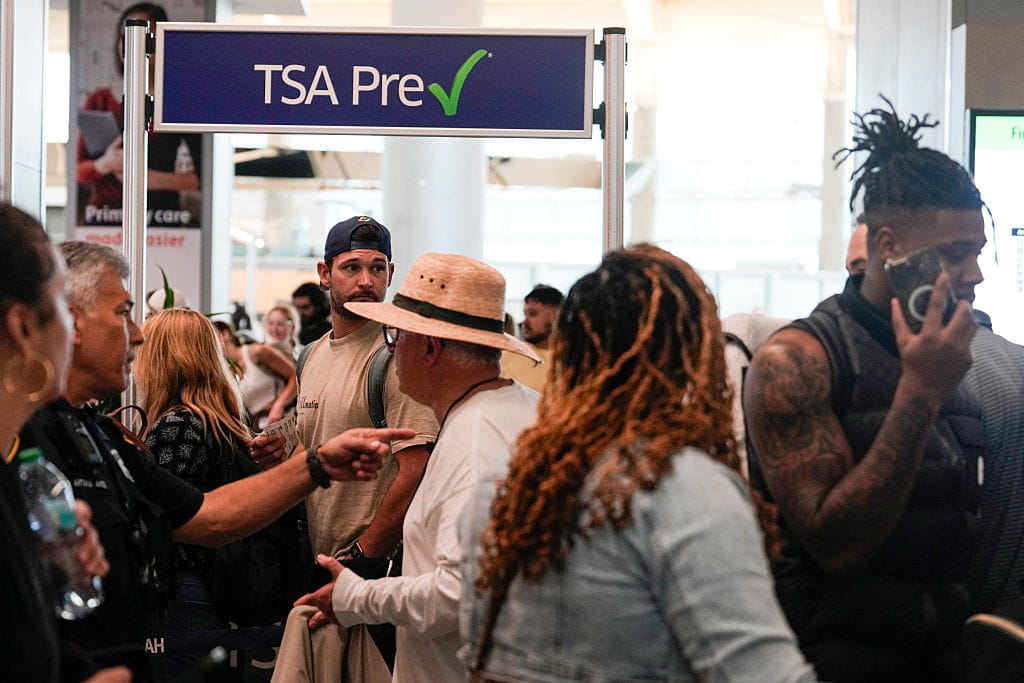
The partial shutdown of the Department of Homeland Security (DHS) entered month two on Saturday, March 14. And still, there is no end in sight. Neither Democrats nor Republicans are budging on DHS funding, and so the shutdown – and the blame game – continues. It’s no game, however, for thousands of department employees who, unlike Congress, aren’t getting paid for this fiasco. Then there’s the looming spring break crisis. The Transportation Security Administration (TSA) is barely functioning as is, and one of the most popular travel weeks of the year is about to begin.
A Most Unfortunate Anniversary
The partial shutdown of DHS kicked off on a holiday: February 14, Valentine’s Day. This weekend, it hit a most unfortunate milestone on a far less conspicuous day. March 14, or 3/14 numerically, is informally celebrated by many as Pi Day. Sure, it’s no major holiday, but fans of the mathematical constant – and puns – happily chortle over it while hunting out $3.14 pizza and pie deals.

As the shutdown officially entered its second month, however, neither Congress nor the federal employees affected by it had much to celebrate. DHS funding failed yet again in the Senate on Thursday, and lawmakers seem just as determined – or more – to make sure the other side of the aisle shoulders the blame than to actually solve the problem.
The 51-46 vote on March 12 was the fourth attempt in as many weeks by Republicans to pass some form of full-year funding for the department, but Democrats won’t budge from their list of ten reform demands before approving another penny for US Immigration and Customs Enforcement (ICE). Meanwhile, Republicans refuse to either meet those demands or pass a series of smaller bills to fund the non-immigration agencies and offices. So both sides have plenty of mud to sling across the aisle this midterm election season, even if they won’t cross it themselves. Shutdown blame makes for great campaign fodder.
Working Without Pay
While the politicians continue to throw their partisan tantrums, however, tens of thousands of DHS employees missed their first full paycheck on Friday. According to the shutdown contingency plan, most DHS workers are considered “excepted,” meaning they have to work whether there’s money to pay them or not. This includes employees of FEMA, the TSA, Coast Guard, Secret Service, and Cybersecurity and Infrastructure Security Agency, among others. That’s reportedly about 90% of the Department.
These employees received partial paychecks earlier in the month, but on Friday the 13th, these workers’ shared nightmare came true: Payday came, but the check didn’t. Now bills are coming due and bank accounts are running dry – and still they’re expected to show up and do the job.
“A lot of employees that I’ve talked to don’t have any money in their bank account,” Johnny Jones, secretary-treasurer of American Federation of Government Employees Council 100, said in an interview with Federal News Network. “They’ve already missed half a check, so they don’t know what bills to pay.” The lapse in funding can be seen at airports in cities like Houston, New Orleans, and Atlanta, where TSA staffing levels are falling short.
“TSA employees are still going in every day – they’re going to work,” Jones explained in the interview. “And if they can’t go to work, it’s because they don’t have any funds.”
The sad reality, of course, is that while they’re expected to work without pay, the electric company isn’t expected to keep their lights on without pay, nor are the grocery stores expected to deliver food now and send a bill later. And the number of those who can’t afford to commute to work – or those who lose their auto insurance or see their cars repossessed for lack of payment – will only grow as the shutdown continues. Eventually, many of them will face the tough decision: lose everything they own or find another job and abandon government work entirely.
Spring Break Shutdown Fears
All this comes to a head just as the first serious travel weeks of the year arrive: spring break, which ranges from early March into April. While some universities let out either the first or second week of March, the most popular – and therefore the peak travel time – is the third week, which begins on Monday, March 16. This year, industry leaders predict it could be a record-breaking season for air travel, with an estimated 171 million passengers expected to fly in March and April, according to Airlines for America (A4A).
Airlines are trying to add more flights to compensate, but the TSA is struggling to keep up with the demand. Already, hours-long wait times are becoming the norm. Passengers at Houston’s Hobby Airport were advised beginning last week to arrive four or five hours ahead of their scheduled departure to accommodate the security delays. Passengers were told to show up at least three hours early in New Orleans and Atlanta.
Wait times and staffing issues are only going to get worse as demand rises during this peak time and the shutdown forces working security officers to go without pay. According to internal agency data dug up by The Hill, more than 300 TSA officers have already left the job since February 14, and the rate of those calling out has more than doubled.
There may be some serious consequences that could have long-term effects on the overall economy. TSA employees will continue to miss work and even quit their jobs – and why wouldn’t they? How many people at any job would continue to show up and work if the paychecks stopped? On the other hand, as travelers have to deal with worsening travel conditions, many may eventually give up and decide it just isn’t worth going anywhere – a potentially financially crippling outcome for airlines and the travel and tourism industry in general.
It’s tempting to add actual security concerns to this list of consequences. But since the TSA has historically consistently failed to catch between 70% to 95% of attempts to pass contraband through screening during undercover tests conducted by the office of the DHS Inspector General, there doesn’t seem to be much point.
The solution to this money problem, however, may not be as simple as lawmakers finally deciding to compromise. President Donald Trump declared he wouldn’t sign any legislation until he has the SAVE America Act on his desk. So to end the shutdown, Congress doesn’t just have to agree on DHS funding – they have to come together on voter ID first. Who can hold out the longest: Congressional Democrats and Republicans, the president, tens of thousands of unpaid federal workers, or the rest of America in general? The ticking of the clock grows louder as we await the answer.